pakistan culture
The culture of Pakistan (Urdu: پاکستانی ثقافت Pākistāni S̱aqāfat) is based in the Indo-Persian cultural matrix that constitutes a foundation plank of South Asian Muslim identity.[1] The region has formed a distinct cultural unit within the main cultural complex of South Asia, Middle East and Central Asia.[2][3] There are differences in culture among the different ethnic groups in matters such as dress, food, and religion, especially where pre-Islamic customs differ from Islamic practices.
The existence of Pakistan as an Islamic state since 1956 has led to the large-scale injection of Islam into most aspects of Pakistani culture and everyday life, which has accordingly affected the historical values and traditions of the Muslim-majority population. Marriages and other major events are significantly affected by regional differences in culture, but generally follow Islamic jurisprudence where required. [citation needed]
Civil society in Pakistan is largely hierarchical, emphasising local cultural etiquette and traditional Islamic values that govern personal and political life. The basic family unit is the extended family,[4] although for socio-economic reasons there has been a growing trend towards nuclear families.[5] The traditional dress for both men and women is the shalwar kameez; trousers, jeans, and shirts are also popular among men.[6] In recent decades, the middle class has increased to around 35 million and the upper and upper-middle classes to around 17 million, and power is shifting from rural landowners to the urbanised elites.[7] Pakistani festivals, including Eid-ul-Fitr, Eid-ul-Azha, Ramazan, Christmas, Easter, Holi, and Diwali, are mostly religious in origin.[4] Increasing globalisation has resulted in Pakistan ranking 56th on the A.T. Kearney/FP Globalization Index.[8]
Literature[edit]
Main articles: Pakistani literature, List of Urdu-language poets, and Pakistani poetry
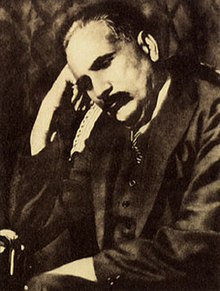
Muhammad Iqbal, Pakistan's national poet who conceived the idea of Pakistan
Pakistan has literature in Urdu, Sindhi, Punjabi, Pashto, Balochi, Persian, English, and many other languages.[9] The Pakistan Academy of Letters is a large literary community that promotes literature and poetry in Pakistan and abroad.[10] The National Library publishes and promotes literature in the country. Before the 19th century, Pakistani literature consisted mainly of lyric and religious poetry and mystical and folkloric works. During the colonial period, native literary figures were influenced by western literary realism and took up increasingly varied topics and narrative forms. Prose fiction is now very popular.[11][12]
The national poet of Pakistan, Muhammad Iqbal, wrote poetry in Urdu and Persian. He was a strong proponent of the political and spiritual revival of Islamic civilisation and encouraged Muslims all over the world to bring about a successful revolution(regarding to the freedom from Hindus).[13] Well-known figures in contemporary Pakistani Urdu literature include Josh Malihabadi Faiz Ahmed Faiz and Saadat Hasan Manto. Sadequain and Gulgee are known for their calligraphy and paintings.[12] The Sufi poets Shah Abdul Latif, Bulleh Shah, Mian Muhammad Bakhsh, and Khawaja Farid enjoy considerable popularity in Pakistan.[14] Mirza Kalich Beg has been termed the father of modern Sindhi prose.[15] Historically, philosophical development in the country was dominated by Muhammad Iqbal, Sir Syed Ahmad Khan, Muhammad Asad, Maududi, and Mohammad Ali Johar.[16]
Ideas from British and American philosophy greatly shaped philosophical development in Pakistan. Analysts such as M. M. Sharif and Zafar Hassan established the first major Pakistani philosophical movement in 1947.[clarification needed][17] After the 1971 war, philosophers such as Jalaludin Abdur Rahim, Gianchandani, and Malik Khalid incorporated Marxism into Pakistan's philosophical thinking. Influential work by Manzoor Ahmad, Jaun Elia, Hasan Askari Rizvi, and Abdul Khaliq brought mainstream social, political, and analytical philosophy to the fore in academia.[18] Works by Noam Chomsky have influenced philosophical ideas in various fields of social and political philosophy.[19]
Performing arts[edit]
Music[edit]
Main article: Music of Pakistan

A sitar workshop in Islamabad, Pakistan.
Pakistani music ranges from diverse forms of provincial folk music and traditional styles such as Qawwali and Ghazal Gayaki to modern musical forms that fuse traditional and western music.[20] Pakistan has many famous folk singers. The arrival of Afghan refugees in the western provinces has stimulated interest in Pashto music, although there has been intolerance of it in some places.[21]
Dances[edit]
Pakistan has various regional dances including:
Punjabi[edit]
Main article: Folk dances of Punjab
- Luddi - Pothohari folk dance, mostly performed on weddings
- Dahamal – Punjabi folk dance (The dance is rooted in Sufi trance dances on trance drum beats)
- Bhangra – Punjabi folk dance
- Jhumar – Saraiki folk dance
Balochi[edit]
- Chaap – Baloch folk dance performed at weddings
Pashtun[edit]
- Attan – Folk dance of Pashtuns tribes of Pakistan including the unique styles of Quetta and Waziristan
- Khattak Dance – Sword dance of Khattak tribe in Khyber Pakhtunkhwa
Sindhi[edit]
Main article: Folk dances of Sindh

Artistic depiction of Sindhi soldiers during medieval times
- Jamalo – Sindhi dance.
- Jhumir: wedding dance.
- Dhamal: performed by Sindhi Sufi devotees on Sufi shrines. The main performance is done by Sufi dervishes who wear long Jamas, special rings, necklaces and Sindhi faqeeri topi or turban.
Drama and theatre[edit]
Main article: Theatre in Pakistan
These are very similar to stage plays in theatres. They are performed by well-known actors and actresses in the Lollywood industry. The dramas and plays often deal with themes from everyday life, often with a humorous touch.
Architecture[edit]
Main article: Pakistani architecture

The Lahore Fort, a landmark built during the Mughal era, is a UNESCO World Heritage Site

The Tomb of Shah Rukn-e-Alam is part of Pakistan's Sufi heritage.[22]
Four periods are recognised in Pakistani architecture: pre-Islamic, Islamic, colonial, and post-colonial. With the beginning of the Indus civilization around the middle of the 3rd millennium BCE,[23] an advanced urban culture developed for the first time in the region, with large buildings, some of which survive to this day.[24] Mohenjo Daro, Harappa, and Kot Diji are among the pre-Islamic settlements that are now tourist attractions.[citation needed] The rise of Buddhism and the influence of Greek civilisation led to the development of a Greco-Buddhist style,[25] starting from the 1st century CE. The high point of this era was the Gandhara style. An example of Buddhist architecture is the ruins of the Buddhist monastery Takht-i-Bahi in Khyber Pakhtunkhwa.[26