antarcita culture

Antarctica. The 7th continent and part of almost everyone’s bucketlist. Here are fifty of our favourite facts about this enormous frozen land to help entice you into visiting.

1. Antarctica is its own continent

Antarctica is one of the world’s seven continents. It is the fifth-largest, being bigger than the whole of Europe and nearly twice the size of Australia.

2. It is very windy

On average, Antarctica is the windiest of all the continents. Because its landscape is flat over very large distances, winds can reach speeds of up to 320 km/h. On other continents, winds only reach these speeds during storms, cyclones, hurricanes, tornados, etc.

3. It is officially a desert

Antarctica is the driest continent on the planet and is officially classified as a desert. The cold temperatures and strong winds result in very low humidity, which makes it difficult for clouds to form. Along the coastline (especially on the Antarctic Peninsula) rain is possible, but it is still rare.

4. Antarctica holds most of the Earth´s fresh water

Although it is a desert, Antarctica contains 70% of the Earth’s fresh water. However, it is mostly bound up in the enormous ice sheet so you won’t be drinking out of too many running streams there.

Antarctica photo tour

Geographical Features

5. Home of the South Poles

The current locations of both the Geographic South Pole (where the Earth’s surface intersects the Earth’s axis of rotation) and the Magnetic South Pole (where the direction of the Earth’s magnetic field is vertically upwards) lie within Antarctica. However, this has not always been the case. Millions of years ago, Antarctica used to be closer to the Equator but has now moved to its position at the bottom of the planet due to tectonic motion.

6. (Almost) everywhere is North

If you are standing at the Magnetic South Pole, then everywhere is North of you. The Magnetic South Magnetic Pole currently lies almost 3,000km from the Geographic South Pole and moves at the rate of about 5km/year.

7. The most remote location in Antarctica is not the South Pole

Antarctica is positioned asymmetrically around the South Pole. This means that the South Pole is not always located the same distance from the coastline. The most remote place in Antarctica (the one furthest from all coastlines) is called the South Pole of Inaccessibility and lies about 900km from the Geographic South Pole.

8. Antarctica is the largest ice sheet in the world

More than 98% of Antarctica is covered with ice. This makes it the largest ice sheet in the world, with Greenland coming in second. It is estimated that Antarctica contains around 90% of the world’s ice, and if it all melted, sea levels would rise by around 60 metres.

9. Around 1-2% of Antarctica is permanently ice-free

The driest places on Earth are Antarctica’s Dry Valleys. The air is so dry and the temperatures so cold in these barren and dusty areas, that even snow does not fall.

10. Home of the world´s largest icebergs

In March 2000, the largest iceberg ever measured broke away from Antarctica’s Ross Ice Shelf. Named B-15, it was about 270 km long and 37 km wide – larger than several of the world’s island states. 18 years after it started drifting north into the Atlantic Ocean and breaking apart, four small icebergs out of the original behemoth remained.

11. Home to the southernmost active volcano

Mount Erebus is one of the Earth’s few constantly active volcanoes. It continuously releases gas and has had several eruption episodes over the years resulting in lava flowing down its slopes and ejected molten rock. It is the site of the Earth’s only long-lived lava lakes and is Antarctica’s second-highest mountain.

12. Antarctica has high mountains

Antarctica’s highest mountain, Mount Vinson, stands 4,987 metres tall. This is just over half the height of Mount Everest. It is named for Carl Vinson, a US Congressman who keenly supported Antarctic expeditions, and was summited for the first time in 1966 by a team led by American, Nicholas Clinch.

13. Antarctica has a buried mountain range

The Gamburtsev mountains (also referred to as the Ghost Mountains) stretch for 1,200 km across Antarctica and reach heights of more than 3,000 metres. However, you can’t see them because the thickness of the ice in those regions is more than 4,000m. They are completely buried by snow and ice.

14. Home to one of the longest mountain ranges on Earth

The Transantarctic Mountains run for more than 3,500km, making them one of the longest mountain ranges on the planet. They essentially run from the Weddell Sea to the Ross Sea and divide Antarctica into East and West, with East Antarctica making up 2/3 of the continent. Their summits are generally ice-free and they are the location of most of Antarctica’s Dry Valleys.

Antarctica photography tours

15. Home to some of the world´s biggest canyons

There are several rift systems in Antarctica – both in the east and the west. The West Antarctic Rift System spans an enormous area (it is ~3,000km long and ~700km wide) and contains the Ferrigno Rift, a 1.6km deep canyon that is almost as deep as the Grand Canyon. Scientists think that this canyon is causing this part of Antarctica to lose ice more rapidly than expected.

16. Home to many underground lakes

More than 200 lakes have been discovered under the Antarctic ice sheet. Geothermal heat from the Earth’s interior and insulation from above by the thick layers of ice ensures that they remain liquid. The freshwater Lake Vostok is the largest of these. Buried under about 4km of ice, it is a subglacial lake, meaning it is encased by the ice of a glacier, not rock or earth.

17. It has a blood-red waterfall

Part of the remote Taylor Glacier in East Antarctica, the disturbing red colour of “Blood Falls” was a mystery for more than 100 years. Then, in 2017, scientists discovered that the water (which originates from a subglacial lake) is high in salt and oxidised iron. When the water comes into contact with air, the iron rusts giving it its amazing red colour.

18. It has the saltiest lake on Earth

At the base of the Transantarctic mountains, the Don Juan Pond is the saltiest body of water on Earth. Its salt concentration is 40% compared with ~30% for the Dead Sea and 3.5% for normal seawater. The salt is actually calcium chloride which lowers the freezing point of water even more than sodium chloride (which is what you use for table salt). This, and the high salinity of the lake means it stays liquid even in the frigid temperatures of Antarctica.

19. It is surrounded by a permanent current

The Circumpolar Current is the world’s largest wind-driven current. It circles clockwise around Antarctica (from west to east) and helps to keep the continent cold by blocking the warmer water from more temperate oceans. It is very rich in nutrients which is why there is a lot of marine life near Antarctica.

20. It is one of the best places on Earth to find meteorites

Certainly, it helps that the dark meteorites stand out against the pristine white snow and ice of Antarctica. But the cold, dry atmosphere also helps to preserve them against the usual weathering processes.

Wildlife

21. There are no polar bears in Antarctica

Polar bears are only found in the Arctic, not the Antarctic.

22. There are no sled dogs in Antarctica

Many of the successful early explorers of Antarctica used sled dogs from the Arctic to help on their expeditions. However, in 1994 all dogs were banned from the continent. This was due to the worry that they may spread diseases to the seal population and that they may also disturb the wildlife if they broke free of their restraints.

23. Antarctica has a lot of penguins

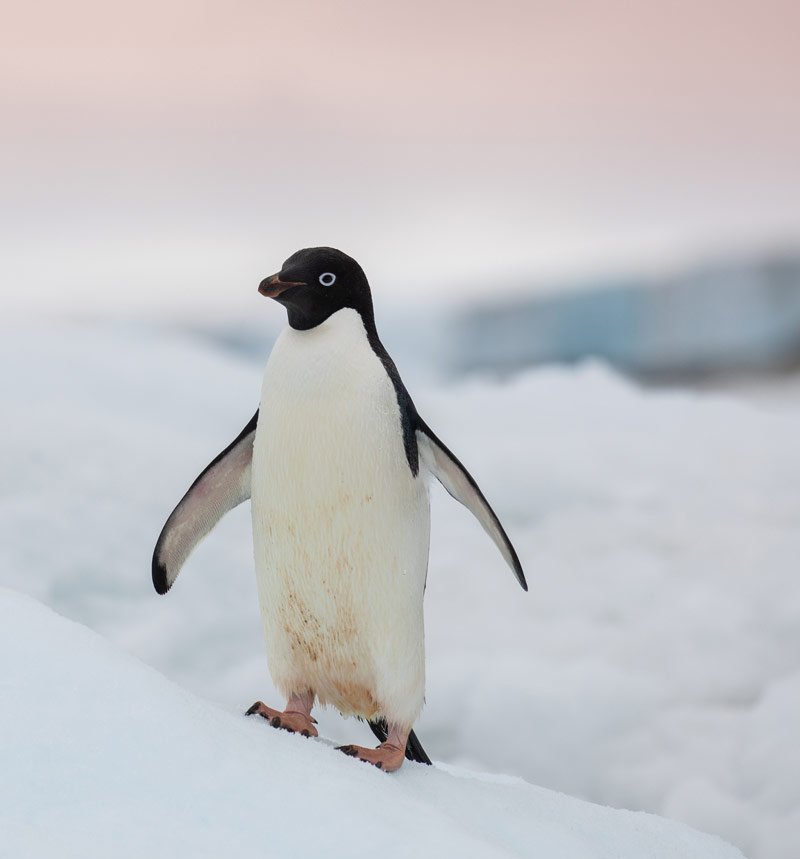
While there may not be any polar bears or sled dogs, Antarctica is one of the best places in the world to see penguins. In fact, the penguin is Antarctica’s “national” animal. Of the 17 different species of penguins on the planet, 8 of them inhabit Antarctica. Emperor penguins and Adélie penguins can only be found on the Antarctic continent, while Chinstraps, Macaronis, Gentoos, Rockhoppers, Magallanics, and Kings can also be found in sub-Antarctic locations.

24. Antarctica is a heaven for whales

There are also 8 species of whale that are commonly seen in Antarctic waters. Southern Right, Sei, Humpback, Fin, Antarctic Minke, Sperm, and the enormous Blue whale spend part of every year near Antarctica, as do Orcas (Killer whales).

antarcatica food

Cracking carrots. 


The best that France has to offer: the tasty carrots from the Aquitaine sandy soil are pleasantly crunchy, full of flavour and available in abundance. Not a single one is wasted. They are far too delicious.

carrots

Exquisite sweet corn. 


The soft French sun and rich moist soils are the perfect nutrition for delicious corn. Blessedly sweet and yet deliciously crunchy. An ideal crop to cherish and nourish the fields.

mais

Peas.
Nutrition powerhouses.


A farmer's skill is revealed through the taste of the peas: by precise harvesting, the extraordinary sweetness of the pea remains. The natural harvest paves the way for organic vegetables.

placeholder

Desirable beans.

Extra fine and extra delicious. The green beans from South West France are a delicacy. An exceptional local product which - luckily for the rest of the world - has travelled beyond the region and become a favourite on the plate.

beans

Of course there’s more!
Taste the entire range.

placeholder

Follow the trail
from seed to our plate?

A selection of our vegetables

The taste of the Aquitaine in vegetables of all sizes. Cultivated with precision craftsmanship, carefully harvested and processed with passion into a ready-made ingredient for every preparation.

Real vegetables, nothing else.

Vegetables of all shapes, sizes and flavours

Pure vegetables for baby food

Extra vitamins according to the most stringent requirements

The natural power of organic

Organically grown

Shh. Quality is growing here

We are proud of our vegetables and their heavenly flavours. Most Definitely! That is why we subject every harvest to the strictest controls and the most stringent requirements. This approach has been rewarded with three quality certificates. It is a logical consequence of our daily efforts.

hawaii culture

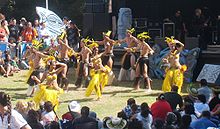
The culture of the Native Hawaiians encompasses the social behavior, institutions, and norms practiced by the original residents of the Hawaiian islands, including their knowledge, beliefs, arts, laws, customs, capabilities, and habits. Humans are estimated to have first inhabited the archipelago between 124 and 1120 AD when it was settled by Polynesians who voyaged to and settled there.[1] Polynesia is made of multiple island groups which extend from Hawaii to New Zealand across the Pacific Ocean. These voyagers developed Hawaiian cuisine, Hawaiian art, and the Native Hawaiian religion.

Hula[edit]

Hula is the dance form originating in Hawaii. It derives from other Polynesian dance form. It has two basic forms: Hula Kahiko and Hula Auana. Hula Kahiko was developed prior to contact with European cultures.[2] Hula Auana reflects European/American influences and is performed with musical instruments (like guitars) that do not originate from the Hawaiian Islands.

The annual Merrie Monarch Festival celebrates Hula and gathers Hula Halau from across the world. It was created to honor King David Kalākaua, who was the last reigning king of Hawaii. He was known for restoring and elevating Hula in the Hawaiian Islands after the United States missionaries arrived. The halau compete and share their knowledge of Hawaiian culture. Winners are crowned in each category, including an individual female winner, Miss Aloha Hula.

Hula is more than a dance, but an art form that communicates the stories of Hawaiian politics, culture, and tradition. As hula is now practiced and recognized around the world, a very limited repertoire has been brought to mainstream culture. Much of the world views Hula as a fitness trend and cultural dance, but the genre has a much greater significance to the Hawaiian people, telling the stories of generations past.[3]

Voyaging[edit]

Polynesians traveled to Hawaii and throughout the Pacific region on voyaging canoes of their own design, navigating using only their senses, observing the skies, wind, water, and wildlife around them.

The outrigger canoe was a common means of traveling around and between the islands.[4] Outrigger canoe paddling spread from Hawaii to become an international sport, educating people from all over the world about Hawaiian culture.

The Polynesian Voyaging Society works to preserve the skills of boat construction and navigation. They build replica canoes like traditional double-hulled canoes, sailing them across the world using Polynesian navigation methods. Their goal is to show the true strength of Polynesian voyagers, making it clear that the voyagers did not stumble upon their land by luck. The double hulled Hōkūleʻa canoe was built in the 1970s to reflect and preserve this knowledge and has since circumnavigated the earth, visiting communities and sharing knowledge since that time.[5]

Religion[edit]

Main article: Hawaiian Religion

The traditional Hawaiian religion is a polytheistic animistic religion. Its beliefs encompass the presence of spirits in objects such as the waves and the sky. The Hawaiian religion believes in four gods; Kāne, Kanaloa, Kū, and Lono. Kāne is the God of creation, Kanaloa is the God of the ocean, Ku is the God of war and male pursuits, and Lono is the God of peace, rain, and fertility.[6] They also believe in forty male gods (ka hā), four hundred gods and goddesses (ke kanahā), the spirits (na ‘unihipili), and the guardians (na ‘aumākua).[7] Notably, Pele is the goddess of volcanos and fire.[8]

Hawaiian religion has birthed many central Hawaiian values, including respect for the 'aina (land), which stems from an emphasis on respect for Lono, the God of the land. Religion has also directed the response to volcanic eruptions and lava flows. When a volcano erupts, Hawaiians believe this is a sacred process of the Earth being reborn. This is a time to pray, sing, and give offerings to Pele, the goddess of the volcano.[9]

The Hawaiian religion is protected under the American Indian Religious Freedom Act.[10]

Music[edit]

Main article: Music of Hawaii

Mele are the Hawaiian poems and songs. Ole are chants. Mele and ole are important parts of Hawaiian rituals. Portuguese, Mexicans, and Spanish brought musical instruments such as the ukulele and the guitar that Hawaiians adopted. As Hawaiian music evolved, music using these instruments found worldwide popularity, beginning in the 1920s. Hawaiians invented the slack-key guitar and steel guitar, instruments that were soon distributed across the world.[11][12]

History[edit]

Western contact, colonization and immigration[edit]

Main article: History of Hawaii

First contact came in 1778 with an expedition led by James Cook, although possibly as early as 1542 with an expedition led by Ruy López de Villalobos.[13] Christian missionaries arrived in the early 1800s, and began coverting the Hawaiians to their faiths and influencing Hawaiian culture.[14] In the 1830s, repeated interactions began between Hawaii and other cultures such as Mexican, Portuguese, and Spanish.[15] Immediate changes could be noticed in Hawaiian culture and daily life.

Many of the missionaries developed negative opinions about Hawaiian culture.[14] After the 1893 overthrow of the Hawaiian Kingdom there were many attempts to extinguish Hawaiian language and culture during the early 20th century. Hula, Hawaiian, paddling, and music were all frowned upon. Hawaiian children were sent to missionary schools where they were taught in English and barred from speaking Hawaiian. English also became the language of business and government, although immigrants from Japan, Portugal, the Philippines, and other places brought their languages with them.[16]

In 1898 the United States enacted the Newlands Resolution, annexing the Hawaiian islands.[17] In 1959, following a referendum in which over 93% of Hawaiian residents voted in favor of statehood, Hawaii became the 50th state. At its height the Hawaiian population an estimated 683,000 Native Hawaiians lived in the islands.[18] By 1900 the native population had dropped below 100,000.[18] The Native Hawaiian population was reduced to 20% of the total due to disease, inter-marriage and migration.[19] The diseases spread from outside Hawaii such as smallpox, cholera, influenza, and gonorrhea. Unlike Europeans, Hawaiians had no history with these diseases and their immune systems were unprepared to fight them.[20]

Overthrow and the influence of other cultures caused drastic changes in the Hawaiian lifestyle. The introduction of Christianity led to the overthrow of the kapu system of social stratification. Changes in traditional Hawaiian diet and introduction of foreign disease not only drastically reduced the Native Hawaiian population. Some forms of Hawaiian culture became much more modernized and Westernized as a result of this exchange. The rise of Hula Auana aptly marks the influence of Western instruments and styles on Hula as a whole.[21]

See also[edit]

  • Hawaiian art
  • Hawaiian language
  • Lei
  • Music of Hawaii
  • Native Hawaiians
  • First Hawaiian Renaissance
  • Second Hawaiian Renaissance
  • Ray Jerome Baker (1880–1972), an American photographer noteworthy as a pioneering photographer, and in particular for his studies portraying the people of Hawaii

References[edit]

  1. ^ Smith, Philippa Mein (2012). A Concise History of New Zealand. Cambridge University Press. p. 7. ISBN 978-1-107-40217-1.
  2. ^ LLC, Twirl Advertising and Design. "Hula Hālau | About Hula | KIAKO Foundation | Testimonials | Hawaiian Culture | Hula Dance | Hawaiian Language | Hawaiian History | Lisa Chang | Hulaaloha.org". hulaaloha.org. Archived from the original on May 2, 2011. Retrieved 2018-04-24.
  3. ^ "We Dance for Knowledge".
  4. ^ Kapitän, Gerhard (May 1989). "Records of native craft in Sri Lanka-I: The single outrigger fishing canoeoruwa-Part 2.2: Rowed, paddled and poledoru". International Journal of Nautical Archaeology. 18 (2): 137–149. doi:10.1111/j.1095-9270.1989.tb00185.x. ISSN 1057-2414.
  5. ^ "Wayfinders : Polynesian History and Origin". www.pbs.org. Retrieved 2023-12-21.
  6. ^ "Religious Beliefs In Hawaii". WorldAtlas. Retrieved 2019-10-23.
  7. ^ Gutmanis, June (1983). Ancient Hawaiian Prayers. Editions Limited. pp. 4–14. ISBN 978-0-9607938-6-0.
  8. ^ 'Iolana, Patricia (2006). "TuTu Pele: The Living Goddess of Hawaiʻi's Volcanoes". Sacred History.
  9. ^ Elbert, Samuel H. (1957). "The Chief in Hawaiian Mythology. 7. The Chief and Religion". The Journal of American Folklore. 70 (277): 264–276. doi:10.2307/538326. ISSN 0021-8715.
  10. ^ "42 U.S. Code § 1996 - Protection and preservation of traditional religions of Native Americans". LII / Legal Information Institute. Retrieved 2018-04-24.
  11. ^ "Na Leo Hawai'i: Musics of Hawai'i". Smithsonian Folkways Recordings. Retrieved 2023-12-21.
  12. ^ Unterberger, Richie (1999). Music USA: The Rough Guide. London: Rough Guides. pp. 465–473. ISBN 1-85828-421-X.
  13. ^ Ferreiro, Martin (1877). "Las Islas de Sandwich o Hauaii; ; Descubierto por los españoles" [The Sandwich Islands or Hawaii; Discovered by the Spanish]. Boletín de la Sociedad Geográfica Nacional. Tomo II.–Primer Semester de 1877. Madrid: T. Fortanet: 347–9. OCLC 816980337.
  14. ^ Jump up to:a b Gavan, Daws (1968). Shoal Of Time; A History Of The Hawaiian Islands. United States Of America: MacMillan Company. pp. 65–73. ISBN 978-0-8248-0324-7.
  15. ^ "Mexican Vaquero". hawaiihistory.org. Archived from the original on 2015-03-21. Retrieved 2018-04-24.
  16. ^ Buck, Elizabeth (1993). Paradise Remade; The Politics and History in Hawai'i. Philadelphia: Temple University Press Philadelphia. pp. 105–123. ISBN 978-0-87722-978-0.
  17. ^ "The 1897 Petition Against the Annexation of Hawaii". National Archives. 2016-08-15. Retrieved 2018-04-24.
  18. ^ Jump up to:a b Goo, Sara Kehaulani (6 April 2015). "After 200 years, Native Hawaiians make a comeback". Pew Research Center. Retrieved 23 April 2018.
  19. ^ Kay-Trask, Haunani (1991). Lovely Hula Lands: Corporate Tourism and the Prostitution of Hawaiian culture. United States of America: Journal Contours. pp. 22–34.
  20. ^ Pirie, Peter (1978). The consequences of Cook's Hawaiian contacts on the local population. Manoa, Hawaii: University of Hawaii at Manoa. pp. 75–85.
  21. ^ "Historical Background: Westernization of Hawaiian Islands". Geriatrics. 2014-

hawaii food

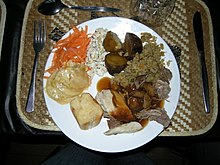
The cuisine of Hawaii incorporates five distinct styles of food, reflecting the diverse food history of settlement and immigration in the Hawaiian Islands.[a]

In the pre-contact period of Ancient Hawaii (300 AD–1778), Polynesian voyagers brought plants and animals to the Islands. As Native Hawaiians settled the area, they fished, raised taro for poi, planted coconuts, sugarcane, sweet potatoes and yams, and cooked meat and fish in earth ovens.[1]

After first contact in 1778, European and American cuisine arrived along with missionaries and whalers, who introduced their foods and built large sugarcane plantations. Christian missionaries brought New England cuisine[2] while whalers introduced salted fish which eventually transformed into lomilomi salmon.

As pineapple and sugarcane plantations grew, so did the demand for labor, bringing many immigrant groups to the Islands between 1850 and 1930. Immigrant workers brought cuisines from China, Korea, Japan, the Philippines, Puerto Rico and Portugal after arriving in Hawaii, introducing their new foods and influencing the region.

The introduction of new ethnic foods, such as Chinese Cantonese char siu bao (manapua), Portuguese sweet bread and malasadas, Puerto Rican pasteles, and the Japanese bento, combined with the existing indigenous, European and American foods in the plantation working environments and the local communities.

This blend of cuisines formed a "local food" style unique to Hawaii, resulting in plantation foods like the plate lunch, snacks like Spam musubi, and dishes like the loco moco. Shortly after World War II several well-known local restaurants opened their doors to serve "Hawaiian Food". Chefs further refined the local style by labeling it "Hawaii regional cuisine" in 1992, a style of cooking that makes use of locally grown ingredients to blend all of Hawaii's historical influences together to form a new fusion cuisine.

History[edit]

Pre-contact period[edit]

Main article: Native Hawaiian cuisine

See also: Ancient Hawaii

Taro, Colocasia esculenta, was brought to Hawaii by the Polynesians

When Polynesian seafarers arrived on the Hawaiian Islands in 300–500 AD,[b] few edible plants existed in the new land, aside from ferns (hāpuʻu ʻiʻi, whose uncoiled fronds are eaten boiled) and fruits that grew at higher elevations. Botanists and archaeologists believe that the Polynesian voyagers introduced anywhere between 27 and more than 30 plants to the islands, known as canoe plants, mainly for food.[3] The most important of them was taro.[4]

For centuries taro, and the poi made from it, was the main staple of their diet, and it is still much loved today. In addition to taro the Polynesians brought sweet potatoes. These are believed to have come from Polynesian contact with the New World.[5]

The Marquesans, the first settlers from Polynesia, brought breadfruit and the Tahitians later introduced the baking banana. These settlers from Polynesia also brought coconuts, candlenuts (known in Hawaiian as kukui nuts), and sugarcane.[6] They found plenty of fish, shellfish, and limu in the new land.[3] Flightless birds were easy to catch and nests were full of eggs for the taking.[3]

Most Pacific islands had no meat animals except bats and lizards, so ancient Polynesians sailed the Pacific with pigs, chickens and dogs as cargo.[7] Pigs were raised for religious sacrifice, and the meat was offered at altars, some of which was consumed by priests and the rest eaten in a mass celebration.[7]

The early Hawaiian diet was diverse, and may have included as many as 130 different types of seafood and 230 types of sweet potatoes.[8] Some species of land and sea birds were consumed into extinction.[9]

Kukui foliage, flowers, and nut (candlenut) was brought to Hawaii by Polynesians.

Sea salt was a common condiment in ancient Hawaii,[10] and Inamona, a relish made of roasted, mashed kukui nutmeats, sea salt and sometimes mixed with seaweeds, often accompanied the meals.[10]

At important occasions, a traditional feast, ‘aha‘aina, was held. When a woman was to have her first child, her husband started raising a pig for the ‘Aha‘aina Mawaewae feast that was celebrated for the birth of a child. Besides the pig, mullet, shrimp, crab, seaweeds and taro leaves were required for the feast.[11]

The modern name for such feasts, lū‘au, was not used until 1856, replacing the Hawaiian words ‘aha‘aina and pā‘ina.[12] The name lū‘au came from the name of a food always served at a ‘aha‘aina, young taro tops baked with coconut milk and chicken or octopus.

Prior to cooking, pigs and dogs were killed by strangulation or by holding their nostrils shut, in order to conserve the animal's blood.[13] Meat was prepared by flattening out the whole eviscerated animal and broiling it over hot coals, or it was spitted on sticks.[13] Large pieces of meat, such as fowl, pigs and dogs, would be typically cooked in earth ovens, or spitted over a fire during ceremonial feasts.[14][13]

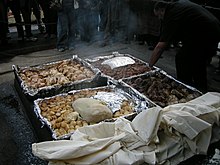
Hawaiian earth ovens, known as an imu, combine roasting and steaming in a method called kālua. A pit is dug into the earth and lined with volcanic rocks and other rocks that do not split when heated to a high temperature, such as granite.[15] A fire is built with embers, and when the rocks are glowing hot, the embers are removed and the foods wrapped in ti, ginger or banana leaves are put into the pit, covered with wet leaves, mats and a layer of earth. Water may be added through a bamboo tube to create steam.

The intense heat from the hot rocks cooked food thoroughly—the quantity of food for several days could be cooked at once, taken out and eaten as needed, and the cover replaced to keep the remainder warm.[10] Sweet potatoes, taro, breadfruit and other vegetables were cooked in the imu, as well as fish. Saltwater eel was salted and dried before being put into the imu.[16] Chickens, pigs and dogs were put into the imu with hot rocks inserted in the abdominal cavities.[10]

Men did all of the cooking, and food for women was cooked in a separate imu; afterwards men and women ate meals separately.[c] The ancient practice of cooking with the imu continues to this day, for special occasions.[17]

Post-contact period[edit]

Hawaiian man pounding taro to make poi. Taro plants can be seen growing behind him

In 1778, Captain James Cook arrived at the island of Niihau, leaving a ram goat, ewes, a boar, an English sow, and seeds for melons, pumpkins, and onions.[18] In 1793, Captain George Vancouver brought the first cattle to the islands; longhorns from California were presented to King Kamehameha I.[19][20]

With no natural predators, the new cattle multiplied out of control; the king hired an American man named John Parker to capture and domesticate cattle.[20] Many of the cattle were butchered and beef was introduced to Hawaiian cuisine.

In 1813, pineapple was first cultivated in Honolulu by Don Francisco de Paula Marin,[21] a Spanish botanist and advisor to King Kamehameha I.

Although grape vines were introduced by Captain Vancouver around 1792, Marin is credited with the first Hawaiian vineyard in 1815 and planting the now rare Mission grape variety.[22] Marin also brewed the first beer in 1812,[23] and planted the first coffee crop in 1817, but his plantings failed.[24] Marin, called "Manini" by the Hawaiians, experimented with planting oranges, limes, beans, cabbages, potatoes, peaches, melons, maize and lettuce.

By the late 19th century, pineapple and sugarcane plantations owned and run by American settlers took over much of Hawaii's land, and these two crops became the most important sources of revenue for the Hawaiian economy.[25]

Ethnic foods[edit]

As the plantations of the Big Five expanded, the demand for labor grew, so the plantation owners hired immigrant workers, which included Chinese, Koreans, Japanese, Filipinos, and Portuguese. Each ethnic group wanted its food in workplaces, and farms and grocery markets were established.

The Chinese immigrants brought Cantonese cuisine, cooking the first stir fry, sweet and sour, and dim sum dishes in the islands,[26] and replaced poi with rice, adding their herbs and spices.[25] Chinese rice growers imported familiar fish varieties from Asia to stock local streams and irrigation ditches.[27]

Korean immigration to Hawaii brought kimchi and built barbecue pits to cook marinated meats. Korean-style bulgogi or boneless meat with moderately sweet garlic sauce and galbi or meat with bones and moderately sweet garlic sauce as well, and another Korean favorite bibimbab or mixed rice with seasoned vegetables, namul, sweet and spicy gochujang and bulgogi topping also became an integral part of Hawaiian cuisine.[28]

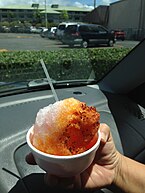
Hawaiian shave ice, believed to have been introduced to Hawaii from Japan by Japanese immigrants who ate kakigōri

The Portuguese immigrants came to Hawaii from the Azores in the late 19th century,[29] introducing their foods with an emphasis on pork, tomatoes and chili peppers, and built forno, their traditional beehive oven, to make pão doce, the Portuguese sweet bread and malasada.[4] Whalers brought in salted fish, which ultimately became lomi-lomi salmon.[15]

The Japanese brought bento and sashimi, and, although many of their vegetable seeds would not grow in the climate of the islands, they succeeded in making tofu and soy sauce.[4] The homes of Japanese immigrants lacked ovens, so their cooking relied on frying, steaming, broiling, and simmering, leading to the popularization of tempura and noodle soups in Hawaii.[26]

By the early 20th century, the Japanese were the largest ethnic group and rice became the third-largest crop in the islands.[30]

Puerto Rican immigration to Hawaii began in 1900, contributing spicy, Spanish-seasoned thick soups, casseroles, pasteles, and meat turnovers.[26]

Filipinos reached Hawaii in 1909, bringing peas and beans, the adobo style of vinegar and garlic dishes, choosing to boil, stew, broil, and fry food instead of baking, and eating sweet potatoes as a staple besides rice.[26]

Samoans arrived in 1919, building their earth ovens above ground instead of below like the imu, and made poi from fruit instead of taro.[26]

After the Vietnam War ended in 1975, immigrants from Southeast Asia arrived,[31] bringing lemongrass, fish sauce and galangal, popular in Thai and Vietnamese cuisine.[26]

Territorial period – statehood[edit]

See also: List of restaurants in Hawaii

Royal Hawaiian Hotel was one of the first hotels built along the shores of Waikīkī.

The first restaurant in Honolulu was opened in 1849 by a Portuguese man named Peter Fernandez. Situated behind the Bishop & Co. bank, the establishment was known as the "eating house" and was followed by other restaurants, such as Leon Dejean's "Parisian Restaurant" at the corner of Hotel and Fort Streets.[32]

In 1872, the Royal Hawaiian Hotel opened on Hotel Street, and as one of the most refined hotels in the Pacific, catering to wealthy clients. The Royal Hawaiian dining room served dishes on par with the best restaurants in Europe, with an 1874 menu offering dishes such as mullet, spring lamb, chicken with tomatoes, and cabinet pudding.[33]

The massive pineapple industry of Hawaii was born when the "Pineapple King", James Dole, planted pineapples on the island of Oahu in 1901.[4] In 1922, Dole purchased the island of Lanai for a large-scale pineapple production. By 1950, his Hawaiian Pineapple Company was the largest in the world.[4]

In 1905, George R. Carter, Territorial Governor of Hawai'i, promoted increasing local agricultural production, saying that "there was a time when Hawaii supplied California with flour, also potatoes and other vegetables. Now California produces her own and sends part of the surplus here."

Newspaper editorials of the time also questioned why locally-grown guavas were rotting on the ground while agribusiness was planting non-native pineapples in Hawaii. These concerns were not addressed until almost a century later, when the regional cuisine movement began encouraging the food industry to "grow local, buy local, and eat local."[34]

Since the 1970s, pineapples have been grown more cheaply in Southeast Asia, so Hawaiian agriculture has taken a diverse approach, producing a variety of crops, including squash, tomatoes, chili peppers and lettuce.[4]

From 1978 to 1988, chefs who came to Hawaii would avoid Hawaiian-grown ingredients like their European counterparts, preferring to ship everything in from the U.S. mainland, or as far away as Australia, New Zealand, and Europe.[35]

While eating out was not as prevalent as it is now, local eateries began to establish themselves starting in the 1960s. Diners and drive ins served local ethnic foods in addition to the American fare such as Rainbow Drive-in, L&L, Liliha Bakery and Zippy's. Smaller mom-n-pop shops such as saimin houses, convenience stores were common in neighborhood serving pre-set bentos or a la carte items at an okazuya (Japanese "deli").[36] Some were even mobile, affectionately known as manapua vans selling small dim sum-like treats long before food truck culture became the trend in the 21st century.[37][38]

Japanese-American baker Robert Taira, came up with a recipe for the Hawaiian version of sweet Portuguese bread in the 1950s. Taira began to commercially produce the bread in Hawaii, and it became successful in Honolulu bakeries and coffee shops, with plant production expanding to California and South Carolina. By the 1980s, Taira's company, King's Hawaiian Bakery, was grossing US$20 million annually.[29]

Hawaii regional cuisine[edit]

Seared ahi and wasabi beurre blanc sauce

Hawaii regional cuisine refers to a style of cooking and the group of chefs who developed it and advocated for it as a distinct Hawaiian fusion style. The cuisine draws from local ingredients (including seafood, beef and tropical foods), and is a fusion of ethnic culinary influences.[39]

The cuisine style was developed by a group of twelve chefs: Sam Choy, Philippe Padovani, Roger Dikon, Gary Strehl, Roy Yamaguchi, Amy Ferguson Ota, Jean-Marie Josselin, George Mavrothalassitis, Beverly Gannon, Peter Merriman, Mark Ellman, and Alan Wong.[35]

The development of Hawaii regional cuisine was a coordinated effort to move away from ingredients shipped over long distances and preparations that copied continental recipes even when they were not well suited to conditions in Hawaii.[40][41] Rather, the group hoped to promote locally sourced ingredients in the hospitality industry while simultaneously informing the world about cuisine in Hawaii.

The goal of the group was to link local ranchers, fishermen and farmers with chefs and business in the hospitality and restaurant industry to develop Hawaii regional cuisine as a reflection of the community.

They took uninspired international and continental hotel cuisine based on imported products and recipes from the mainland and replaced them with dishes and a cuisine based on locally grown foods.[6]

This founding group of chefs worked to publish the 1994 cookbook by Janice Wald Henderson, The New Cuisine of Hawaii. These chefs also sponsored a cookbook to be sold for charity.[42]

Contemporary times[edit]

This section does not cite any sources. Please help improve this section by adding citations to reliable sources. Unsourced material may be challenged and removed. (May 2014) (Learn how and when to remove this template message)

The continued popularity of Hawaii in the 21st century as a tourist destination has helped spawn Hawaiian-themed and Hawaiian cuisine restaurants in the contiguous United States such as Ono Hawaiian BBQ[43] and L&L Hawaiian Barbecue. Its popularity is also reaching Europe, with the restaurant POND Dalston opening in 2014 as first New Hawaiian Cuisine in the United Kingdom.[44] There are also many Hawaiian-made specialties such as Lilikoi açaí bowls from places like Ono Yo on the North Shore of Oahu. There are also branded items such as Mauna Loa macadamia nuts. Sugarcane producer Alexander & Baldwin continues to operate and has diversified into other businesses.

Dole Food Company is based in Hawaii and still has a pineapple operation on Oahu. Maui Land & Pineapple Company ceased production in 2009. Some of its assets and employees are involved in the Haliʻimaile Pineapple Company startup and Kapalua Farms organic pineapple operation was taken over by Ulupono Sustainable Agriculture Development with backing from Pierre Omidyar. Beer producer Kona Brewing Company and the Volcano Winery are active.

Local eateries include the Zippy's chain. Foodland Hawaii is a grocery chain. There are also distinctive and historic business operations such as Kanemitsu Bakery, Helena's Hawaiian Food,[45] Common Ground Kauai,[46] Anna Miller's, Nisshodo Candy Store,[47] Maui Tacos and Waiʻoli Tea Room & Bakery at Salvation Army Waiʻoli Tea Room.

Roy Yamaguchi's Roy's and various cookbooks promoting Hawaiian regional cuisine have also helped popularize Hawaiian cuisine and Hawaiian fusion cuisine.

india culture

Indian culture is the heritage of social norms and technologies that originated in or are associated with the ethno-linguistically diverse India, pertaining to the Indian subcontinent until 1947 and the Republic of India post-1947. The term also applies beyond India to countries and cultures whose histories are strongly connected to India by immigration, colonisation, or influence, particularly in South Asia and Southeast Asia. India's languages, religions, dance, music, architecture, food, and customs differ from place to place within the country.

Indian culture, often labelled as a combination of several cultures, has been influenced by a history that is several millennia old, beginning with the Indus Valley Civilization and other early cultural areas.[1][2] There is specifically evidence for early influences from East and Southeast Asian-derived cultural areas, primarily via Austroasiatic (Mon Khmer) groups during the Neolithic period, on certain cultural and political elements of Ancient India, and which may have arrived together with the spread of rice cultivation from Mainland Southeast Asia. A significant number of ethnic minorities in Eastern India are still speaking Austroasiatic languages, most notably the Munda languages.[3][4][5][6][7]

Many elements of Indian culture, such as Indian religions, mathematics, philosophy, cuisine, languages, dance, music, and movies have had a profound impact across the Indosphere, Greater India, and the world. The British Raj further influenced Indian culture, such as through the widespread introduction of the English language,[8] and a local dialect developed.

Religious culture[edit]

Main articles: Indosphere, Greater India, and Hinduism in Southeast Asia

Indian religions have shaped Indian culture

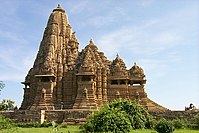
Hindu Kandariya Mahadeva Temple

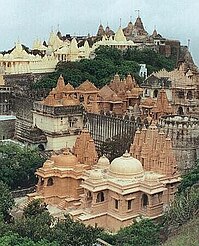
Jain Palitana Temples

Buddhist Mahabodhi Temple

Sikh Harmandir Sahib

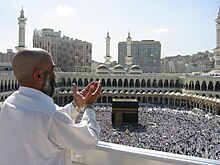
Indian-origin religions Hinduism, Jainism, Buddhism, and Sikhism,[9] are all based on the concepts of dharma and karma. Ahimsa, the philosophy of nonviolence, is an important aspect of native Indian faiths whose most well known proponent was Shri Mahatma Gandhi, who used civil disobedience to unite India during the Indian independence movement – this philosophy further inspired Martin Luther King Jr. during the American civil rights movement. Foreign-origin religion, including Abrahamic religions, such as Judaism, Christianity and Islam, are also present in India,[10] as well as Zoroastrianism[11][12] and Baháʼí Faith[13][14] both escaping persecution by Islam[15][16][17] have also found shelter in India over the centuries.[18][19]

India has 28 states and 8 union territories with different cultures and is the most populated country in the world.[20] The Indian culture, often labeled as an amalgamation of several various cultures, spans across the Indian subcontinent and has been influenced and shaped by a history that is several thousand years old.[1][2] Throughout the history of India, Indian culture has been heavily influenced by Dharmic religions.[21] Influence from East/Southeast Asian cultures onto ancient India and early Hinduism, specifically via Austroasiatic groups, such as early Munda and Mon Khmer, but also Tibetic and other Tibeto-Burmese groups, had noteworthy impact on local Indian peoples and cultures. Several scholars, such as Professor Przyluski, Jules Bloch, and Lévi, among others, concluded that there is a significant cultural, linguistic, and political Mon-Khmer (Austroasiatic) influence on early India, which can also be observed by Austroasiatic loanwords within Indo-Aryan languages and rice cultivation, which was introduced by East/Southeast Asian rice-agriculturalists using a route from Southeast Asia through Northeast India into the Indian subcontinent.[22][23] They have been credited with shaping much of Indian philosophy, literature, architecture, art and music.[24] Greater India was the historical extent of Indian culture beyond the Indian subcontinent. This particularly concerns the spread of Hinduism, Buddhism, architecture, administration and writing system from India to other parts of Asia through the Silk Road by the travelers and maritime traders during the early centuries of the Common Era.[25][26] To the west, Greater India overlaps with Greater Persia in the Hindu Kush and Pamir Mountains.[27] Over the centuries, there has been a significant fusion of cultures between Buddhists, Hindus, Muslims, Jains, Sikhs and various tribal populations in India.[28][29]

India is the birthplace of Hinduism, Buddhism, Jainism, Sikhism, and other religions. They are collectively known as Indian religions.[30] Indian religions are a major form of world religions along with Abrahamic ones. Today, Hinduism and Buddhism are the world's third and fourth-largest religions respectively, with over 2 billion followers altogether,[31][32][33] and possibly as many as 2.5 or 2.6 billion followers.[31][34] Followers of Indian religions – Hindus, Sikhs, Jains and Buddhists make up around 80–82% population of India.

India is one of the most religiously and ethnically diverse nations in the world, with some of the most deeply religious societies and cultures. Religion plays a central and definitive role in the lives of many of its people. Although India is a secular Hindu-majority country, it has a large Muslim population. Except for Jammu and Kashmir, Punjab, Meghalaya, Nagaland, Mizoram and Lakshadweep, Hindus form the predominant population in all 28 states and 8 union territories. Muslims are present throughout India, with large populations in Uttar Pradesh, Bihar, Maharashtra, Kerala, Telangana, Andhra Pradesh, West Bengal and Assam; while only Jammu and Kashmir and Lakshadweep have majority Muslim populations. Christians are other significant minorities of India.

Because of the diversity of religious groups in India, there has been a history of turmoil and violence between them. India has been a theatre for violent religious clashes between members of different religions such as Hindus, Christians, Muslims, and Sikhs.[35] Several groups have founded various national-religious political parties, and in spite of government policies minority religious groups are being subjected to prejudice from more dominant groups in order to maintain and control resources in particular regions of India.[35]

According to the 2011 census, 79.8% of the population of India practice Hinduism. Islam (14.2%), Christianity (2.3%), Sikhism (1.7%), Buddhism (0.7%) and Jainism (0.4%) are the other major religions followed by the people of India.[36] Many tribal religions, such as Sarnaism, are found in India, though these have been affected by major religions such as Hinduism, Buddhism, Islam and Christianity.[37] Jainism, Zoroastrianism, Judaism, and the Baháʼí Faith are also influential but their numbers are smaller.[37] Atheism and agnostics also have visible influence in India, along with a self-ascribed tolerance to other faiths.[37]

Atheism and agnosticism have a long history in India and flourished within Śramaṇa movement. The Cārvāka school originated in India around the 6th century BCE.[38][39] It is one of the earliest form of materialistic and atheistic movement in ancient India.[40][41] Sramana, Buddhism, Jainism, Ājīvika and some schools of Hinduism consider atheism to be valid and reject the concept of creator deity, ritualism and superstitions.[42][43][44] India has produced some notable atheist politicians and social reformers.[45] According to the 2012 WIN-Gallup Global Index of Religion and Atheism report, 81% of Indians were religious, 13% were not religious, 3% were convinced atheists, and 3% were unsure or did not respond.[46][47]

Philosophy[edit]

Main article: Indian philosophy

Indian philosophical traditions

Earliest Hindu philosophy were arranged and codified by Hindu Vedic sages, such as Yajnavalkya (c. 8th century BCE), who is considered one of the earliest philosophers in recorded history, after Aruni (c. 8th century BCE).[48]

Jain philosophy were propagated by 24 Tirthankaras, notably Parshvanatha (c. 872 – c. 772 BCE) and Mahavira (c. 549–477 BCE).

Buddhist philosophy was founded by Gautama Buddha (c. 563–483 BCE).

Sikh philosophy was crystallised in Guru Granth Sahib enshrined by Guru Gobind Singh (c. 1666–1708 CE).

Indian philosophy comprises the philosophical traditions of the Indian subcontinent. There are six schools of orthodox Hindu philosophy—Nyaya, Vaisheshika, Samkhya, Yoga, Mīmāṃsā and Vedanta—and four heterodox schools—Jain, Buddhist, Ājīvika and Cārvāka – last two are also schools of Hinduism.[49][50] However, there are other methods of classification; Vidyarania for instance identifies sixteen schools of Indian philosophy by including those that belong to the Śaiva and Raseśvara traditions.[51] Since medieval India (ca.1000–1500), schools of Indian philosophical thought have been classified by the Brahmanical tradition[52][53] as either orthodox or non-orthodox – āstika or nāstika – depending on whether they regard the Vedas as an infallible source of knowledge.[47]

The main schools of Indian philosophy were formalized chiefly between 1000 BCE to the early centuries of the Common Era. According to philosopher Sarvepalli Radhakrishnan, the earliest of these, which date back to the composition of the Upanishads in the later Vedic period (1000–500 BCE), constitute "the earliest philosophical compositions of the world."[54] Competition and integration between the various schools were intense during their formative years, especially between 800 BCE and 200 CE. Some schools like Jainism, Buddhism, Śaiva, and Advaita Vedanta survived, but others, like Samkhya and Ājīvika, did not; they were either assimilated or became extinct. Subsequent centuries produced commentaries and reformulations continuing up to as late as the 20th century. Authors who gave contemporary meaning to traditional philosophies include Shrimad Rajchandra, Swami Vivekananda, Ram Mohan Roy, and Swami Dayananda Saraswati.[55]

Family structure and marriage[edit]

Further information: wedding in India, Bengali Hindu wedding, and Telugu wedding ceremony

Marriage in India

North Indian Hindu wedding with the bride and groom in traditional dress.

South Indian Telugu Hindu wedding ceremony officiated by priests.

For generations, India has had a prevailing tradition of the joint family system. It is when extended members of a family – parents, children, the children's spouses, and their offspring, etc. – live together. Usually, the oldest male member is the head of the joint Indian family system. He mostly makes all important decisions and rules, and other family members are likely to abide by them. With the current economy, lifestyle, and cost of living in most of the metro cities are high, the population is leaving behind the joint family model and adapting to the nuclear family model. Earlier living in a joint family was with the purpose of creating love and concern for the family members. However, now it's a challenge to give time to each other as most of them are out for survival needs.[56] Rise in the trends of nuclear family settings has led to a change in the traditional family headship structure and older males are no longer the mandated heads of the family owing to the fact that they mostly live alone during old age and are far more vulnerable than before.[57]

In a 1966 study, Orenstein and Micklin analysed India's population data and family structure. Their studies suggest that Indian household sizes had remained similar over the 1911 to 1951 period. Thereafter, with urbanisation and economic development, India has witnessed a break up of traditional joint family into more nuclear-like families.[58][59] Sinha, in his book, after summarising the numerous sociological studies done on the Indian family, notes that over the last 60 years, the cultural trend in most parts of India has been an accelerated change from joint family to nuclear families, much like population trends in other parts of the world. The traditionally large joint family in India, in the 1990s, accounted for a small percent of Indian households, and on average had lower per capita household income. He finds that joint family still persists in some areas and in certain conditions, in part due to cultural traditions and in part due to practical factors.[58] Youth in lower socio-economic classes are more inclined to spend time with their families than their peers due to differing ideologies in rural and urban parenting.[60] With the spread of education and growth of economics, the traditional joint-family system is breaking down rapidly across India and attitudes towards working women have changed.

Arranged marriage[edit]

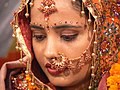
Brides in India

  • Bride in a Hindu Indian wedding

    Bride in a Hindu Indian wedding

  • Indian bride on her wedding day

    Indian bride on her wedding day

Arranged marriages have long been the norm in Indian society. Even today, the majority of Indians have their marriages planned by their parents and other respected family members. In the past, the age of marriage was young.[61] The average age of marriage for women in India has increased to 21 years, according to the 2011 Census of India.[62] In 2009, about 7% of women got married before the age of 18.[63]

In most marriages, the bride's family provides a dowry to the bridegroom. Traditionally, the dowry was considered a woman's share of the family wealth, since a daughter had no legal claim on her natal family's real estate. It also typically included portable valuables such as jewelry and household goods that a bride could control throughout her life.[64] Historically, in most families the inheritance of family estates passed down the male line. Since 1956, Indian laws treat males and females as equal in matters of inheritance without a legal will.[65] Indians are increasingly using a legal will for inheritance and property succession, with about 20 percent using a legal will by 2004.[66]

In India, the divorce rate is low — 1% compared with about 40% in the United States.[67][68] These statistics do not reflect a complete picture, though. There is a dearth of scientific surveys or studies on Indian marriages where the perspectives of both husbands and wives were solicited in-depth. Sample surveys suggest the issues with marriages in India are similar to trends observed elsewhere in the world. The divorce rates are rising in India. Urban divorce rates are much higher. Women initiate about 80 percent of divorces in India.[69]

Opinion is divided over what the phenomenon means: for traditionalists, the rising numbers portend the breakdown of society while, for some modernists, they speak of healthy new empowerment for women.[70]

Recent studies suggest that Indian culture is trending away from traditional arranged marriages. Banerjee et al. surveyed 41,554 households across 33 states and union territories in India in 2005. They find that the marriage trends in India are similar to trends observed over the last 40 years in China, Japan, and other nations.[71] The study found that fewer marriages are purely arranged without consent and that the majority of surveyed Indian marriages are arranged with consent. The percentage of self-arranged marriages (called love marriages in India) was also increasing, particularly in the urban parts of India.[72]

Wedding rituals[edit]

A Hindu wedding ritual in progress. The bride and the groom are seated together, receiving instructions from the priest. The sacred square fire container (yajna kund) is behind the priest.

Weddings are festive occasions in India with extensive decorations, colors, music, dance, costumes and rituals that depend on the religion of the bride and the groom, as well as their preferences.[73] The nation celebrates about 10 million weddings per year,[74] of which over 80% are Hindu weddings.

While there are many festival-related rituals in Hinduism, vivaha (wedding) is the most extensive personal ritual an adult Hindu undertakes in his or her life.[75][76] Typical Hindu families spend significant effort and financial resources to prepare and celebrate weddings. The rituals and processes of a Hindu wedding vary depending on the region of India, local adaptations, family resources and preferences of the bride and the groom. Nevertheless, there are a few key rituals common in Hindu weddings – Kanyadaan, Panigrahana, and Saptapadi; these are respectively, gifting away of daughter by the father, voluntarily holding hand near the fire to signify impending union, and taking seven circles before firing with each circle including a set of mutual vows. Mangalsutra necklace of bond a Hindu groom ties with three knots around the bride's neck in a marriage ceremony. The practice is integral to a marriage ceremony as prescribed in Manusmriti, the traditional law governing Hindu marriage. After the seventh circle and vows of Saptapadi, the couple is legally husband and wife.[76][77][78] Sikhs get married through a ceremony called Anand Karaj. The couple walks around the holy book, the Guru Granth Sahib four times. Indian Muslims celebrate a traditional Islamic wedding following customs similar to those practiced in the Middle East. The rituals include Nikah, payment of financial dower called Mahr by the groom to the bride, signing of a marriage contract, and a reception.[79] Indian Christian weddings follow customs similar to those practiced in the Christian countries in the West in states like Goa but have more Indian customs in other states.

india food

Indian cuisine consists of a variety of regional and traditional cuisines native to the Indian subcontinent. Given the diversity in soil, climate, culture, ethnic groups, and occupations, these cuisines vary substantially and use locally available spices, herbs, vegetables, and fruits.

Indian food is also heavily influenced by religion, in particular Hinduism and Islam, cultural choices and traditions.[1][2]

Historical events such as invasions, trade relations, and colonialism have played a role in introducing certain foods to this country. The Columbian discovery of the New World brought a number of new vegetables and fruits to India. A number of these such as potatoes, tomatoes, chillies, peanuts, and guava have become staples in many regions of India.[3]

Indian cuisine has shaped the history of international relations; the spice trade between India and Europe was the primary catalyst for Europe's Age of Discovery.[4] Spices were bought from India and traded around Europe and Asia. Indian cuisine has influenced other cuisines across the world, especially those from Europe (especially Britain), the Middle East, Southern African, East Africa, Southeast Asia, North America, Mauritius, Fiji, Oceania, and the Caribbean.[5][6]

History

Main article: History of Indian cuisine

Indian cuisine reflects an 8,000-year history of various groups and cultures interacting with the Indian subcontinent, leading to diversity of flavours and regional cuisines found in modern-day India. Later, trade with British and Portuguese influence added to the already diverse Indian cuisine.[7][8]

Prehistory and Indus Valley civilization

This section does not cite any sources. Please help improve this section by adding citations to reliable sources. Unsourced material may be challenged and removed. (May 2022) (Learn how and when to remove this template message)

See also: Meluhha, Indus–Mesopotamia relations, and Indian maritime history

After 9000 BCE, a first period of indirect contacts between Fertile Crescent and Indus Valley civilizations seems to have occurred as a consequence of the Neolithic Revolution and the diffusion of agriculture. Wheat and barley were first grown around 7000 BCE, when agriculture spread from the Fertile Crescent to the Indus Valley. Sesameand humped cattle were domesticated in the local farming communities. Mehrgarh is one of the earliest sites with evidence of farming and herding in South Asia. From circa 4500 to 1900 BC, the rulers of Lower Mesopotamia were Sumerians who spoke a non-Indo-European and non-Semitic language, may have initially come from India and may have been related to the original Dravidian population of India.

By 3000 BCE, turmeric, cardamom, black pepper and mustard were harvested in India.

From Around 2350 BCE the evidence for imports from the Indus to Ur in Mesopotamia have been found, as well as Clove heads which are thought to originate from the Moluccas in Maritime Southeast Asia were found in a 2nd millennium BC site in Terqa. Akkadian Empire records mention timber, carnelian and ivory as being imported from Meluhha by Meluhhan ships, Meluhha being generally considered as the Mesopotamian name for the Indus Valley Civilization.

Vedic age

This section does not cite any sources. Please help improve this section by adding citations to reliable sources. Unsourced material may be challenged and removed. (May 2022) (Learn how and when to remove this template message)

The ancient Hindu text Mahabharata mentions rice and vegetable cooked together, and the word "pulao" or "pallao" is used to refer to the dish in ancient Sanskrit works, such as Yājñavalkya Smṛti. Ayurveda, ancient Indian system of wellness, deals with holistic approach to the wellness, and it includes food, dhyana (meditation) and yoga.

Antiquity

Early diet in India mainly consisted of legumes, vegetables, fruits, grains, dairy products, and honey.[citation needed] Staple foods eaten today include a variety of lentils (dal), whole-wheat flour (aṭṭa), rice, and pearl millet (bājra), which has been cultivated in the Indian subcontinent since 6200 BCE.[8]

Over time, segments of the population embraced vegetarianism during the Śramaṇa movement[9][10] while an equitable climate permitted a variety of fruits, vegetables, and grains to be grown throughout the year.

A food classification system that categorised any item as saatvic, raajsic, or taamsic developed in Yoga tradition.[11][12] The Bhagavad Gita proscribes certain dietary practices (chapter 17, verses 8–10).[13]

Consumption of beef is taboo, due to cows being considered sacred in Hinduism.[14] Beef is generally not eaten by Hindus in India except for Kerala, parts of southern Tamil Nadu and the north-east.[15]

Ingredients mentioned in ancient Indian scripture

Pomegranate

While many ancient Indian recipes have been lost in history, one can look at ancient texts to see what was eaten in ancient and pre-historic India.

  • Barley[16]—(known as Yava in both Vedic and Classical Sanskrit) is mentioned many times in Rigveda and other Indian scriptures as one of the principal grains in ancient India
  • Betel leaf[17]—primary use is as a wrapper for the chewing of areca nut or tobacco, where it is mainly used to add flavour; may also be used in cooking, usually raw, for its peppery taste
  • Breadfruit—fritters called jeev kadge phodi in Konkani[18] or kadachakka varuthath[19] in Malayalam are a local delicacy in coastal Karnataka and Kerala
  • Chickpeas[20]—popular dishes are made with chickpea flour, such as mirchi bajji and mirapakaya bajji
  • Curd—a traditional yogurt or fermented milk product, originating from the Indian subcontinent, usually prepared from cow's milk, and sometimes buffalo milk, or goat milk
  • Figs[16]—cultivated from Afghanistan to Portugal, also grown in Pithoragarh in the Kumaon hills of India; from the 15th century onwards, also grown in areas including Northern Europe and the New World
  • Ghee—a class of clarified butter that originated in ancient India, commonly used in the Indian subcontinent, Middle-Eastern cuisine, traditional medicine, and religious rituals
  • Grape wine[21]—first-known mention of grape-based wines in India is from the late 4th-century BC writings of Chanakya
  • Honey[22]—the spiritual and supposed therapeutic use of honey in ancient India was documented in both the Vedas and the Ayurveda texts
  • Mango—the Jain goddess Ambika is traditionally represented as sitting under a mango tree
  • Mustard[16]—brown mustard is a spice that was cultivated in the Indus Valley civilization and is one of the important spices used in the Indian subcontinent today
  • Pomegranate—in some Hindu traditions, the pomegranate (Hindi: anār) symbolizes prosperity and fertility, and is associated with both Bhoomidevi (the earth goddess) and Lord Ganesha (the one fond of the many-seeded fruit)
  • Rice—cultivated in the Indian subcontinent from as early as 5,000 BC
  • Rice cake—quite a variety are available[23]
  • Rose apple—mainly eaten as a fruit and also used to make pickles (chambakka achar)
  • Saffron[24]—almost all saffron grows in a belt from Spain in the west to Kashmir in the east
  • Salt[24]—considered to be a very auspicious substance in Hinduism and is used in particular religious ceremonies like house-warmings and weddings; in Jainism, devotees lay an offering of raw rice with a pinch of salt before a deity to signify their devotion, and salt is sprinkled on a person's cremated remains before the ashes are buried
  • Sesame oil[24]—popular in Asia, especially in Korea, China, and the South Indian states of Karnataka, Andhra Pradesh, and Tamil Nadu, where its widespread use is similar to that of olive oil in the Mediterranean
  • Sorghum[20]—commonly called jwaarie, jowar, jola, or jondhalaa, sorghum is one of the staple sources of nutrition
  • Sugar—produced in the Indian subcontinent since ancient times, its cultivation spread from there into modern-day Afghanistan through the Khyber Pass
  • Sugarcane[20]—the earliest known production of crystalline sugar began in northern India; the earliest evidence of sugar production comes from ancient Sanskrit and Pali texts
  • Turmeric[21]—used widely as a spice in South Asian and Middle Eastern cooking

Middle Ages to the 16th century

During the Middle Ages, several Indian dynasties were predominant, including the Gupta dynasty. Travel to India during this time introduced new cooking methods and products to the region, including tea.[citation needed]

India was later invaded by tribes from Central Asian cultures, which led to the emergence of Mughlai cuisine, a mix of Indian and Central Asian cuisine. Hallmarks include seasonings such as saffron.[25]

Colonial Period

The Portuguese and British during their rule introduced cooking techniques such as baking, and foods from the New World and Europe. The new-world vegetables popular in cuisine from the Indian subcontinent include maize, tomato, potato, sweet potatoes, peanuts, squash, and chilli. Most New World vegetables such as sweet potatoes, potatoes, Amaranth, peanuts and cassava based Sago are allowed on Hindu fasting days. Cauliflower was introduced by the British in 1822.[26] In the late 18th/early 19th century, an autobiography of a Scottish Robert Lindsay mentions a Sylheti man called Saeed Ullah cooking a curry for Lindsay's family. This is possibly the oldest record of Indian cuisine in the United Kingdom.[27][28]

  • Bhang eaters in India c. 1790. Bhang is an edible preparation of cannabis native to the Indian subcontinent. It was used by Hindus in food and drink as early as 1000 BCE.[29]

    Bhang eaters in India c. 1790. Bhang is an edible preparation of cannabis native to the Indian subcontinent. It was used by Hindus in food and drink as early as 1000 BCE.[29]

  • A page from the Nimatnama-i-Nasiruddin-Shahi, book of delicacies and recipes. It documents the fine art of making kheer.

    A page from the Nimatnama-i-Nasiruddin-Shahi, book of delicacies and recipes. It documents the fine art of making kheer.

  • Medieval Indian Manuscript Nimatnama-i-Nasiruddin-Shahi (circa 16th century) showing samosas being served.

    Medieval Indian Manuscript Nimatnama-i-Nasiruddin-Shahi (circa 16th century) showing samosas being served.

  • Prawn with a Rohu fish, Kalighat Painting. Freshwater fishes and crustaceans are staple diet in eastern regions, prominently in Bengal.

    Prawn with a Rohu fish, Kalighat Painting. Freshwater fishes and crustaceans are staple diet in eastern regions, prominently in Bengal.

Ingredients

Spices at a grocery shop in India

Staple foods of Indian cuisine include pearl millet (bājra), rice, whole-wheat flour (aṭṭa), and a variety of lentils, such as masoor (most often red lentils), tuer (pigeon peas), urad (black gram), and moong (mung beans). Lentils may be used whole, dehusked—for example, dhuli moong or dhuli urad—or split. Split lentils, or dal, are used extensively.[30] Some pulses, such as channa or cholae (chickpeas), rajma (kidney beans), and lobiya (black-eyed peas) are very common, especially in the northern regions. Channa and moong are also processed into flour (besan).

Many Indian dishes are cooked in vegetable oil, but peanut oil is popular in northern and western India, mustard oil in eastern India,[25] and coconut oil along the western coast, especially in Kerala and parts of southern Tamil Nadu.[31][self-published source?] Gingelly (sesame) oil is common in the south since it imparts a fragrant, nutty aroma.[32]

In recent decades, sunflower, safflower, cottonseed, and soybean oils have become popular across India.[33] Hydrogenated vegetable oil, known as Vanaspati ghee, is another popular cooking medium.[34] Butter-based ghee, or deshi ghee, is used commonly.

Many types of meat are used for Indian cooking, but chicken and mutton tend to be the most commonly consumed meats. Fish and beef consumption are prevalent in some parts of India, but they are not widely consumed except for coastal areas, as well as the north east.[citation needed]
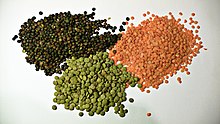
Lentils are a staple ingredient in Indian cuisine.

The most important and frequently used spices and flavourings in Indian cuisine are whole or powdered chilli pepper (mirch, introduced by the Portuguese from Mexico in the 16th century), black mustard seed (sarso), cardamom (elaichi), cumin (jeera), turmeric (haldi), asafoetida (hing), ginger (adrak), coriander (dhania), and garlic (lasoon).[35]

One popular spice mix is garam masala, a powder that typically includes seven dried spices in a particular ratio, including black cardamom, cinnamon (dalchini), clove (laung), cumin (jeera), black peppercorns, coriander seeds and anise star.[36][self-published source?]. Each culinary region has a distinctive garam masala blend—individual chefs may also have their own.

There are other spice blends which are popular in various regions. Panch phoron is a spice blend which is popular in eastern India. Goda masala is a sweet spice mix which is popular in Maharashtra. Some leaves commonly used for flavouring include bay leaves (tejpat), coriander leaves, fenugreek (methi) leaves, and mint leaves. The use of curry leaves and roots for flavouring is typical of Gujarati[37] and South Indian cuisine.[38] Sweet dishes are often seasoned with cardamom, saffron, nutmeg, and rose petal essences.

Regional cuisines

See also: List of Indian dishes

Indian food at restaurant in Paris.

Cuisine differs across India's diverse regions as a result of variation in local culture, geographical location (proximity to sea, desert, or mountains), and economics. It also varies seasonally, depending on which fruits and vegetables are ripe.

Andaman and Nicobar Islands

Seafood plays a major role in the cuisine of the Andaman and Nicobar Islands.[39] Staples of the diet of the Indigenous Andamanese traditionally include roots, honey, fruits, meat, and fish, obtained by hunting and gathering. Some insects were also eaten as delicacies.[40] Immigration from mainland of India, however, has resulted in variations in the cuisine.

Andhra Pradesh

Main article: Andhra cuisine

This section needs additional citations for verification. Please help improve this article by adding citations to reliable sources in this section. Unsourced material may be challenged and removed. (April 2020) (Learn how and when to remove this template message)

A vegetarian Andhra meal served on important occasions

The cuisine of Andhra Pradesh belongs to the two Telugu-speaking regions of Rayalaseema and Coastal Andhra and is part of Telugu cuisine. The food of Andhra Pradesh is known for its heavy use of spices, and the use of tamarind.

Seafood is common in the coastal region of the state. Rice is the staple food (as is with all South Indian states) eaten with lentil preparations such as pappu (lentils) and pulusu (stew) and spicy vegetables or curries.

In Andhra, leafy greens or vegetables such as bottle-gourd and eggplant are usually added to dal. Pickles are an essential part of the local cuisine; popular among those are mango-based pickles such as avakaya and maagaya, gongura (a pickle made from sorrel leaves),[41] usirikaya (gooseberry or amla), nimmakaya (lime), and tomato pickle.

Perugu (yogurt) is a common addition to meals, as a way of tempering spiciness. Breakfast items include dosa, pesarattu (mung bean dosa), vada, and idli.

Arunachal Pradesh

Main article: Cuisine of Arunachal Pradesh

Pitang Oying

The staple food of Arunachal Pradesh is rice, along with fish, meat, and leaf vegetables.[42] Native tribes of Arunachal are meat eaters and use fish, eggs, beef, chicken, pork, and mutton to make their dishes.

Many varieties of rice are used. Boiled rice cakes wrapped in leaves are a popular snack. Thukpa is a kind of noodle soup common among the Monpa tribe of the region.[43]

Lettuce is the most common vegetable, usually prepared by boiling with ginger, coriander, and green chillies.[44]

Apong or rice beer made from fermented rice or millet is a popular beverage in Arunachal Pradesh and is consumed as a refreshing drink.[45]

Assam

Main article: Assamese cuisine

A lunch platter of Assamese cuisine

Assamese cuisine is a mixture of different indigenous styles, with considerable regional variation and some external influences. Although it is known for its limited use of spices,[46] Assamese cuisine has strong flavours from its use of endemic herbs, fruits, and vegetables served fresh, dried, or fermented.

Rice is the staple food item and a huge variety of endemic rice varieties, including several varieties of sticky rice are a part of the cuisine in Assam. Fish, generally freshwater varieties, are widely eaten. Other non-vegetarian items include chicken, duck, squab, snails, silkworms, insects, goat, pork, venison, turtle, monitor lizard, etc.

The region's cuisine involves simple cooking processes, mostly barbecuing, steaming, or boiling. Bhuna, the gentle frying of spices before the addition of the main ingredients, generally common in Indian cooking, is absent in the cuisine of Assam.

A traditional meal in Assam begins with a khar, a class of dishes named after the main ingredient and ends with a tenga, a sour dish. Homebrewed rice beer or rice wine is served before a meal. The food is usually served in bell metal utensils.[47] Paan, the practice of chewing betel nut, generally concludes a meal.[48]

Bengal

Main article: Bengali cuisine

Pithe Puli

Mughal cuisine is a universal influencer in the Bengali palate, and has introduced Persian and Islamic foods to the region, as well as a number of more elaborate methods of preparing food, like marination using ghee. Fish, meat, rice, milk, and sugar all play crucial parts in Bengali cuisine.[49]

Bengali cuisine can be subdivided into four different types of dishes, charbya (চারব্য), or food that is chewed, such as rice or fish; choṣya, or food that is sucked, such as ambal and tak; lehya (লেহ্য), or foods that are meant to be licked, like chuttney; and peya (পেয়ে), which includes drinks, mainly milk.[50]

Shorshe Pabda (Pabo catfish in Mustard paste)

During the 19th century, many Odia-speaking cooks were employed in Bengal,[51] which led to the transfer of several food items between the two regions. Bengali cuisine is the only traditionally developed multi-course tradition from the Indian subcontinent that is analogous in structure to the modern service à la russe style of French cuisine, with food served course-wise rather than all at once.[52]

Bengali cuisine differs according to regional tastes, such as the emphasis on the use of chilli pepper in the Chittagong district of Bangladesh[53] However, across all its varieties, there is predominant use of mustard oil along with large amounts of spices.

The cuisine is known for subtle flavours with an emphasis on fish, meat, vegetables, lentils, and rice.[54] Bread is also a common dish in Bengali cuisine, particularly a deep-fried version called luchi is popular. Fresh aquatic fish is one of its most distinctive features; Bengalis prepare fish in many ways, such as steaming, braising, or stewing in vegetables and sauces based on coconut milk or mustard.

East Bengali food, which has a high presence in West Bengal and Bangladesh, is much spicier than the West Bengali cuisine, and tends to use high amounts of chilli, and is one of the spiciest cuisines in India and the World.

Shondesh and Rashogolla are popular dishes made of sweetened, finely ground fresh cheese. For the latter, West Bengal and neighboring Odisha both claim to be the origin of dessert. Each state also has a geographical indication for their regional variety of rasgulla.[55][56]

The cuisine is also found in the state of Tripura and the Barak Valley of Assam.

Bihar

Main article: Bihari cuisine

See also: Angika cuisine, Bhojpuri cuisine, Maithil cuisine, and Magahi cuisine

Litti Chokha

Bihari cuisine may include litti chokha,[57] a baked salted wheat-flour cake filled with sattu (baked chickpea flour) and some special spices, which is served with baigan bharta,[58] made of roasted eggplant (brinjal) and tomatoes.[59][60]

Among meat dishes, meat saalan[61] is a popular dish made of mutton or goat curry with cubed potatoes in garam masala.

Dalpuri is another popular dish in Bihar. It is salted wheat-flour bread, filled with boiled, crushed, and fried gram pulses.[62]

Malpua is a popular sweet dish of Bihar, prepared by a mixture of maida, milk, bananas, cashew nuts, peanuts, raisins, sugar, water, and green cardamom. Another notable sweet dish of Bihar is balushahi, which is prepared by a specially treated combination of maida and sugar along with ghee, and the other worldwide famous sweet, khaja is made from flour, vegetable fat, and sugar, which is mainly used in weddings and other occasions. Silao near Nalanda is famous for its production.

During the festival of Chhath, thekua, a sweet dish made of ghee, jaggery, and whole-meal flour, flavoured with aniseed, is made.[59]

Other food items that are quite prominent in Bihar are, Pittha, Aaloo Bhujiya, Reshmi Kebab, Palwal ki mithai, and Puri Sabzi.[63]

portugal culture

The culture of Portugal is a very rich result of a complex flow of many different civilizations during the past millennia. From prehistoric cultures, to its Pre-Roman civilizations (such as the Lusitanians, the Gallaeci, the Celtici, and the Cynetes, amongst others), passing through its contacts with the Phoenician-Carthaginian world, the Roman period (see Hispania, Lusitania and Gallaecia), the Germanic invasions of the Suebi, Buri (see Kingdom of the Suebi) and Visigoths (see Visigothic Kingdom), Viking incursions, Sephardic Jewish settlement, and finally, the Moorish Umayyad invasion of Hispania and the subsequent expulsion, during the Reconquista, all have made an imprint on the country's culture and history.

The name of Portugal itself reveals much of the country's early history, stemming from the Roman name Portus Cale, a Latin name meaning "Port of Cale" (Cale likely is a word of Celtic origin - Cailleach-Bheur her other name; the Mother goddess of the Celtic people as in Calais, Caledonia, Beira. She was the one who, with a hammer created mountains and valleys; the one who hid in stones and trees - Mother nature), later transformed into Portucale, and finally into Portugal, which emerged as a county of the Kingdom of León see County of Portugal) and became an independent kingdom in 1139. During the 15th and 16th centuries, Portugal was a major economic, political, and cultural power, its global empire stretching from the Americas, to Africa, and various regions of Asia and Oceania.

Portugal, as a country with a long history, is home to several ancient architectural structures, as well as typical art, furniture and literary collections mirroring and chronicling the events that shaped the country and its peoples. It has a large number of cultural landmarks ranging from museums to ancient church buildings to medieval castles, which testify its rich national cultural heritage. Portugal is home to fifteen UNESCO World Heritage Sites, ranking it 8th in Europe and 17th in the world.

Overview[edit]

Rooster of Barcelos, the iconic Portuguese souvenir

The Portuguese participate in many cultural activities, indulging their appreciation of art, music, drama, and dance. Portugal has a rich traditional folklore (Ranchos Folclóricos), with great regional variety. Many cities and towns have a museum and a collection of ancient monuments and buildings. Many towns have at least a cinema, some venues to listen to music and locations to see arts and crafts. In the larger cities visits to the theatre, concerts or galleries of modern exhibitions are popular, and Portugal can boast not only international-scale venues in Lisbon, Porto, Braga, Guimarães and Coimbra but also many acclaimed artists from various disciplines. The importance of the arts is illustrated by the fact that on the death of Amália Rodrigues, the "Queen of Fado" (fado is Portugal's national music) in October 1999, three days of national mourning was declared. In 1998, José Saramago, one of Portugal's well-known writers, was awarded the Nobel Prize for literature. Lisbon (1994), Porto (2001) and Guimarães (2012) were all designated European Capitals of Culture, contributing to a current renaissance in artistic creation, and in 2004 Portugal hosted the European football finals in specially constructed stadiums.

In smaller towns and villages, cultural activity may revolve around local folklore, with musical groups performing traditional dance and song. Local festivities are very popular during the summer season in all kinds of localities ranging from villages to cities, as well as beach holidays from July to September. Portuguese people in almost all major towns and the cities like to know their places which are generally well equipped with modern facilities and offer a wide variety of attractions ranging from shops and stores of the most renowned brands to cinemas, restaurants and hypermarkets. Café culture is also regarded as an important cultural feature of the Portuguese. As the most popular sport, football events involving major Portuguese teams are always widely followed with great enthusiasm. There are a few bullrings in Portugal, although the passion for bullfighting was traditionally more popular in the Ribatejo and Alentejo regions.

Architecture[edit]

Centum Cellas Tower, c. 1st century AD (Roman period)

Jerónimos Monastery is Portugal's best example of its Manueline architecture

Aldeia Velha de Monsanto

Main article: Architecture of Portugal

Rua Augusta street and its typical Portuguese calçada in the Pombaline Lower Town, Lisbon

Since the second millennium BC, there has been important construction in the area where Portugal is situated today. Portugal boasts several scores of medieval castles, as well as the ruins of several villas and forts from the period of Celtic and Roman occupation. Modern Portuguese architecture follows the most advanced trends seen in European mainstream architecture with no constraints, though preserving some of its distinct characteristics. The azulejo and the Portuguese pavement are two typical elements of Portuguese architecture. Portugal is perhaps best known for its distinctive Late-Gothic Manueline architecture, with its rich, intricate designs attributed to Portugal's Age of Discoveries. Another type of architecture is JohannineBaroque, owing to King John V's long reign which lasted 44 years. Thanks to the gold from Brazil, John V of Portugal could afford foreign artists such as Nicolau Nasoni, to build outstanding works of art. The creations of Portuguese artists can be identified throughout the country, in the altars of gilded panels, blue and white tiles which adorn churches, halls, staircases and gardens. It was during this period of prosperity, that some of the greatest Portuguese artworks were completed, including: the Royal Building of Mafra, the Clérigos Church (also known as Tower of the Clerics), the Baroque Library Biblioteca Joanina, the Sanctuary of Bom Jesus do Monte in Braga, the Shrine of Our Lady of Remedies in Lamego or the Mateus Palace in Vila Real. Because of the history of the Portuguese Empire, several countries across the world are home to sizeable heritages of Portuguese colonial architecture, notably Brazil and Uruguay in the Americas, Angola, Cabo Verde, São Tomé and Príncipe, Benin, Ghana, Morocco, Guinea Bissau, Zimbabwe, and Mozambique in Africa, and China, India, Indonesia, Malaysia, and Timor Leste in Asia. Notable Portuguese architects of the past have included Diogo de Arruda (15–16th c.), João Antunes (17th c.), Eugénio dos Santos and Carlos Mardel (18th c.), José Luis Monteiro (19th c.), Raul Lino, Cassiano Branco and Fernando Távora (20th c.). Famous living architects include Gonçalo Byrne, Eduardo Souto de Moura (Pritzker winner), António Maria Braga, João Carrilho da Graça and Álvaro Siza Vieira (Priktzer winner).

Dance[edit]

A traditional dance of Póvoa de Varzim

Folk dances include: Circle dance, Vira (of the Minho region), Two-Steps Waltz, Fandango (of the Ribatejo region), Schottische (Chotiça), Corridinho (of the Algarve and Estremadura regions), Bailarico, Vareirinha, Malhão, Vareira, Maneio, Vira de Cruz, Vira Solto, Vira de Macieira, Sapatinho, Tau-Tau, Ciranda, Zé que Fumas, Regadinho, O Pedreiro and Ó Ti Taritatu. There are also variations of these dances called the Chamarita in the Azores. Dance apparel is highly varied, ranging from work clothes to Sunday's best, with rich distinguished from the poor.

Cinema[edit]

Main article: Cinema of Portugal

In the 1990s around 10 full-length fictional works were produced per annum, Portugal's filmmakers tending to be artisans. Financing of Portuguese cinema is by state grants and from television stations. The internal market is very small and Portuguese penetration of international markets is fairly precarious. A film is considered a success when it draws an audience of more than which few Portuguese films manage to achieve.

Filmmaker Manoel de Oliveira

Director Manoel de Oliveira was the oldest director in the world, and continued to make films until his death on 2 April 2015, at the age of 106. Since 1990 he made an average of one film per annum. He has received international recognition awards and won the respect of the cinematography community all over the world. Retrospectives of his works have been shown at the Los Angeles Film Festival (1992), the National Gallery of Art in Washington, D.C. (1993), the San Francisco Film Festival, and the Cleveland Museum of Art (1994). Despite his international recognition, the films of Oliveira (and that of other Portuguese directors) are neglected locally.

João César Monteiro, a member of the generation that founded the "New Portuguese Cinema" in the 1960s which was influenced by the Nouvelle Vague, a provocative film maker in the 1990s made "O Último Mergulho" (1992), "A Comédia de Deus" (1995), "Le Bassin de John Wayne" (1997) and "As Bodas de Deus" (1998). "A Comédia de Deus" won the Jury's Special Prize at the Venice Film Festival in 1995.

Teresa Villaverde is a younger filmmaker and in the 1990s she surfaced as a director, her film (Três Irma's, 1994) won the best actress award at the Venice Film Festival.

Significant comedy films of the 1930s and 1940s include: A Canção de Lisboa (1933) directed by José Cottinelli Telmo, starring Vasco Santana and Beatriz Costa, the second Portuguese sound feature film (the first was A Severa, a 1931 documentary by Manoel de Oliveira, was originally filmed without soundtrack, which was added afterwards), and still one of the best-loved films in Portugal, with several of its lines and songs still being quoted today; O Pai Tirano (lit. The Tyrant Father) (1941), directed by António Lopes Ribeiro, starring Vasco Santana, Francisco Ribeiro and Leonor Maia and one of the best-known comedies of the Golden Age of Portuguese Cinema; O Pátio das Cantigas (lit. The Courtyard of Songs), a comedy/ musical from 1942 directed by Francisco Ribeiro, with Vasco Santana (as Narciso), António Silva (as Evaristo), Francisco Ribeiro (as Rufino) and others. It's a portrait of the relations between neighbours in a Lisbon courtyard. A story made of small episodes of humor, friendship, rivalry, and love.

Recent films[edit]

O Crime do Padre Amaro: (lit. The Crime of Father Amaro) is a Portuguese film (2005) adapted from a book of Eça de Queiroz, directed by Carlos Coelho da Silva. This was a low quality production sponsored by Sociedade Independente de Comunicação (television channel). Even so, this film beat all the records of box- office of all the Portuguese film in Portugal. The main characters are Jorge Corrula as Padre Amaro and Soraia Chaves as Amélia, and the main ingredients of this film are the sex and the nudity.

Zona J: is a Portuguese drama/romance film directed by Leonel Vieira in 1998, starring Sílvia Alberto, Ana Bustorff, Núria Madruga, Milton Spencer and Félix Fontoura.

Sorte Nula: (lit. The Trunk) directed by Fernando Fragata, starring Hélder Mendes, António Feio, Adelaide de Sousa, Rui Unas, Isabel Figueira, Bruno Nogueira, Carla Matadinho, Tânia Miller and Zé Pedro.

Alice directed by Marco Martins and starring Beatriz Batarda, Nuno Lopes, Miguel Guilherme, Ana Bustorff, Laura Soveral, Ivo Canelas, Carla Maciel, José Wallenstein and Clara Andermatt is a multi-prize film from 2005. It has won prizes in Cannes Film Festival; Las Palmas Festival in Spain; Golden Globes in Portugal; Mar del Plata International Film Festival in Argentina, Raindance film Festival in United Kingdom and other prizes.

Filme do Desassossego or Film of Disquiet directed by João Botelho, starring Cláudio da Silva, Alexandra Lencastre, Rita Blanco, Catarina Wallenstein, Margarida Vila-Nova, Mónica Calle, Marcello Urgeghe and Ricardo Aibéo in 2010. Inspired by a book of Fernando Pessoa.

Meu Querido Mês de Agosto directed by Miguel Gomes is a hybrid fiction/documentary film from 2009 that achieved some visibility at the Cannes Film Festival.

Tabu directed by Miguel Gomes starring Ana Moreira, Carloto Cotta, Ivo Mueller, Laura Soveral, Manuel Mesquita, Isabel Muñoz Cardoso, Henrique Espírito Santo and Teresa Madruga. The film won two prizes in the 2012 Berlin International Film Festival and another two in the Las Palmas Festival in Spain.

Rafa, a short-film directed by João Salaviza, starring Rodrigo Perdigão and Joana de Verona.This film have win the best short film is Berlin International Film Festival in 2012.

Arena, directed by João Salaviza starring Carloto Cotta, won the 2009 Cannes Film Festival Golden Palm for best short film.

Sangue do meu Sangue directed by João Canijo, starring Rita Blanco, Nuno Lopes, Cleia Almeida, Anabela Moreira, Rafael Morais and Fernando Luís. Is a multi-prized film from 2012 that won prizes in: International auteur cinema festival of Barcelona; Miami Festival, Pau Festival in France; New Vision Award in Crossing Europe Festival in Austria; San Sebastin Festival; Otra Mirada Prize by TVE channel in Spain; Faial Film Festival in Portugal; Golden Globes in Portugal; Auteur Portuguese Society in Portugal and Ways of Portuguese cinema in Coimbra, Portugal.

O Barão directed by Edgar Pêra, starring Nuno Melo, Luísa Costa Gomes, Leonor Keil, Edgar Pêra, Marina Albuquerque, Miguel Sermão and Marcos Barbosa in 2010.

Alma Portuguesa (en: Portuguese Soul), a 2020 documentary directed by Brazilian Mauro Ventura.[1]

Cuisine[edit]

Main article: Portuguese cuisine

A dish of cozido à portuguesa

Food[edit]

Each region of Portugal has its own traditional dishes, including various kinds of meat, seafood, fresh fish, dried and salted cod (bacalhau), and the famous Cozido à Portuguesa (a Portuguese stew).

Alcoholic beverages[edit]

Main article: Wines of Portugal

Portugal is a country of wine lovers and winemakers, known since the Roman Empire-era; the Romans immediately associated Portugal with its God of Wine Bacchus. Today, many Portuguese wines are known as some of the world's best: Vinho do Douro, Vinho do Alentejo, Vinho do Dão, Vinho Verde, Rosé and the sweet: Port wine (Vinho do Porto, literally Porto's wine), Madeira wine, Muscatel of Setúbal, and Moscatel of Favaios. Beer is also widely consumed, with the largest national beer brands being Sagres and Super Bock. Liqueurs, like Licor Beirão and Ginjinha, are popular.

Literature[edit]

The Lusiads

Main article: Portuguese literature

Portuguese literature has developed since the 12th century from the lyrical works of João Soares de Paiva, Paio Soares de Taveirós and King Denis of Portugal. They wrote mostly from Galician-Portuguese and oral traditions known as "Cantigas d'amor e amigo" and "Cantigas de escárnio e maldizer", which were consecutively performed by troubadours and joglars.

Following chroniclers such as Fernão Lopes after the 15th century, fiction has its roots in chronicles and stories linked to theatre, following Gil Vicente, the father of Portuguese theatre, whose works were often criticisms and satires of society in his time.

Classical lyrical works, include The Lusiads (Os Lusíadas) by Luís de Camões, a national epic book of the history of Portugal [2] which incorporates elements of Ancient Greek mythology, written in the 16th century.

Romanticism and Realism period authors from 19th century including Antero de Quental, Almeida Garrett, Camilo Pessanha, Camilo Castelo Branco, Eça de Queiroz, Alexandre Herculano, Ramalho Ortigão, Júlio Dinis and others.

Portuguese modernism is found in the works of Fernando Pessoa, José Régio, Miguel Torga, Mário de Sá-Carneiro and others.

Following the Carnation Revolution in 1974, the Portuguese society, after several decades of repression, regained freedom of speech.

José Saramago received the Nobel Prize in Literature in 1998.

Herberto Hélder, one of the major portuguese poets of the second half of the twentieth century, has been an influence, among many others, to the young generation of highly considered Portuguese poets and, to a lesser extend, fiction writers from a recent wave of writers such as Valter Hugo Mãe, José Luís Peixoto, Gonçalo M. Tavares, Jorge Reis-Sá, Maria Antonieta Preto, José Ricardo Pedro and others.

portugal food

The oldest known book on Portuguese cuisine (Portuguese: Cozinha portuguesa), entitled Livro de Cozinha da Infanta D. Maria de Portugal, from the 16th century, describes many popular dishes of meat, fish, poultry and others.[1]

Culinária Portuguesa, by António-Maria De Oliveira Bello, better known as Olleboma, was published in 1936.[2] Despite being relatively restricted to an Atlantic, Celtic sustenance,[3][4] the Portuguese cuisine also has strong French[2] and Mediterranean[5] influences.

The influence of Portugal's spice trade in the East Indies, Africa, and the Americas is also notable, especially in the wide variety of spices used. These spices include piri piri (small, fiery chili peppers), white pepper, black pepper, saffron, paprika, clove, allspice, cumin, cinnamon and nutmeg are used in meat, fish or multiple savoury dishes from Continental Portugal, the Azores and Madeira islands. Cinnamon, vanilla, lemon zest, orange zest, aniseed, clove and allspice are used in many traditional desserts and some savoury dishes.

Garlic and onions are widely used, as are herbs; bay leaf, parsley, oregano, thyme, mint, marjoram, rosemary and coriander being the most prevalent.

Broa was likely introduced by the Suebi as brauþ (bread)

Olive oil is one of the bases of Portuguese cuisine, which is used both for cooking and flavouring meals. This has led to a unique classification of olive oils in Portugal, depending on their acidity: 1.5 degrees is only for cooking with (virgin olive oil), anything lower than 1 degree is good for dousing over fish, potatoes and vegetables (extra virgin). 0.7, 0.5 or even 0.3 degrees are for those who do not enjoy the taste of olive oil at all, or who wish to use it in, say, a mayonnaise or sauce where the taste is meant to be disguised.

Portuguese dishes include meats (pork, beef, poultry mainly also game and others), seafood (fish, crustaceans such as lobster, crab, shrimps, prawns, octopus, and molluscs such as scallops, clams and barnacles), vegetables and legumes and desserts (cakes being the most numerous). Portuguese often consume rice, potatoes, sprouts (known as grelos), and bread with their meals and there are numerous varieties of traditional fresh breads like broa[6][7][8] which may also have regional and national variations within the countries under Lusophone or Galician influence.[2][9] In a wider sense, Portuguese and Galician cuisine share many traditions and features.[10]

Middle Ages[edit]

During the Middle Ages, the Portuguese lived mostly from husbandry. They grew cereals, vegetables, root vegetables, legumes and chestnuts, poultry, cattle, pigs, that they used as sustenance. Fishing and hunting were also common in most regions. During this period, novel methods to conserve fish were introduced, along with plants like vines and olive trees.[11] Bread (rye, wheat, barley, oats) was widely consumed and a staple food for most of the populations.[11] Oranges were introduced in Portugal by Vasco Da Gama in the 15th century. [citation needed] Many of today's foods such as potatoes, tomatoes, chilli, bell peppers, maize, cocoa, vanilla or turkey were unknown in Europe until the post-Columbus arrival in the Americas in 1492.

Meals[edit]

See also: List of Portuguese dishes

Traditional caldo verde served in a bowl

A Portuguese breakfast often consists of fresh bread, with butter, ham, cheese or jam, accompanied by coffee, milk, tea or hot chocolate. A small espresso coffee (sometimes called a bica after the spout of the coffee machine, or Cimbalino after the Italian coffee machine La Cimbali) is a very popular beverage had during breakfast or after lunch, which is enjoyed at home or at the many cafés in towns and cities throughout Portugal. Sweet pastries are also very popular, as well as breakfast cereal, mixed with milk or yogurt and fruit. Portuguese love a fresh baked "Pastel de Nata" which is one of their unique pastries. They enjoy it together with a shot of espresso, for breakfast or even as an afternoon treat.

Lunch, often lasting over an hour, is served between noon and 2 o'clock, typically around 1 o'clock and dinner is generally served around 8 o'clock. There are three main courses, with lunch and dinner usually including a soup. A common Portuguese soup is caldo verde, which consists of a base of cooked, then pureed, potato, onion and garlic, to which shredded collard greens are then added. Slices of chouriço (a smoked or spicy Portuguese sausage) are often added as well, but may be omitted, thereby making the soup fully vegan.

Among fish recipes, salted cod (bacalhau) dishes are pervasive. The most popular desserts are caramel custard, known as pudim de ovos or flã de caramelo, chocolate mousse known as mousse de chocolate,[12] Crème brûlée known as leite-creme,[13] rice pudding known as arroz doce[14] decorated with cinnamon, and apple tart known as tarte de maçã. Also a wide variety of cheeses made from sheep, goat or cow's milk. These cheeses can also contain a mixture of different kinds of milk. The most famous are queijo da serra from the region of Serra da Estrela, Queijo São Jorge from the island of São Jorge, and Requeijão.[15] A popular pastry is the pastel de nata, a small custard tart often sprinkled with cinnamon.
Fish and seafood[edit]

Pastéis de bacalhau (literally "codfish pastries")

Amêijoas à Bulhão Pato (Bulhão Pato clams)

Portugal is a seafaring nation with a well-developed fishing industry and this is reflected in the amount of fish and seafood eaten. The country has Europe's highest fish consumption per capita, and is among the top four in the world for this indicator.[16][17] Fish is served grilled, boiled (including poached and simmered), fried or deep-fried, stewed known as caldeirada (often in clay pot cooking), roasted, or even steamed.

Foremost amongst these is bacalhau (cod), which is the type of fish most consumed in Portugal. It is said that there are more than 365 ways to cook cod,[18] meaning at least one dish for each day of the year. Cod is almost always used dried and salted, because the Portuguese fishing tradition in the North Atlantic developed before the invention of refrigeration—therefore it needs to be soaked in water or sometimes milk before cooking. The simpler fish dishes are often flavoured with virgin olive oil and white wine vinegar.

Portugal has been fishing and trading cod since the 15th century, and this cod trade accounts for its widespread use in the cuisine. Other popular seafoods includes fresh sardines (especially as sardinhas assadas),[19] sea bass, snapper, swordfish, mackerel, sole, brill, halibut, John Dory, turbot, monkfish, octopus, squid, cuttlefish, crabs, shrimp and prawns, lobster, spiny lobster, and many other crustaceans, such as barnacles, hake, horse mackerel (scad), scabbard (especially in Madeira), and a great variety of other fish and shellfish, as well as molluscs, such as clams, mussels, oysters, scallops and periwinkles.

Caldeirada is a range of different stews consisting of a variety of fish (turbot, monkfish, hake, mussels) and shellfish, resembling the Provençal bouillabaisse, or meats and games, together with multiple vegetable ingredients. These stews traditionally consist of (rapini) grelos,[20] and/or potatoes, tomatoes, peri-peri, bell peppers, parsley, garlic, onions, pennyroyal, and in some regions, coriander.

River lamprey and eels are considered fresh water delicacies. The Coimbra and Aveiro regions of central Portugal, are renowned for eel stews[21] and lamprey seasonal dishes and festivals.[22] Arganil and Penacova have popular dishes such as Arroz de Lampreia or Lampreia à Bordalesa.[23][24]

Grilled sardines in Portugal

Sardines used to be preserved in brine for sale in rural areas. Later, sardine canneries developed all along the Portuguese coast. Ray fish is dried in the sun in Northern Portugal. Canned tuna is widely available in Continental Portugal. Tuna used to be plentiful in the waters of the Algarve. They were trapped in fixed nets when they passed the Portuguese southern coast on their way to spawn in the Mediterranean, and again when they returned to the Atlantic. Portuguese writer Raul Brandão, in his book Os Pescadores, describes how the tuna was hooked from the raised net into the boats, and how the fishermen would amuse themselves riding the larger fish around the net. Fresh tuna, however, is usually eaten in Madeira and the Algarve where tuna steaks are an important item in local cuisine. Canned sardines or tuna, served with boiled potatoes, black-eyed peas, collard greens and hard-boiled eggs, constitute a convenient meal when there is no time to prepare anything more elaborate.

Meat and poultry[edit]

Cozido à portuguesa with its variety of meats

Eating meat and poultry on a daily basis was historically a privilege of the upper classes. Pork and beef are the most common meats in the country. Meat was a staple at the nobleman's table during the Middle Ages. A Portuguese Renaissance chronicler, Garcia de Resende, describes how an entrée at a royal banquet was composed of a whole roasted ox garnished with a circle of chickens. A common Portuguese dish, mainly eaten in winter, is cozido à portuguesa, which somewhat parallels the French pot-au-feu or the New England boiled dinner. Its composition depends on the cook's imagination and budget. An extensive lavish cozido may include beef, pork, salt pork, several types of charcutaria (such as cured chouriço, morcela e chouriço de sangue, linguiça, farinheira, etc.), pig's feet, cured ham, potatoes, carrots, turnips, cabbage and rice. This would originally have been a favourite food of the affluent farmer, which later reached the tables of the urban bourgeoisie and typical restaurants.

Meat[edit]

Bife com ovo a cavalo

Arroz de pato (duck rice) often includes toucinho (bacon) and chouriço as a topping

Cured meats

Tripas à moda do Porto (tripe with white beans) is said to have originated in the 14th century, when the Castilians laid siege to Lisbon and blockaded the Tagus entrance. The Portuguese chronicler Fernão Lopes dramatically recounts how starvation spread all over the city. Food prices rose astronomically, and small boys would go to the former wheat market place in search of a few grains on the ground, which they would eagerly put in their mouths when found. Old and sick people, as well as prostitutes, or in short anybody who would not be able to aid in the city's defence, were sent out to the Castilian camp, only to be returned to Lisbon by the invaders. It was at this point that the citizens of Porto decided to organize a supply fleet that managed to slip through the river blockade. Apparently, since all available meat was sent to the capital for a while, Porto residents were limited to tripe and other organs. Others claim that it was only in 1415 that Porto deprived itself of meat to supply the expedition that conquered the city of Ceuta. Whatever the truth may be, since at least the 17th century, people from Porto have been known as tripeiros or tripe eaters. Another Portuguese dish with tripe is dobrada.

Nowadays, the Porto region is equally known for the toasted sandwich known as a francesinha (meaning "Frenchie").

Many other meat dishes feature in Portuguese cuisine. In the Bairrada area, a famous dish is Leitão à Bairrada [ pt] (roasted suckling pig). Nearby, another dish, chanfana (goat slowly cooked in red wine, paprika and white pepper) is claimed by two towns, Miranda do Corvo ("Capital da Chanfana")[25] and Vila Nova de Poiares ("Capital Universal da Chanfana").[26] Carne de porco à alentejana, fried pork with clams, is a popular dish with some speculation behind its name and its origin as clams would not be as popular in Alentejo, a region with only one sizeable fishing port, Sines, and small fishing villages but would instead have a much popular usage in the Algarve and its seaside towns. One of the theories as to why the plate may belong to the Algarve is that pigs in the region used to be fed with fish derivatives, so clams were added to the fried pork to disguise the fishy taste of the meat.[27] The dish was used in the Middle Ages to test Jewish converts' new Christian faith; consisting of pork and shellfish (two non-kosher items), Cristãos-novos were expected to eat the dish in public in order to prove they had renounced the Jewish faith.[28] In Alto Alentejo (North Alentejo), there is a dish made with lungs, blood and liver, of either pork or lamb. This traditional Easter dish is eaten at other times of year as well. A regional, islander dish, alcatra, beef marinated in red wine, garlic and spices like cloves and whole allspice, then roasted in a clay pot, is a tradition of Terceira Island in the Azores.

The Portuguese steak, bife, is a slice of fried beef or pork marinated in spices and served in a wine-based sauce with fried potatoes, rice, or salad. An egg, sunny-side up, may be placed on top of the meat, in which case the dish acquires a new name, bife com ovo a cavalo (steak with an egg on horseback). This dish is sometimes referred to as bitoque, to demonstrate the idea that the meat only "touches" the grill twice, meaning that it does not grill for too long before being served, resulting in a rare to medium-rare cut of meat. Another variation of bife is bife à casa (house steak), which may resemble the bife a cavalo[29] or may feature garnishing, such as asparagus.[30]

Iscas (fried liver) was a favourite request in old Lisbon taverns. Sometimes, they were called iscas com elas, the elas referring to sautéed potatoes. Small beef or pork steaks in a roll (pregos or bifanas, respectively) are popular snacks, often served at beer halls with a large mug of beer. In modern days, a prego or bifana, eaten at a snack bar counter, may constitute lunch in itself. Espetada (meat on a skewer) is very popular in the island of Madeira.

Charcuterie[edit]

Alheiras basket display, Mirandela

Alheira,[31] a yellowish sausage from Trás-os-Montes, traditionally served with fried potatoes and a fried egg, has an interesting story. In the late 15th century, King Manuel of Portugal ordered all resident Jews to convert to Christianity or leave the country. The King did not really want to expel the Jews, who constituted the economic and professional élite of the kingdom, but was forced to do so by outside pressures. So, when the deadline arrived, he announced that no ships were available for those who refused conversion—the vast majority—and had men, women and children dragged to churches for a forced mass baptism. Others were even baptized near the ships themselves, which gave birth to a concept popular at the time: baptizados em pé, literally meaning: "baptized while standing". It is believed that some of the Jews maintained their religion secretly, but tried to show an image of being good Christians. Since avoiding pork was a tell-tale practice in the eyes of the Portuguese Inquisition, new Christians devised a type of sausage that would give the appearance of being made with pork, but only contained heavily spiced game and chicken. Over time, pork has been added to the alheiras. Alheira-sausage varieties with PGI protection status, include Alheira de Vinhais and Alheira de Barroso-Montalegre.[32][33]

Chouriço or Chouriça (the latter usually denoting a larger or thicker version) is a distinct sausage and not to be confused with chorizo. It is made (at least) with pork, fat, paprika, garlic, and salt (wine and sometimes pepper also being common ingredients in some regions). It is then stuffed into natural casings from pig or lamb and slowly dried over smoke.[34] The many different varieties differ in color, shape, spices and taste. White pepper, piri-piri, cumin and cinnamon are often an addition in Portuguese ex-colonies and islands. Traditional Portuguese cured chouriço varieties are more meaty, often use red wine and not many spices.[35] Many Portuguese dishes use chouriço, including cozido à portuguesa and feijoada.[36]

Farinheira is another Portuguese smoked sausage, which uses wheat flour as base ingredient. This sausage is one of the ingredients of traditional dishes like Cozido à Portuguesa. Borba, Estremoz and Portalegre farinheiras all have a "PGI" in the European Union.[37][38]

Presunto de Chaves, cured prosciutto

Presunto (prosciutto ham) comes in a wide variety in Portugal, the most famous presunto being from the Chaves region. Presunto is usually cut in thin slices or small pieces and consumed as aperitif, tea, or added as ingredient to different dishes.

Several varieties of presunto are protected by European law with protected designations of origin (PDO) or protected geographical indication (PGI), such as Presunto de Barrancos or Presunto Bísaro de Vinhais.[39][40]

Porco bísaro is a prized native pig breed in Portugal with PDO status.[41] Several products derived from this breed, such as «Bucho de Vinhais», «Chouriço de Ossos de Vinhais» and «Chouriça Doce de Vinhais» also have PGI status. According to the General Cattle Census on the Continent of the Kingdom of Portugal (1870), "... bísaro is the name given to the tucked-up pig, more or less leggy, with loose ears to distinguish him from the good plump and pernicious pig of the Alentejo". The name Celtic is proposed and used by Sanson to express the antiquity of the race of this type, which was the only one that existed in the regions inhabited by the Celtic people,[42] such as the north of Portugal and Galicia, the former Gaul and the British islands, before the introduction in these countries, of the Asian and Romanesque races.

In 1878, Macedo Pinto described the bísaro pig as an animal belonging to the Typo Bizaro or Celta, with the morphological characteristics mentioned above, distinguishing two varieties within the breed, according to the corpulence, color and greater or lesser amount of bristles.

Traditional Portuguese enchidos

He considered the existence of pigs from 200 to 250 kg of carcass and others between 120 and 150 kg; as for color, he says they are mostly black, also some spotted and those with white fur were called Galegos, as they come from Galicia. Molarinhos were spotted animals that had few bristles and smooth, smooth skin. The same author also mentions that they are animals of slow and late growth, difficult to fatten (only completing their growth at the age of two), producing more lean meat than fat and accumulating more in the fat than in thick blankets of bacon. In 1946, Cunha Ortigosa classifies the Bísara breed, originally from the Celtic family, as one of the three national breeds. When describing the varieties within the breed, in addition to Galega and Beirôa which encompasses the Molarinho and Cerdões subtypes.[43]

Portuguese cold cuts and sausages (charcutaria and enchidos, respectively) have long and varied traditions in meat preparation, seasoning, preservation and consumption: cured, salted, smoked, cooked, simmered, fermented, fried, wrapped, dried. Regional variations in form and flavour, specialities and names also occur. Further pork (and other meats) charcuterie products include toucinho, paio, morcela, beloura, bucho, butelo, cacholeira, maranho, pernil, salpicão and others.[44][45]

ukraine culture

Ukrainian culture is composed of the material and spiritual values of the Ukrainian people that has formed throughout the history of Ukraine. Strong family values and religion, alongside the traditions of Ukrainian embroidery and folk music are integral aspects of the country’s culture. It is closely intertwined with ethnic studies about ethnic Ukrainians and Ukrainian historiography which is focused on the history of Kyiv and the region around it.[1]

History[edit]

Gold ornament of the Scythian era discovered at Tovsta Mohyla

Gold Pectoral from Tovsta Mohyla

Interior of Saint Sophia Cathedral in Kyiv

Although the country has often struggled to preserve its independence[2] its people have managed to retain their cultural possessions and are proud of the considerable cultural legacy they have created. Numerous writers have contributed to the country's literary history such as Ivan Kotliarevsky, Taras Shevchenko[3] and Ivan Franko.[4] The Ukrainian culture has experienced a significant resurgence[5][failed verification] since the establishment of independence in 1991.[citation needed]

The earliest evidence of cultural artefacts in the Ukrainian lands can be traced to decorated mammoth tusks in the Neanderthal era.[6] Later, the nomadic tribes of the southern lands of the 4th century BCE, like the Scythians, produced finely worked gold ornaments such as the pectoral found in the Tovsta Mohyla mound.[7]

The modern Ukrainian culture is believed to be formed as a descendant of the ancient state of Kyivan Rus' centered in Kyiv as well the Kingdom of Galicia–Volhynia, both of which Ukrainians claim as their historical ancestors.[8][9] Therefore, it has a shared culture and history with neighbouring nations, such as Belarusians and Russians. Ukrainian historian, academic and politician of the Ukrainian People's Republic, Mykhailo Hrushevsky referred to Ukraine as Ukraine-Rus, emphasising Ukraine's historical claim to the ancient state of Kievan Rus.[10]

Traditional peasant folk art, embroidery and vernacular architecture are critical to Ukrainian culture, and its elements have often been determined by the resources available at the time. The country's strong tradition of folk art and embroidery continues to this day, with Ukrainian embroidery often considered an art form in itself.[citation needed]

Ukrainian customs are heavily influenced by the Ukrainian Greek Catholicism, Ruthenian Greek Catholicism and Eastern Orthodox Church[11] and traditions from Slavic mythology.[12] Prior to the Soviet Union, the Ukrainian culture has had heavy influence from other East Slavic cultures such as Russian and Belarusian culture.[13]

Ukrainian culture has had to overcome numerous obstacles in order to survive and retain its originality, since foreign powers and empires who dominated the country and its people in the past often implemented policies aimed at assimilating the Ukrainian population into their own population, as well as trying to eradicate and purge elements of the culture. For example, the policy of Russification posed significant obstacles to the development of the culture.[13]

Whilst progressing into modernity, Ukraine remains a highly traditional country, where the observance of certain customs and practices play a central role in its culture. Many significant Ukrainian holidays and events are based on the old Julian Calendar and so differ from their Gregorian counterparts.[14] These include Christmas and New Year's Eve, both of which are highly important in Ukrainian culture.[15]

Customs[edit]

Holidays and celebrations[edit]

Christmas icon, Adoration of the Shepherds, from the Ivan Honchar Museum collection. Artist unknown, c. 1670.

Ukrainians in Lviv celebrate Christmas with traditional Koliada festival "The flash of Christmas star".

See also: Public holidays in Ukraine

Social gatherings like Vechornytsi have a long history in Ukrainian culture, and so do traditional holidays like Ivan Kupala Night, Masliana (Masnytsia), Koliaduvannia, and Malanka, where people gather in large groups. "Razom nas bahato, nas ne podolaty" is a popular cultural and political statement of both traditional and modern Ukrainians. It translates as "Together we are many! We cannot be defeated!"[16]

Weddings[edit]

This section needs additional citations for verification. Please help improve this article by adding citations to reliable sources in this section. Unsourced material may be challenged and removed.
Find sources: "Culture of Ukraine" – news · newspapers · books · scholar · JSTOR (August 2022) (Learn how and when to remove this template message)

Main article: Ukrainian wedding traditions

Traditional Ukrainian wedding celebrations have many rituals that involve music and dancing, drinking and eating, and crowds of people. The wedding consists of three separate parts that can last for days or even weeks. First there is a betrothal, then a ceremony, followed by a big celebration. The betrothal involves the groom going to the bride's parents to bargain for the dowry he will pay for the bride and to seek the blessing of her parents. There are many stories in Ukrainian folklore of a bride being stolen without the groom paying ransom. Often, the stolen bride is a willing participant and the couple elopes without her parents' permission. Alternatively, the bride can refuse an offer of marriage, in which case, it is customary for the parents to meet the groom at the door with a pumpkin to convey the message, if a pumpkin is given then the bridegroom can find one of the friends of the bride to see who is interested and begin the courtship process again if he finds one of the friends of the girlfriend is interested if the parents of the girlfriend gave a pumpkin, (this is specifically a Ukrainian traditional custom), the parents they usually ask for a moment before giving a final reply to see if the daughter is interested in private without the boyfriend being present while he is waiting in the guestroom. living room for the reply, if the girlfriend is not interested or if the parents find the man unsuitable for their daughter, then the father comes forward and gives a pumpkin, but even though a pumpkin is not the end of the world, for the boyfriend means the end of a relationship and that means that one of the friends of the bride he can show his interest, in that case and see if one of them is interested in him then they begin the relationship, still nowadays the tradition is the relationship ideally between the courtship process all the way to marriage should no longer than two years.[citation needed]

Unlike the West where people can question the parents, in Ukrainian culture if the boyfriend is given a pumpkin he cannot ask why he was declined.[17] However, that means that the groom has to respect it and move on.[citation needed] In Ukrainian culture, as well as most Slavic and Eastern cultures, it is considered very rude for someone younger, even if they are not part of the same family, to question parents.[citation needed]

Once the young man and young woman reach an agreement and the parents fully consent and give the blessing, the official wedding takes place in a church, often in a group ceremony with other couples each one carries a wedding icon the lady carries the Theotokos and the man carries the icon of Our Lord (both icons need to be previously blessed by a priest) once this happens the couple holds the icon as the parents give the blessing to them with another traditional custom. A celebration follows at home with the entire community participating.[18]

Education[edit]

Main article: Education in Ukraine

Chernivtsi University.

Language[edit]

Main article: Ukrainian language

The main language is Ukrainian. However, most of the Ukrainian citizens also speak Russian. Almost all Ukrainians know the Russian language. As for foreign languages, English or German are mainly taught in schools. [19][20]

Religion[edit]

Main article: Religion in Ukraine

Religion is practiced throughout the country. Eastern Orthodox Christianity and Eastern Catholicism and Roman Catholicism are the three most widely practiced religions. The Ukrainian Orthodox Church[21] is the largest in the country.[22] Faithful of the Ukrainian Greek Catholic Church, the second largest, practice Byzantine rites, but are in communion with the Roman Catholic Church which means that they are also fully Catholic.[citation needed]

Cuisine[edit]

Ukrainian borscht with smetana

Main article: Ukrainian cuisine

See also: Ukrainian wine

Food is an important part to the Ukrainian culture. Special foods are used at Easter, as well as Christmas. During Christmas, for example, people prepare kutia, which is a mixture of cooked wheat groats, poppy seeds, honey, and special sweet breads.[23]

An average Ukrainian diet includes cheese and a variety of sausages.[citation needed] Head cheese is also quite popular in Ukraine, as well as kovbasa (Ukrainian: ковбаса), a type of sausage. Typically bread is a core part of every meal, and must be included for the meal to be "complete".[24] During Christmas, for example, it is the tradition to have a twelve-course meal. Included at Easter are the famous pysanky, which are colored and patterned eggs. Making these eggs is a long process, and they are used for display at the center of the table rather than consumed.[25]

Ukrainians often toast to good health, linger over their meal, and engage in lively conversation with family and friends. Often they will drink tea (chai), wine, or coffee afterwards with a simple dessert, such as a fruit pastry. Popular foods include salo, borscht,[22] chicken Kiev,[22] varenyky, holubtsi, and syrnyky.[26]

Art[edit]

Mariinskyi Palace

Architecture[edit]

Main article: Ukrainian architecture

Ukrainian architecture reflects distinct features of that particular location and time period. Design and architecture are influenced by the existing political and economic climate.[citation needed]

Vernacular architecture[edit]

Different regions in Ukraine have their own distinctive style of vernacular architecture, based on local traditions and the knowledge handed down through generations.[27] The Museum of Folk Architecture and Way of Life of Central Naddnipryanshchyna is located in Pereiaslav. The open-air museum contains 13 theme museums, 122 examples of national architecture, and over 30,000 historical cultural objects.[28] The Museum of Decorative Finishes is one of the featured museums that preserves the handiwork of decorative architectural applications in Ukrainian architecture. Decorative finishes use ancient traditional design patterns.[29]

Ornamental and visual art[edit]

Christmas card by Jacques Hnizdovsky

On special occasions, every aspect of ordinary life is transformed into ornamental art form of artistic expression. Ornamentation and design motifs are steeped in symbolism, religious ritual and meaning.[30] From the illuminated manuscripts of the Peresopnytsia Gospel[31] to the famous pysanky and vytynanky, intricate details have ancient meaning. Much of the oral history was lost during the past 300 years of Russification of Ukraine when Ukrainian culture and language were forbidden.[32] Organizations like the Ivan Honchar Museum, Pysanka Museum and the Ukrainian Museum are dedicated to historic preservation. Different regions of Ukraine have their own traditional ornamentation with their own variation of style and meaning. Examples can be seen in Ukrainian painting (Petrykivka, Kosiv, Opishnia, Bubnivka), ornamental architecture, Ukrainian embroidery, and textile motifs from various Ukrainian historical regions. Some of these works are inscribed in UNESCO[33] and National[34][35] lists of Intangible Cultural Heritage of Ukraine.

Jewelry[edit]

Main article: History of jewellery in Ukraine

Painting[edit]

Main articles: List of Ukrainian painters, Ukrainian avant-garde, and Ukrainian underground

Traditional costume[edit]

Ukrainians in national dress

Main article: Ukrainian national clothing

The iconic embroidered shirt or blouse, the vyshyvanka,[36] is the most recognizable part of Ukrainian national costume, and even has its own public celebration in May.[37] For men, traditional dress also includes kozhukh, kontusz, żupan and sharovary. For women, traditional dress includes kozhushanka, ochipok for married women, and Ukrainian wreath for unmarried girls. Garments are made using elaborate structural design, complicated weaving techniques, extensive embroidery, and cutwork needlework.[citation needed]

Weaving and embroidery[edit]

Artisan textile arts play an important role in Ukrainian culture,[38] especially in Ukrainian wedding traditions. Ukrainian embroidery, weaving, and lace-making are used in traditional folk dress and in traditional celebrations.[39] Ukrainian embroidery varies depending on the region of origin,[40] and the designs have a long history of motifs, compositions, choice of colors, and types of stitches.[41] Use of color is very important and has roots in Ukrainian folklore. Embroidery motifs found in different parts of Ukraine are preserved in the Rushnyk Museum in Pereiaslav.[42]

National dress is woven and highly decorated. Weaving with handmade looms is still practiced in the village of Krupove, situated in Rivne Oblast. The village is the birthplace of two famous personalities in the scene of national crafts fabrication. Nina Myhailivna[43] and Uliana Petrivna[44] with international recognition. In order to preserve this traditional knowledge, the village is planning to open a local weaving center, museum, and weaving school.[45] Other centres of embroidery include Krolevets,[46] Reshetylivka,[47] Borshchiv,[48] Klembivka,[49] and Yavoriv.[50]

Performance art[edit]

Dance[edit]

Main article: Ukrainian dance

The Hopak is often popularly referred to as the "National Dance of Ukraine".[citation needed]

Traditional dances are popular within Ukraine, many of which derive from rural Cossack villages.[51] One Ukrainian style of dancing is called the kalyna. Both men and women participate in this type of dancing.[52]

  • The women wear colourful costumes, sometimes featuring a solid-coloured (usually blue, green, red, or black) tunic and matching apron, and under that an open skirt, and below that a white skirt with an embroidered hem that should reach an inch or so below the knee. If they wear a tunic, then under that they wear a long-sleeved richly embroidered white shirt. Traditionally, women wear a type of red leather boots to dance in. They also wear a flower head piece (vinok), that is a headband covered with flowers and has long flowing ribbons down the back that flow when they dance, and plain red coral necklaces.[53]
  • The men wear baggy trousers (usually blue, white, black or red) and a shirt (usually white, but sometimes black) embroidered at the neck and down the stomach. Over the shirt they sometimes will wear a richly embroidered vest. Around their waist they wear a thick sash with fringed ends. Like the women, they wear boots, but these can be black or white in addition to red.[53]
  • Kalyna dancing involves partner dancing. One dance, called the pryvitannia, is a greeting dance. It is slow and respectful, the women bow to the audience and present bread with salt on a cloth and flowers. Another, called the hopak is much more lively, and involves many fast-paced movements. Hence hopak as a dance is derived from hopak martial art of Cossacks.[54]

Music[edit]

Main article: Music of Ukraine

Theatre[edit]

Main article: Theater in Ukraine

National Art Museum of Ukraine. Established in 1898.

Museums and libraries[edit]

Main article: Western European paintings in Ukrainian museums

There are nearly 5,000 different museums in Ukraine,[55] including National Art Museum of Ukraine, National Historical Museum of Ukraine, Museum of Western and Oriental Art, Ukrainian National Chernobyl Museum in Kyiv, Lviv National Art Gallery, Poltava Art Museum, Simferopol Art Museum, and many others of art, history, traditions or dedicated to different issues. Many of these museums are at risk due to the 2022 Russian invasion of Ukraine.[56]

There are 14 libraries of state significance (Vernadsky National Library of Ukraine, National Parliamentary Library of Ukraine, National historical library of Ukraine in Kyiv, Korolenko State Scientific Library in Kharkiv, and others), and 45,000 public libraries all over Ukraine. All these institutions own 700 million books.[57]

ukraine food

Ukrainian cuisine is the collection of the various cooking traditions of the people of Ukraine, one of the largest and most populous European countries. It is heavily influenced by the rich dark soil (chornozem) from which its ingredients come, and often involves many components.[1] Traditional Ukrainian dishes often experience a complex heating process – "at first they are fried or boiled, and then stewed or baked. This is the most distinctive feature of Ukrainian cuisine".[2]

The national dish of Ukraine is red borscht, a well-known beet soup, of which many varieties exist. However, varenyky (boiled dumplings similar to pierogi) and a type of cabbage roll known as holubtsi are also national favourites, and are a common meal in traditional Ukrainian restaurants.[3] These dishes indicate the regional similarities within Eastern European cuisine.

The cuisine emphasizes the importance of wheat in particular, and grain in general, as the country is often referred to as the "breadbasket of Europe".[4] The majority of Ukrainian dishes descend from ancient peasant dishes based on plentiful grain resources such as rye, as well as staple vegetables such as potato, cabbages, mushrooms and beetroots. Ukrainian dishes incorporate both traditional Slavic techniques as well as other European techniques, a byproduct of years of foreign jurisdiction and influence. As there has been a significant Ukrainian diaspora over several centuries (for example, over a million Canadians have Ukrainian heritage), the cuisine is represented in European countries and those further afield, particularly Argentina, Brazil, and the United States.

Soups[edit]

Ukrainian borscht with smetana (sour cream)

  • Chervonyi borshch (red borscht; usually simply called borshch) is a vegetable soup made out of beets, cabbage, potatoes, tomatoes, carrots, onions, garlic, dill.[5][6] There are about 30 varieties of Ukrainian borscht.[6] It may include meat or fish.[5]
  • Zelenyi borshch (green borscht) or shchavlevyi borshch (sorrel soup): water or broth based soup with sorrel and various vegetables, served with chopped hard-boiled egg and sour cream. It is to be noted the word "borscht" is not implying beet's presence.
  • Hrechanyi sup: soup made with buckwheat, vegetables, and sometimes meat.
  • Kapusniak: soup made with pork, salo, cabbage, beans, and served with smetana (sour cream).
  • Rosolnyk: soup with pickled cucumbers.
  • Solianka: thick, spicy and sour soup made with meat, fish or mushrooms and various vegetables and pickles.
  • Yushka: clear soup; the most common variety - rybna yushka (fish yushka) is made from various types of fish such as carp, bream, wels catfish, or even ruffe. Another common variety is hrybna yushka (clear mushroom soup).

Salads and appetizers[edit]

Kholodets

  • Brynza or bryndza: white cow or sheep cheese from the Carpathians.
  • Kovbasa: various kinds of smoked or boiled pork, beef or chicken sausage. One specific variety is krovyanka, the blood sausage.
  • Salo: cured fatback. Usually served sliced, with pieces of bread, onion, and horseradish or hot mustard sauce. It may also be fried (shkvarky), or even boiled.
  • Kavyar or ikra: caviar, served on top of buttered slices of bread.
  • Kholodets: aspic (studenets) made with meat or fish (zalyvna ryba).
  • Olivier: salad made out of cooked and chopped potatoes, dill pickles, boiled chopped eggs, cooked and chopped chicken or ham, chopped onions, peas, mixed with mayonnaise.
  • Vinehret: salad with cooked and shredded beets, sauerkraut, cooked and chopped potatoes, onions, and carrots, sometimes pickles mixed with some sunflower oil and salt.

Bread and grain[edit]

Traditional Ukrainian paska

Bread and wheat products are important to Ukrainian cuisine. The country has been considered one of the traditional "breadbaskets" of the world.[7] Decorations on the top can be elaborate for celebrations.

  • Babka: Easter bread, usually a sweet dough with raisins and other dried fruit. It is usually baked in a tall, cylindrical form.
  • Bublyk: ring-shaped bread roll made from dough that has been boiled before baking. It is similar to bagel, but usually somewhat bigger and with a wider hole.
  • Kolach: ring-shaped bread typically served at Christmas and funerals. The dough is braided, often with three strands representing the Holy Trinity. The braid is then shaped into a circle (circle = kolo in Ukrainian) representing the circle of life and family.
  • Korovai: a round, braided bread, similar to the kolach. It is most often baked for weddings and its top decorated with birds and periwinkle.
  • Palianytsia: regular baked bread (famously difficult to pronounce for non-Ukrainian speakers).
  • Savory pampushky: soft, fluffy bread portions, or deep-fried pieces of dough, topped with garlic butter.
  • Paska: traditional rich pastry.

Main courses[edit]

Varenyky stuffed with meat, served with fried onions and sour cream

Smetannyk, a traditional Ukrainian dessert

  • Banush: a cornmeal stew.
  • Deruny: potato pancakes, usually served with sour cream.
  • Fish (ryba): fried in egg and flour; cooked in oven with mushrooms, cheese, and lemon; marinaded, dried or smoked variety.
  • Holubtsi: cabbage leaves, or sometimes vine leaves (fresh or preserved) rolled with rice or millet filling that may contain meat (minced beef or bacon), baked in oil and caramelized onions and may contain as a baking sauce tomato soup, cream or sour cream, bacon drippings or roasted with bacon strips on top.[8]
  • Huliash: refers to stew in general, or specifically Zakarpattian variety of Hungarian goulash.
  • Kasha: porridge, usually made out of buckwheat, wheat, barley, rye, millet, rice, oat, or corn. One specific variety is kasha hrechana zi shkvarkamy (buckwheat cereal with fried pork rinds and onion).
  • Kartoplianyky: fried balls of potato mash with flour and eggs; may have a filling.
  • Kotlety or sichenyky (cutlets, meatballs): minced meat or fish mixed with onions, raw eggs, breadcrumbs or bread, and sometimes garlic and milk, fried in oil and sometimes rolled in breadcrumbs.
  • Kotleta po-kyivsky: Kyiv-style chicken cutlet filled with butter and fresh herbs.
  • Kruchenyky or zavyvantsi: pork or beef rolls with various stuffing: mushrooms, onions, eggs,[9] cheese, prunes, sauerkraut, carrots, etc.
  • Mlyntsi: thin pancakes, similar to French crêpes. Stuffed mlyntsi are called nalysnyky, and they are usually filled with quark, meat, cabbage, or fruits, and served with sour cream.
  • Potato (kartoplia, also dialectally barabolia, bulba, krumplia, mandeburka): young or peeled, served with butter, sour cream, dill; a more exclusive variety includes raw egg. May be boiled, fried, baked, or mashed.
  • Pyrizhky: baked buns stuffed with different fillings, such as ground meat, liver, eggs, rice, onions, fried cabbage or sauerkraut, quark, cherries etc.
  • Pyrih: a big pie with various fillings.
  • Roast meat (pechenia): pork, veal, beef or lamb roast.
  • Smazhenyna: fried meat.
  • Stuffed duck or goose with apples.
  • Varenyky: dumplings made with fillings[5][6] such as mashed potatoes and fried onions, boiled ground meat and fried onions, liver and fried onions, fried cabbage with fried onions, quark, cherries, and strawberries. Served with sour cream and butter or sugar, when filled with fruits.
  • Deruny in a traditional crockery dish.

    Deruny in a traditional crockery dish.

  • Kotleta po-kyivsky (Kyiv-style chicken)

    Kotleta po-kyivsky (Kyiv-style chicken)

Desserts[edit]

For a more comprehensive list, see List of Ukrainian desserts.

  • Kutia: traditional Christmas dish, made of poppy seeds, wheat, nuts, honey, and delicacies.[10]
  • Kyiv cake: creamy dessert consisting of two layers of meringue with hazelnuts and a buttercream filling.
  • Molozyvo: dish made by baking a beestings and egg mixture.
  • Sweet pampushky: sweet dough similar to doughnut holes. Frequently tossed with sugar. Traditionally filled with rose preserve, but can also be filled with poppy seed or other sweet fillings.
  • Pinnyk: berry mousse.
  • Ptashyne moloko (literally: bird's milk): milk soufflé with chocolate coating.
  • Syrnyky: fried quark fritters, sometimes with raisins, served with sour cream, jam (varennya), honey or apple sauce.
  • Tort: many varieties of cakes, from moist to puffy, most typical ones being Kyivskyi, Prazhskyi, and Trufelnyi. They are frequently made without flour, instead using ground walnuts or almonds.
  • Varennia: a whole fruit preserve made by cooking berries and other fruits in sugar syrup.
  • Vatrushka: pastry with sweet quark filling.
  • Verhuny: crispy deep-fried pastry, similar to angel wings.
  • Zhele: (plural and singular): jellied fruits, like cherries, pears, etc.
  • Kutia

    Kutia

  • Syrnyky with raisins

    Syrnyky with raisins

Beverages[edit]

Mead

Alcoholic[edit]

  • Horilka (горілка): strong spirit of industrial production or its home-made equivalent – samohon (самогон or moonshine) is also popular, including with infusions of fruit, spices, herbs or hot peppers. One of the most exotic is flavoured with honey and red pepper.
  • Beer (пиво, pyvo): the largest producers of beer are Obolon, Lvivske, Chernihivske, Slavutych, Sarmat, and Rogan, which partly export their products.
  • Wine (вино, vyno): from Europe and Ukraine (particularly from Crimea), mostly sweet. See Ukrainian wine.
  • Mead (мед, med, or медуха, medukha): a fermented alcoholic beverage made from honey, water, and yeast. Its flavour depends on the plants frequented by the honeybees, the length of time and method of aging, and the specific strain of yeast used. Its alcohol content will vary from maker to maker depending on the method of production.
  • Nalyvka (наливка): a homemade wine made from cherries, raspberries, gooseberries, bilberries, blackberries, plums, blackthorns or other berries. Berries were put into a sulija (a big glass bottle), some sugar was added. After the berries fermented, the liquid was separated from the berries, and put into corked bottles. The berries were used to make pyrizhky (baked or fried pastry). The wine has about 15% of alcohol.

Non-alcoholic[edit]

Ryazhanka

  • Mineral water: well-known brands are Truskavetska, Morshynska, and Myrhorodska. They usually come strongly carbonated.
  • Kompot (компот): a sweet beverage made of dried or fresh fruits or berries boiled in water.
  • Uzvar (узвар): a specific type of kompot made of dried fruit, usually apples, pears, and/or prunes. Traditionally served on Christmas.
  • Kysil (кисіль): a kompot that is thickened with potato starch.
  • Kvas (квас): a sweet-and-sour sparkling beverage brewed from yeast, sugar, and dried rye bread.
  • Kefir (кефір):[5] milk fermented by both yeast and lactobacillus bacteria, that has a similar taste to yogurt. Homemade kefir may contain a slight amount of alcohol.
  • Pryazhene moloko (пряжене молоко): baked milk, a milk product that has a creamy colour and a light caramel flavour. It is made by simmering milk on low heat for at least eight hours.
  • Ryazhanka (ряжанка): fermented baked milk.
  • Syta (сита): water with honey.

See also[edit]

  • flagUkraine portal
  • iconFood portal
  • Culinary arts
  • Mushroom picking in Slavic culture
  • Twelve-dish Christmas Eve supper
  • Cuisine of Odesa
  • Olha Franko

References[edit]

  1. ^ "Food in Ukraine – Ukrainian Food, Ukrainian Cuisine – traditional, popular, dishes, recipe, diet, history, common, meals, staple". www.foodbycountry.com.
  2. ^ "Ukrainian National Food and Cuisine". ukrainetrek.com.
  3. ^ "5 Best Ukraine traditional Foods".
  4. ^ "The Bread Basket of Europe". InfoPlease.
  5. ^ Jump up to:a b c d "Cuisine – Flavors and Colors of Ukrainian Culture." Ukraine.com. Accessed July 2011.
  6. ^ Jump up to:a b c "Ukraine National Food, Meals and Cookery." Ukrainetrek.com. Accessed July 2011.
  7. ^ Merrill, Lorraine (2003). "Environment". In Katz, Solomon (ed.). Encyclopedia of Food and Culture. Vol. 1. New York: Charles Scribner's Sons. p. 576. ISBN 0-684-80565-0.
  8. ^ Pochle͏̈bkin, Vilʹjam V. (1988). Nationale Küchen die Kochkunst der sowjetischen Völker (2., überarb. Aufl ed.). Moskau. ISBN 978-3-7304-0053-1. OCLC 75011701.
  9. ^ Stuffed Pork Rolls with Mushrooms (Kruchenyky). Enjoyyourcooking.com (2010-11-20). Retrieved on 2016-12-17.
  10. ^ Recipe: Kutia, Star of the Ukrainian Christmas Eve Supper Archived 2019-11-14 at the Wayback Machine. Sovabooks.com.au. Retrieved on 2016-12-17.

Further reading[edit]

  • UCWL Cook Book. Ukrainian Traditional and Favourite Recipes. — Yorkton : The Ukrainian Catholic Women's League, 1970. — 111 p.
  • Artiukh, Lidia 1977, Ukrainska Narodna Kulinaria [Ukrainian Folk Cuisine], Naukova Dumka, Kyiv
  • Artiukh, Lidia 2001, Ukrainian Cuisine and Folk Traditions, Baltija-Druk, Kyiv
  • Corona, Annette 2012, The New Ukrainian Cookbook, Hippocrene Books, New York
  • Faryna, Natalka (ed.) 1976, Ukrainian Canadiana, Ukrainian Women's Association of Canada, Edmonton
  • Stechishin, Savella 1959, Traditional Ukrainian Cookery, Trident Press, Winnipeg
  • Stechishin, Savella 2007, “Traditional Foods" Encyclopedia of Ukraine (Retrieved 2007-08-10)
  • Tracz, Orysia 2015, First Star I See Tonight, Mazepa Publications Zhuravli, Winnipeg
  • Ukrainian Food, Ukrainian International Directory
  • Ukrainian Women's Association of Canada, Daughters of Ukraine Branch 1984, Ukrainian Daughters' Cookbook, Centax of Canada, Winnipeg
  • Yakovenko, Svitlana 2013, Taste of Ukraine: Rustic Cuisine from the Heart of Ukraine, Sova Books, Sydney
  • Yakovenko, Svitlana 2016, Ukrainian Christmas Eve Supper: Traditional village recipes for Sviata Vecheria, Sova Books, Sydney (e-format edition)

turkmenistan culture

The Turkmen people have traditionally been nomads and equestrians, and even today after the fall of the USSR attempts to urbanize the Turkmens have not been very successful. They never really formed a coherent nation or ethnic group until they were forged into one by Joseph Stalin in the 1930s. Rather they are divided into clans, and each clan has its own dialect and style of dress. Turkmens are famous for making knotted Turkmen carpets, often mistakenly called "Bukhara rugs" in the West. These are elaborate and colorful hand-knotted carpets, and these too help indicate the distinctions among the various Turkmen clans.

The Turkmens are Sunni Muslims but they, like most of the region's nomads, adhere to Islam.

A Turkmen man can be identified anywhere by the traditional "telpek" hats, which are large black or white sheepskin hats that resemble afros. Traditional dress for men consists of high, shaggy sheepskin hats and red robes over white shirts. Women wear long sack-dresses over narrow trousers (the pants are trimmed with a band of embroidery at the ankle). Female headdresses usually consist of silver jewelry. Bracelets and brooches are set with semi-precious stones.

History[edit]

Main article: History of Turkmenistan

See also: Oghuz Turks

[icon]

This section needs expansion. You can help by adding to it. (February 2022)

Language[edit]

Outside the capital, the national language of Turkmen is the most widely encountered. In Ashgabat and Türkmenbaşy, the Russian language is commonly encountered; however, with recent efforts to revive the ancient culture of Turkmenistan, Turkmen is quickly regaining its place as the chief language of the state.

Literature[edit]

Two significant figures in traditional Turkmen literature are the poets Magtymguly Pyragy and Mämmetweli Kemine.

Theatre[edit]

There are 10 state theaters in Turkmenistan: 5 in Ashgabat and 5 in regional centers. [1]

Music[edit]

Main article: Music of Turkmenistan

Turkmen music is very similar to Khorasani music.

Heritage sites[edit]

Turkmenistan in the list of World Heritage Sites

ImageNameLocationNotesDate addedType

Ancient MervBaýramaly, Mary Regiona major oasis-city in Central Asia, on the historical Silk Road1995Cultural[2]

KöneürgençKöneürgençunexcavated ruins of the 12th-century capital of Khwarazm2005Cultural[3]

Parthian Fortresses of NisaBagyr neighborhood, Ashgabatone of the first capitals of the Parthians2007Cultural[4]
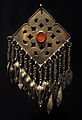
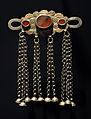
Gallery[edit]

  • Tekke Turkmen kapunuk (door surround), early 19th century. A kapunuk is designed to surround a door frame, providing a decorative entry to a circular Turkmen yurt.

    Tekke Turkmen kapunuk (door surround), early 19th century. A kapunuk is designed to surround a door frame, providing a decorative entry to a circular Turkmen yurt.

  • Turkmen woman's jewelry, metal and cornelian, 20th century. Musée du Quai Branly, Paris, France.

    Turkmen woman's jewelry, metal and cornelian, 20th century. Musée du Quai Branly, Paris, France.

  • Turkmen woman's jewelry, silver, gold and cornelian, 20th century. Musée du Quai Branly, Paris, France.

    Turkmen woman's jewelry, silver, gold and cornelian, 20th century. Musée du Quai Branly, Paris, France.

  • Turkmen man and his son hoist the flag of Turkmenistan while on horseback at the opening ceremony for the 2008 World Nomad Games.

    Turkmen man and his son hoist the flag of Turkmenistan while on horseback at the opening ceremony for the 2008 World Nomad Games.

See also[edit]

  • Akhal-Teke horse
  • Yomut carpet
  • Turkmen carpet
  • Islam in Turkmenistan
  • Merv
  • Turkmen cuisine
  • Turkmen jewelry

References[edit]

  1. ^ В Туркменистане утверждён порядок предоставления театрам статусов «Академический» и «Национальный»
  2. ^ UNESCO World Heritage Centre (26 January 2009). "Ancient Merv State Historical and Cultural Park". Whc.unesco.org. Retrieved 25 November 2013.
  3. ^ UNESCO World Heritage Centre (15 July 2005). "Köneürgenç". Whc.unesco.org. Retrieved 25 November 2013.
  4. ^ UNESCO World Heritage Centre. "Nisa Fortress". Whc.unesco.org. Retrieved 25 November 2013.

Further reading[edit]

  • Blackwell, Carole (2001). Tradition and Society in Turkmenistan: Gender, Oral Culture and Song. Curzon. ISBN 0-7007-1354-9.
  • Clement, Victoria (2018). Learning to Become Turkmen. University of Pittsburgh Press. ISBN 978-0822964636.
  • Edgar, Adrienne Lynn (2004). Tribal Nation: The Making of Soviet Turkmenistan. Princeton University Press. ISBN 978-0-691-12799-6.
  • Smith, Graham, ed. (1995). The Nationalities Question in the Soviet Union (2nd ed.).

turkmenistan food

Turkmen cuisine, the cuisine of Turkmenistan, is similar to that of the rest of Central Asia. Turkmen seminomadic culture revolved around animal husbandry, especially sheep herding, and accordingly Turkmen cuisine is noted for its focus on meat, particularly mutton and lamb.[1] One source notes,

The nomadic past has left a very noticeable trace in Turkmen cuisine - the basis of the diet is meat: lamb, meat of gazelles, non-working camels, wild fowl, chicken. Beef is consumed much less frequently because this food appeared on the table much later, Turkmens don't eat horse meat at all.[2]

Turkmen cuisine does not generally use spices or seasonings other than salt and black pepper, and is typically cooked with large amounts of widely available cottonseed oil.[3]

A description of Turkmen foods presented at an annual culinary festival included "...more than 15 kinds of soup, meat and fish delicacies, ruddy ichlekli (meat pies), appetizing gutaps with different fillings (pumpkin, spinach), crumbly pilaf, kelle bash ayak and chekdirme, whole roasted lamb, kakmach, hearty yarma, numerous salads, traditional pishme, as well as sweets..."[4] At a formal ribbon-cutting ceremony for new housing, the offerings included "...all kinds of meat, poultry and fish dishes, cereals, vegetables and gourds, soups, culinary products made of dough, dairy products and drinks prepared according to ancient recipes. These include tamdyrlama, ichlekli, yarma, dograma, different kinds of pilaf, çorba, somsa, pishme, süzme, çal, agaran and much else."[5]
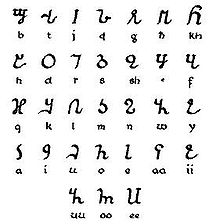
Meat[edit]

Shashlyk (Turkmen: çişlik), skewered chunks of mutton, lamb, chicken, or sometimes fish, grilled over charcoal and garnished with raw sliced onion and a special vinegar-based sauce, is served in restaurants and often sold in the street. Shashlyk from pork and beef was introduced during the Russian Imperial period, and is easily found in major cities. Kebabs of ground meat are commonly prepared from beef and occasionally camel. Kakmach (Turkmen: kakmaç) is preserved, dried meat prepared in individual portions or strips. Kakmach may be fried in fat or baked in a tandoor, but it is traditionally dried like jerky in the hot desert sun.[1][3]

Gowurma is deep-fat-fried meat in bite-sized chunks, typically cooked in a cauldron (Turkmen: gazan, a large hemispherical iron pot placed over an open fire). Gowurma is used in various soups and can be eaten hot or cold, or put up for later use.[2]

Dumplings[edit]

A wide variety of filled pies and dumplings are available in restaurants and bazaars. Manty are steamed dumplings filled with ground meat, onions or pumpkin. Typical fried dishes include somsa, gutap (often filled with spinach), fitchi (fitçi), börek, and ichlekli (içlekli). These are popular with travelers and taxi drivers, as they can be eaten quickly on the run, and are often sold at roadside stands.

Fruit[edit]

Melons[edit]

Melon vendor from Samarkand, Russian Turkestan (picture taken around 1905 to 1915)

In the culinary arena, Turkmenistan is perhaps most famous for its melons (Turkmen: gawun), especially in the former Soviet Union, where it was once the major supplier. Turkmen state-controlled media have referred to the melon as the "tsarina of the garden" (Russian: царица бахчи).[6] Though very few melons are exported today,[7] they are a great source of national pride in Turkmenistan and subject of their own Melon Day holiday.[8] Turkmen sources claim the country is home to up to 400 distinct varieties.

Pomegranate[edit]

Residents of oases use pomegranate (Turkmen: nar) as a flavoring, often crushing for juice to be added to or mixed into dishes.[9]

Pumpkin[edit]

Pumpkins (Turkmen: kädi) are mainly used as a soup flavoring but, hollowed out, may be used as a vessel for baking casseroles or meats. Pumpkin seeds are crushed for cooking oil.[10]

Tomato[edit]

Although a foreign import from the New World, tomatoes have become a major influence on Turkmen cuisine in the last two centuries. Tomatoes are pickled, dried, pureed, and chopped for adding to dishes, and made into tomato soup and juice.[11]

Cereal-based dishes[edit]

Breads[edit]

Turkmen bread baking in tandyr

Pishme

Turkmen girls at a Novruz festival greet guests with pishme and dried fruits.

Meals are almost always served with naan, Central Asian flatbread, known locally as çörek. Turkmen bread is prepared differently from other breads in the region in thick, round disc-shaped loaves baked in a traditional tamdyr clay oven. Bread baked with meat inside (etli çörek, or "meat bread") can be consumed as a meal in itself. Ýagly çörek (literally "oily bread, buttery bread") is a flaky, layered type of flat bread made with butter. Pishme (Turkmen: pişme) are soft, bite-sized, sweetened, fried breads traditionally presented to arriving guests as a welcoming gesture.

Bread bears highly symbolic importance in Turkmen culture.[12] It is considered highly impolite to turn a loaf of bread upside down or to mistreat bread in any way. There are many superstitions surrounding bread and its preparation. In the words of Turkmen state-controlled media,

...the main role in the hospitality of the peoples of Central Asia is played by bread - çörek, which also serves as a symbol of hospitality, brotherhood, honor, hard work, prosperity, gratitude and the kindest wishes. Bread is baked in many kinds...ancient recipes have many modern variations, but the matter is not even in the ingredients themselves, which determine the softness, puffiness and taste of dough, but in the special ritual of its preparation, especially for festive meals...[4]

The student of Turkmen culture Sergey Demidov wrote,

And yet, despite the high authority of the horse, there was something even higher and more sacred in the Turkmen household, bearing the stamp of taboo from ancient times. This was the tamdyr, the oven for baking çörek - a symbol of life, well-being and family hearth, supported by the sanctity of bread and, perhaps, by echoes of Zoroastrian-Mazdean beliefs associated with fire. Therefore, in the scale of ethical values there might have been a judgment such as: "It is better to slit a horse's throat or rob someone than to destroy a tamdyr".[13]
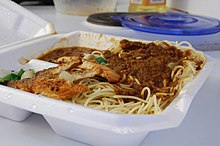
Pilaf[edit]

Pilaf (Turkmen: palaw) is served at celebrations and to honored guests; one source calls it "king in Turkmen cuisine."[14] It consists of rice typically cooked with chunks of mutton and carrots, onions, and garlic, prepared in a large cast-iron cauldron. Different pilaf recipes may call for addition of raisins (Turkmen: kişmiş), fruits, fish, and ground meat.[3] Pilaf is traditionally eaten with the hands.

Porridges[edit]

Yarma (Turkmen: ýarma, from the Turkmen word ýarym "half, split") is cracked wheat cooked in sheep fat with very small pieces of mutton mixed in for flavor. The dish is claimed to have existed for at least one thousand years.[15] Shule (Turkmen: şüle) is a watery rice porridge with meat, sometimes served with shredded carrots.[16] Sorghum porridge (Turkmen: etli köje) is a traditional dish for the Novruz festival; the dish is ancient, for sorghum was introduced to the Turkmen by trade on the Silk Road.[17]

Casseroles[edit]

Chegdermeh (Turkmen: çegderme) is a mixture of boiled rice, fried meat, tomato, and chopped, sautéed onions, typically cooked in a cauldron.

Soups[edit]

Shurpa (Turkmen: şurpa), meat boullion, is the base of most soups. The most traditional Turkmen soups are various types of unash (Turkmen: unaş), made with milk and noodles or with beans and noodles. Other common soups include dograma (also dogramaly şurpa), made with diced organ meats and bread, onion, and tomato;[18] dumpling soup (Turkmen: etli börek şurpasy); and mung bean soup (Turkmen: şurpa maş).[2] Suytlash (Turkmen: süýtlaş, also süýtli unaş and süýtli aş) is a vermicelli pudding traditionally served as the second course at wedding feasts. Some variants use rice in lieu of vermicelli.[19] Though considered by some Turkmen to be a type of porridge, Turkmen cookbooks categorize it as a soup.[20][21] Drawing from culinary traditions of neighbors, lagman, a soupy Uyghur noodle dish, is also common.

Bottle of Turkmen brandy (cognac) bearing a portrait of Saparmurat Niyazov in a military uniform.

Beverages[edit]

As in the rest of Central Asia, green tea (Turkmen: çaý) is the primary drink, consumed at all hours. In the Turkmen language, çaý (pronounced "chai") can refer either to a meal (typically breakfast) or to sitting down for a visit over tea.[14][22] In the Dashoguz region, it is sometimes drunk "Kazakh-style" with milk, often to disguise the salty taste of the drinking water in that area.

Gatyk, a thick drinking yogurt similar to kefir, is often served with breakfast and sometimes used as a condiment on börek or manty, replacing the traditional sour cream. The drink the nation is known for, however, is çal ("chal"), fermented camel's milk, which is a white sparkling beverage with a sour flavour, popular in Central Asia, particularly in Turkmenistan.[23] Because of specific preparation requirements and its being extremely perishable, çal presents a great challenge for exporters to ship outside Turkmenistan or the region for foreign consumption.[24] It is similar to the Kyrgyz drink shoro. One source notes that Turkmens like to skim agaran (a type of butter) from the surface of chal.[25]

Alcoholic beverages[edit]

Vodka (Turkmen: arak) is the most popular alcoholic beverage, due to its relatively low cost, followed by beer, wine, brandy, and sparkling wine (Russian: шампанское shampanskoye). Spirits and beer were introduced during the Russian imperial period. Beer was introduced in the 19th century by German brewers and though not a traditional beverage is popular in urban areas. Two domestic beer brands, Berk and Zip, are produced in Turkmenistan.[26][27][28]

Archeological exploration indicates viticulture in the oasis area north of the Kopet Dag Mountains dates to the 3rd-2nd centuries BCE. Wheat was cultivated in the lowlands and vineyards were planted in the foothills. Wine grapes were also grown in the upper Murghab Valley near the present-day Turkmenistan-Afghanistan border. Introduction of Islam to Central Asia did not impede continuation of wine production, in part because wine is central to Sufism.[29] In the 21st century, Turkmenistan produces over 200 different grape wines and brandies from 100 grape varieties.[30]

Fish[edit]

Fish forms part of the traditional diet of Turkmen tribes residing near the Caspian Sea and along the Amu Darya. The Caspian Turkmen recipes call for both grilling and frying fish, but serving with "sesame, rice, apricots, raisins, pomegranate juice."[31]

Foreign influences[edit]

Restaurants in Turkmenistan often also serve Russian fare such as pelmeni, buckwheat (grechka), golubtsy, and a wide variety of mayonnaise-based salads. The potato and tomato, both introduced from the New World, are widely used in meal preparation.[32] Urban steakhouses have appeared in Ashgabat, the capital city.[33][34][35]

See also[edit]

  • iconFood portal
  • Central Asian cuisine
  • Soviet cuisine

Bibliography[edit]

  • Bagdasarov, A.; Vanukevich, A.; Hudaýşukurow, T. (1981), Tуркменская кулинария [Turkmen Cuisine] (in Russian), Ashgabat: Izdatel'stvo "Turkmenistan"
  • Berdimuhamedow, Gurbanguly (2014), Turkmen dastarkhan, Dishes of the national cuisine, Ashgabat: Turkmen State Publishing Service Volume 1, Volume 2
  • Eden, Caroline (2020), Red Sands, London: Quadrille, ISBN 978-1-787-134829
  • Esenova, Gyulshat (2019), Sachak, Traditional Turkmen Recipes in a Modern Kitchen, ISBN 978-0-578-81405-6
  • One Turkmen Kitchen, One Turkmen Kitchen, retrieved 25 January 2023, website with recipes
  • Туркменская национальная кухня и ее особенности [Turkmen national cuisine and its particulars] (in Russian), Infoabad, 20 November 2021, retrieved 26 January 2023

turkey culture

The culture of Turkey (Turkish: Türkiye kültürü) or the Turkish culture (Türk kültürü) combines a heavily diverse and heterogeneous set of elements that have been derived from the various cultures of the Eastern European, Eastern Mediterranean, Caucasian, Middle Eastern and Central Asian traditions. Many of these traditions were initially brought together by the Ottoman Empire, a multi-ethnic and multi-religious state spanning across Southern Europe, Eastern Europe, the Middle East and North Africa.

During the early years of the Republic of Turkey, established after the collapse of the Ottoman Empire, the government invested large sums of resources into fine arts such as architecture and sculpture, and other artistic fields around the country in-line with the newly implemented reformist and West-leaning policies. This was done as part of a process of modernization, westernization, and of creating and outlining a new Turkish cultural identity, rather than the previously established and depicted Ottoman identity.

People[edit]

Adnan Menderes, İsmet İnönü, and the other members of the Parliament wearing a white tie and top hat.

History[edit]

The Ottoman system was a multi-ethnic state that enabled people within it not to mix with each other and thereby retain separate ethnic and religious identities within the empire (albeit with a dominant Turkish and Southern European ruling class). Upon the fall of the empire after World War I the Turkish Republic adopted a unitary approach, which leads the different cultures within its borders to mix with each other with the aim of producing a national and cultural identity. A series of radical reforms soon followed, central to these reforms were the belief that Turkish society would have to Westernize itself both politically and culturally in order to modernize. Political, legal, religious, cultural, social, and economic policy changes were designed to convert the new Republic of Turkey into a secular, modern nation-state. These changes were implemented under the leadership of Mustafa Kemal Atatürk.

Literature[edit]

This section does not cite any sources. Please help improve this section by adding citations to reliable sources. Unsourced material may be challenged and removed. (March 2021) (Learn how and when to remove this template message)

Main article: Turkish literature

Namık Kemal was a prominent Turkish poet, novelist, playwright and journalist of the late-19th-century Ottoman Empire.

Karagöz and Hacivat are the lead characters of the traditional Turkish shadow play, popularized during the Ottoman period.

Turkish literature is the collection of written and oral texts composed in the Turkish language, either in its Ottoman form or in less exclusively literary forms, such as that spoken in the Republic of Turkey today. Traditional examples for Turkish folk literature include stories of Karagöz and Hacivat, Keloğlan, İncili Çavuş and Nasreddin Hoca, as well as the works of folk poets such as Yunus Emre and Aşık Veysel. The Book of Dede Korkut and the Epic of Köroğlu have been the main elements of the Turkish epic tradition in Anatolia for several centuries.

The two primary streams of Ottoman literature were poetry and prose. Of the two, the Ottoman Divan poetry, a highly ritualized and symbolic art form, was the dominant stream. The vast majority of Divan poetry was lyric in nature: either ghazals or qasidas. There were, however, other common genres, most particularly the mathnawi (also known as mesnevî), a kind of verse romance and thus a variety of narrative poetry. The tradition of Ottoman prose was exclusively non-fictional in nature; as the fiction tradition was limited to narrative poetry.

Sami Frashëri (1850–1904) and his wife Emine, May 1884.

The Tanzimat reforms of 1839–1876 brought changes to the language of Ottoman written literature and introduced previously unknown Western genres, primarily the novel and the short story. Many of the writers in the Tanzimat period wrote in several different genres simultaneously: for instance, the poet Namık Kemal also wrote the important 1876 novel İntibâh (Awakening), while the journalist İbrahim Şinasi is noted for writing, in 1860, the first modern Turkish play, the one-act comedy "Şair Evlenmesi" (The Poet's Marriage). Most of the roots of modern Turkish literature were formed between the years 1896 and 1923. Broadly, there were three primary literary movements during this period: the Edebiyyât-ı Cedîde (New Literature) movement; the Fecr-i Âtî (Dawn of the Future) movement; and the Millî Edebiyyât (National Literature) movement. The Edebiyyât-ı Cedîde (New Literature) movement began with the founding in 1891 of the magazine Servet-i Fünûn (Scientific Wealth), which was largely devoted to progress (both intellectual and scientific) along the Western model. Accordingly, the magazine's literary ventures, under the direction of the poet Tevfik Fikret, were geared towards creating a Western-style "high art" in Turkey.

Poetry[edit]

Main article: Turkish poetry

Tevfik Fikret (1867–1915) was a prominent Turkish poet of the late Ottoman era.

Poetry is the most dominant form of literature in modern Turkey.

The 'folk poetry' as indicated above, was strongly influenced by the Islamic Sunni and Shi'a traditions. Furthermore, as partly evidenced by the prevalence of the still-existent ashik ("aşık" or "ozan") tradition, the dominant element in Turkish folk poetry has always been song. The development of folk poetry in Turkish—which began to emerge in the 13th century with such important writers as Yunus Emre, Sultan Veled, and Şeyyâd Hamza—was given a great boost when, on 13 May 1277, Karamanoğlu Mehmed Bey declared Turkish the official state language of Anatolia's powerful Karamanid state; subsequently, many of the tradition's greatest poets would continue to emerge from this region.[citation needed]

Recaizade Mahmud Ekrem (1847–1914) was another prominent Turkish poet of the late Ottoman era.

There are, broadly speaking, two traditions of Turkish folk poetries;

  • the aşık/ozan tradition, which—although much influenced by religion, as mentioned above—was, for the most part, a secular tradition;
  • the explicitly religious tradition, which emerged from the gathering places (tekkes) of the Sufi religious orders and Shi'a groups.

Much of the poetry and song of the aşık/ozan tradition, being almost exclusively oral until the 19th century, remains anonymous. There are, however, a few well-known aşıks from before that time whose names have survived together with their works: the aforementioned Köroğlu (16th century); Karacaoğlan (1606?–1689?), who may be the best-known of the pre-19th century aşıks; Dadaloğlu (1785?–1868?), who was one of the last of the great aşıks before the tradition began to dwindle somewhat in the late 19th century; and several others. The aşıks were essentially minstrels who traveled through Anatolia performing their songs on the bağlama, a mandolin-like instrument whose paired strings are considered to have a symbolic religious significance in Alevi/Bektashi culture. Despite the decline of the aşık/ozan tradition in the 19th century, it experienced a significant revival in the 20th century thanks to such outstanding figures as Aşık Veysel Şatıroğlu (1894–1973), Aşık Mahzuni Şerif (1938–2002), Neşet Ertaş (1938–2012), and many others.

Ottoman Divan poetry was a highly ritualized and symbolic art form. From the Persian poetry that largely inspired it, it inherited a wealth of symbols whose meanings and interrelationships—both of similitude (مراعات نظير mura'ât-i nazîr / تناسب tenâsüb) and opposition (تضاد tezâd)—were more or less prescribed. Examples of prevalent symbols that, to some extent, oppose one another include, among others:

the nightingale (بلبل bülbül) — the rose (ﮔل gül) the world (جهان cihan; عالم 'âlem) — the rosegarden (ﮔﻠﺴﺘﺎن gülistan; ﮔﻠﺸﻦ gülşen) the ascetic (زاهد zâhid) — the dervish (درويش derviş)[citation needed]

In the early years of the Republic of Turkey, there were a number of poetic trends. Authors such as Ahmed Hâşim and Yahyâ Kemâl Beyatlı (1884–1958) continued to write important formal verse whose language was, to a great extent, a continuation of the late Ottoman tradition. By far the majority of the poetry of the time, however, was in the tradition of the folk-inspired "syllabist" movement (Five Syllabists or Beş Hececiler), which had emerged from the National Literature movement and which tended to express patriotic themes couched in the syllabic meter associated with Turkish folk poetry.[citation needed]

The first radical step away from this trend was taken by Nâzım Hikmet, who—during his time as a student in the Soviet Union from 1921 to 1924—was exposed to the modernist poetry of Vladimir Mayakovsky and others, which inspired him to start writing verse in a less formal style.

Orhan Veli Kanık was the founder of the Garip Movement in Turkish poetry.

Another revolution in Turkish poetry came about in 1941 with the publication of a small volume of verse preceded by an essay and entitled Garip (meaning both "miserable" and "strange"). The authors were Orhan Veli Kanık (1914–1950), Melih Cevdet Anday (1915–2002), and Oktay Rifat (1914–1988). Explicitly opposing themselves to everything that had gone in poetry before, they sought instead to create a popular art, "to explore the people's tastes, to determine them, and to make them reign supreme over art".[21] To this end, and inspired in part by contemporary French poets like Jacques Prévert, they employed not only a variant of the free verse introduced by Nâzım Hikmet, but also highly colloquial language, and wrote primarily about mundane daily subjects and the ordinary man on the street. The reaction was immediate and polarized: most of the academic establishment and older poets vilified them, while much of the Turkish population embraced them wholeheartedly.

Fazıl Hüsnü Dağlarca was one of the most prolific Turkish poets of the Turkish Republic with more than 60 collections of his poems published, laureate of the Struga Poetry Evenings Golden Wreath Award.

Just as the Garip movement was a reaction against earlier poetry, so—in the 1950s and afterwards—was there a reaction against the Garip movement. The poets of this movement, soon known as İkinci Yeni ("Second New"[22]), opposed themselves to the social aspects prevalent in the poetry of Nâzım Hikmet and the Garip poets, and instead—partly inspired by the disruption of language in such Western movements as Dada and Surrealism—sought to create a more abstract poetry through the use of jarring and unexpected language, complex images, and the association of ideas. To some extent, the movement can be seen as bearing some of the characteristics of postmodern literature. The best-known poets writing in the "Second New" vein were Turgut Uyar (1927–1985), Edip Cansever (1928–1986), Cemal Süreya (1931–1990), Ece Ayhan (1931–2002), and İlhan Berk (1918–2008).

Outside of the Garip and "Second New" movements also, a number of significant poets have flourished, such as Fazıl Hüsnü Dağlarca (1914–2008), who wrote poems dealing with fundamental concepts like life, death, God, time, and the cosmos; Behçet Necatigil (1916–1979), whose somewhat allegorical poems explore the significance of middle-class daily life; Can Yücel (1926–1999), who—in addition to his own highly colloquial and varied poetry—was also a translator into Turkish of a variety of world literature; and İsmet Özel (1944– ), whose early poetry was highly leftist but whose poetry since the 1970s has shown a strong mystical and even Islamist influence.

Prose[edit]

Main article: Prose of the Republic of Turkey

The style of the current novelists can be traced back to the Genç Kalemler journal in the Ottoman period. Young Pens was published in Selanik under Ömer Seyfettin, Ziya Gökalp and Ali Canip Yöntem. They covered the social and political concepts of their time with the nationalistic perspective. They were the core of a movement which became known as the "national literature."

With the declaration of the Turkish Republic in 1923, Turkish literature became interested in folkloric styles. This was also the first time since the 19th century that Turkish literature was escaping from Western influence and began to mix Western forms with other forms. During the 1930s, Yakup Kadri Karaosmanoğlu and Vedat Nedim Tor published Kadro, which was revolutionary in its view of life.

Orhan Pamuk, winner of the 2006 Nobel Prize in Literature.

Stylistically, the early prose of the Republic of Turkey was essentially a continuation of the National Literature movement, with Realism and Naturalism predominating. This trend culminated in the 1932 novel Yaban (The Wilds) by Yakup Kadri Karaosmanoğlu. This novel can be seen as the precursor to two trends that would soon develop: social realism, and the "village novel" (köy romanı). The social realist movement was led by the short-story writer Sait Faik Abasıyanık. The major writers of the "village novel" tradition were Kemal Tahir, Orhan Kemal, and Yaşar Kemal. In a very different tradition, but evincing a similar strong political viewpoint, was the satirical short-story writer Aziz Nesin. Other important novelists of this period were Ahmet Hamdi Tanpınar and Oğuz Atay. Orhan Pamuk, winner of the 2006 Nobel Prize in Literature, is among the innovative novelists, whose works show the influence of postmodernism and magic realism. Important poets of the Republic of Turkey period include Ahmet Haşim, Yahya Kemal Beyatlı and Nâzım Hikmet (who introduced the free verse style). Orhan Veli Kanık, Melih Cevdet Anday and Oktay Rifat led the Garip movement; while Turgut Uyar, Edip Cansever and Cemal Süreya led the İkinci Yeni movement. Outside of the Garip and İkinci Yeni movements, a number of other significant poets such as Fazıl Hüsnü Dağlarca, Behçet Necatigil and Can Yücel also flourished.

Orhan Pamuk is a leading Turkish novelist of post-modern literature. His works have been translated into more than twenty languages. He is the recipient of major Turkish and international literary awards, such as the 2006 Nobel Prize in Literature.

Architecture[edit]

Main article: Architecture of Turkey

See also: Ottoman Architecture

See also: Seljuk Architecture

Early architecture (1299–1437)[edit]

Interior of the Sultanahmet Mosque in Istanbul, Turkey.

A view from the interior of a traditional Turkish house, by John Frederick Lewis (1805–1875)

One of the main entrance gates of the Dolmabahçe Palace.

Early Ottoman period (1299–1326)[edit]

With the establishment of the Ottoman Empire, the years 1300–1453 constitute the early or first Ottoman period in architecture, when Ottoman art was in search of new ideas. This period witnessed three types of mosques: tiered, single-domed and subline-angled mosques. The Hacı Özbek Mosque (1333) in İznik, the first important center of Ottoman art, is the first example of an Ottoman single-domed mosque.

Bursa period (1326–1437)[edit]

The domed architectural style evolved from Bursa and Edirne. The Grand Mosque of Bursa was the first Seljuk mosque to be converted into a domed one. Edirne (Adrianople) was the Ottoman capital between 1365 and 1453, when Istanbul (Constantinople) became the new capital, and it is here that we witness the final stages in the architectural development which culminated in the construction of the great mosques of Istanbul. The buildings constructed in Istanbul during the period between the Turkish conquest of the city in 1453 and the construction of the Istanbul Bayezid II Mosque are also considered works of the early period. Among these are the Fatih Mosque (1470), Mahmut Paşa Mosque, the tiled palace and Topkapı Palace. The Ottomans integrated mosques into the community and added soup kitchens, theological schools, hospitals, hammams (popularly, but incorrectly known in the West as Turkish baths), and tombs.

turkey food

Turkish cuisine (Turkish: Türk mutfağı) is the cuisine of Turkey and the Turkish diaspora. Although the cuisine took its current rich form after numerous cultural interactions throughout centuries, it should not be confused with other cuisines such as Ottoman cuisine (Osmanlı mutfağı) or Seljuk cuisine.[1][2] Turkish cuisine with traditional Turkic elements such as yogurt, ayran, kaymak, exerts and gains influences to and from Mediterranean, Balkan, Middle Eastern, Central Asian and Eastern European cuisines.[3]

Turkish cuisine shows variation across Turkey. The cooking of Istanbul, Bursa, İzmir, and rest of the Anatolia region inherits many elements of Ottoman court cuisine, including moderate use of spices, a preference for rice over bulgur, koftes, and a wider availability of vegetable stews (türlü), eggplant, stuffed dolmas and fish. The cuisine of the Black Sea Region uses fish extensively, especially the Black Sea anchovy (hamsi) and includes maize dishes. The cuisine of the southeast (e.g. Urfa, Gaziantep, Adıyaman and Adana) is famous for its variety of kebabs, mezes and dough-based desserts such as baklava, şöbiyet, kadayıf, katmer and künefe.

Especially in the western parts of Turkey, where olive trees grow abundantly, olive oil is the major type of oil used for cooking.[4] The cuisines of the Aegean, Marmara and Mediterranean regions are rich in vegetables, herbs, and fish. Central Anatolia has many famous specialties, such as keşkek, mantı (especially from Kayseri) and gözleme. Food names directly cognate with mantı are also found in Chinese (mantou or steamed bun) and Korean cuisine (mandu) and it is generally considered to have originated in Mongolia during the 13th century.[5]

Specialties are often named for places, and may refer to different styles of preparation. For example, Urfa kebap is less spicy and thicker than Adana kebap. Although meat-based foods such as kebabs are common in Turkish cuisine abroad, meals in Turkey largely center around rice, vegetables, and bread.

History[edit]

In the early years of the republic, a few studies were published about regional Anatolian dishes, but cuisine did not feature heavily in Turkish folkloric studies until the 1980s when the fledgling tourism industry encouraged the Turkish state to sponsor two food symposia. The papers submitted at the symposia presented the history of Turkish cuisine on a "historical continuum" that dated back to Turkic origins in Central Asia and continued through the Seljuk and Ottoman periods.[6]

Many of the papers presented at these first two symposia were unreferenced. Prior to the symposia, the study of Turkish culinary culture was first popularized by the publication of Süheyl Ünver's Fifty Dishes in Turkish History in 1948. This book was based on recipes found in an 18th-century Ottoman manuscript. His second book was about the 15th century palace cuisine during the reign of Sultan Mehmed II. Following the publication of Ünver's book, subsequent studies were published, including a 1978 study by a historian named Bahaettin Ögel about the Central Asian origins of Turkish cuisine.[6]

Culinary customs[edit]

Breakfast[edit]

Simit, a circular bread with sesame seeds, is a common breakfast item in Turkey.

A traditional Turkish breakfast is rich in variety. A typical serving consists of cheese (beyaz peynir, kaşar, etc.), butter, olives, eggs, muhammara, tomatoes, cucumbers, jam, honey, and kaymak, sucuk (optionally spicy Turkish sausage), pastırma, börek, simit, poğaça, açma, fried dough (known as pişi), as well as soups are eaten as a morning meal in Turkey. A specialty for breakfast is called menemen, which is prepared with tomatoes, green peppers, onion, olive oil and eggs. The breakfast menu can also include kuymak (depending on the province the dish is also known as muhlama, mıhlama and yağlaş). Another specialty is the Balkan Turkish dish çılbır, also known as Turkish eggs, made with poached eggs and yogurt. Invariably, Turkish tea is served at breakfast. The Turkish word for breakfast, kahvaltı, means "before coffee".

Homemade food[edit]

Homemade food is still preferred by Turkish people. Although the newly introduced way of life pushes the new generation to eat out, Turkish people generally prefer to eat at home. A typical meal starts with soup (especially in wintertime), followed by a dish made of vegetables (olive oil or with ground meat), meat or legumes boiled in a pot (typically with meat or minced meat), often with or before Turkish pilav,[7] pasta or bulgur pilav accompanied by a salad or cacık (diluted cold yogurt dish with garlic, salt, and cucumber slices). In summertime many people prefer to eat a cold dish of vegetables cooked with olive oil (zeytinyağlı yemekler) instead of the soup, either before or after the main course, which can also be a chicken, meat or fish plate.

Restaurants[edit]

Food from Turkey including börek and sarma

Adana kebabı

fast food is gaining popularity and many major foreign fast food chains have opened all over Turkey. Some traditional Turkish foods, especially köfte, döner, kokoreç, kumpir, midye tava, börek and gözleme, are often served as fast food in Turkey. Eating out has always been common in large commercial cities.[8] Esnaf lokantası (meaning restaurants for shopkeepers and tradesmen) are widespread, serving traditional Turkish home cooking at affordable prices.

Summer cuisine[edit]

In the hot Turkish summer, a meal often consists of fried vegetables such as eggplant (aubergine) and peppers or potatoes served with yogurt or tomato sauce. Menemen and çılbır are typical summer dishes, based on eggs. Sheep cheese, cucumbers, tomatoes, watermelons and melons also make a light summer meal. Those who like helva for dessert prefer "summer helva", which is lighter and less sweet than the regular version.

Key ingredients[edit]

Manti of Kayseri

Frequently used ingredients in Turkish specialties include lamb, chicken, beef, fish, rice, eggplants, green peppers, onions, garlic, lentils, beans, zucchinis, chickpeas and tomatoes. Average per person per year beef consumption is 15 kilograms (33 lb).[9] Nuts, especially pistachios, chestnuts, almonds, hazelnuts, and walnuts, together with spices, have a special place in Turkish cuisine, and are used extensively in desserts or eaten separately. About 1.5 kg of pistachios are eaten per person per year, some packaged and some used in desserts such as baklava.[10] Tahini is a common sauce from sesame seeds sold both pre-packaged or in bulk on tap. Semolina flour is used to make a cake called revani and irmik helvasi.

Commonly used spices and flavorings:

NameTurkishUsed inReferences

AllspiceYenibahar or Dolma baharDolma, vegetables, pilav, fish, köfte[11][12]

AniseAnasonPeksimet, rakı, used to season nut and dried fruit mixtures in both sweet and savory dishes[11][12]

Black pepperKara biberEgg dishes, meat dishes, Laz böreği[11]

CardamomKakuleRarely used, mostly in coffee. A common ingredient in Persian and Indian desserts, Turkish variations usually replace it with vanilla and rosewater.[12]

CinnamonTarçınDesserts, pastries, salep, boza, iç pilav, fish, lamb, vegetables, tomato sauces, milk puddings, desserts[11][12]

CloveKaranfilFruit compotes, spiced black tea, meat casseroles, sweets, breads, pastries[11][12]

CorianderKişnişExtremely rare. Used in some fish and meat dishes, particularly in southern and eastern Anatolia.[12]

CuminKimyonKofta spice, pastirma, lentil soup[11]

FenugreekÇemen otuVegetables, fish, breads, pastirma[12]

HaspirYalancı safran (fake saffron)Used primarily in the regional cuisine of Gaziantep to give yogurt soups a saffron-like tint[11]

IsotUrfa biberiCiğ köfte[11]

MahlepMahlepBaked goods[11]

MasticSakızUsed in milk desserts, ice creams, Turkish delight[11]

Nigella seedsÇörek otuSavory pastries, homemade cheese. Can be mixed with coriander, cumin and haspir to make a spice for fish.[11][12]

Red pepperkırmızı biber, pul biberGarnish for soups, manti, Adana kebab[11][12]

Rose waterGül suyu,Su muhallebisi, güllaç, aşure[11]

Poppy seedsHaşhaşBread, rolls, meat, fish, light sauces and yogurt dressings[12]

SaffronSafranzerde, pilav[11]

SalepSalepA winter beverage made with milk and sugar[11]

Sesame seedsSusamSimit, tahini, helva[11]

SumacSumakJuice from sumac berries can be used in a marinade for fish or chicken. Ground sumac can be used to season salads, pilav and soups. A spice mix of sumac, dried thyme and roasted sesame seeds is used with grilled meats.[12]

Olives are also common on various breakfasts and meze tables frequently. Beyaz peynir and yoğurt are part of many dishes including börek, manti, kebab and cacık.

Oils and fats[edit]

Meze from Turkey uses different types of oil.

Butter or margarine, olive oil, sunflower oil, canola oil, and corn oil are widely used for cooking. Sesame, hazelnut, peanut and walnut oils are used as well. Kuyruk yağı (tail fat of sheep) is sometimes used in kebabs and meat dishes.

Fruit[edit]

The diverse flora of Turkey means that fruit is varied, abundant and cheap. In Ottoman cuisine, fruit frequently accompanied meat as a side dish. Plums, apricots, pomegranates, pears, apples, grapes, figs and quinces along with many kinds of citrus are the most frequently used fruit, either fresh or dried, in Turkish cuisine. For example, komposto (compote) or hoşaf (from Persian khosh âb, literally meaning "nice water") are among the main side dishes to meat or pilav. Dolma and pilav usually contain currants or raisins. Etli yaprak sarma (vine leaves stuffed with meat and rice) used to be cooked with sour plums in Ottoman cuisine. Turkish desserts do not normally contain fresh fruit, but may contain dried varieties.

Meats[edit]

The main use of meat in cooking remains the combination of ground meat and vegetable, with names such as kıymalı fasulye (beans with ground meat) or kıymalı ıspanak (spinach with ground meat, which is sometimes served with yoğurt).

Alternatively, in coastal towns cheap fish such as sardalya (sardines) or hamsi (anchovies) are widely available, as well as many others with seasonal availability. Poultry consumption, almost exclusively of chicken and eggs, is common. Milk-fed lambs, once the most popular source of meat in Turkey, comprise a small part of contemporary consumption. Kuzu çevirme, cooking milk-fed lamb on a spit, once an important ceremony, is rarely seen.

Dishes and foods[edit]

Dairy products[edit]

Fresh ayran with a head of foam

Yoğurt is an important element in Turkish cuisine.[4] In fact, the English word yogurt or yoghurt derives from the Turkish word yoğurt. Yoğurt can accompany almost all meat dishes (kebabs, köfte), vegetable dishes (especially fried eggplant, courgette, spinach with minced meat, etc.), meze and a specialty called mantı (folded triangles of dough containing minced meat). In villages, yoğurt is regularly eaten with pilav or bread. A thicker, higher-fat variety, süzme yoğurt or "strained yogurt", is made by straining the yoğurt curds from the whey. One of the most common Turkish drinks, ayran, is made from yoğurt. Also, yoğurt is often used in the preparation of cakes, some soups and pastries. Kashk is a fermented and strained sour yogurt that can be consumed on its own as a cheese, or used as an ingredient in soups.

Cheeses[edit]

Beyaz peynir with eggs

Varieties of tulum: Otlu tulum peyniri, or tulum with herbs, in Ankara

Turkey produces many varieties of cheese, mostly from sheep's milk. In general, these cheeses are not long matured, with a comparatively low fat content. The production of many kinds of cheese is local to particular regions. There are 193 different cheeses in Turkey, but only 8 of these cheeses have geographical indication.

  • Beyaz peynir – is a salty brined cheese taking its name from its white color ("white cheese"). It is similar to feta but not as strong. This is produced in styles ranging from unmatured cheese curds to a quite strong mature version. It has many varieties due to source of milk, region (Ezine or Thrace) and production methods (classic or cultured). It is eaten plain (e.g. as part of the traditional Turkish breakfast), used in salads, and incorporated into cooked foods such as menemen, börek and pide.
  • Çerkez peyniri – means "Circassian cheese". It has two variations, smoked or non-smoked.
  • Çökelek – is dried cottage cheese. There are many regional varieties of çökelek. Some are eaten fresh while others are preserved, either by storage in goatskin bags or pottery jars, or by drying in the sun.
  • Çömlek cheese – is a typical artisanal cheese from Central Anatolia.
  • Kurut and keş – are regional names for dried bricks of yogurt made from low-fat milk or from çökelek made from buttermilk.[13]
  • Golot cheese – is one of the most important traditional cheeses produced in the region of East Black Sea.
  • Gravyer – is produced in Turkey as well. Among others, Kars is famous for this type of cheese.
  • Hellim – is a salty, firm-textured goat cheese, generally with some mint added, made in Cyprus. In Turkey, it is common to fry hellim in a pan in some olive oil.
  • Kaşar – is Turkey's other ubiquitous cheese made from cow's milk (occasionally mixed with sheep's or goat's milk), sometimes marketed as "Turkish cheddar", being closer in consistency and taste to mild cheddar-style cheese than other Turkish cheeses. Less matured kaşar, called fresh kaşar, is widely consumed as well. Two varieties are popular Kars and Thrace.
  • Kaşkaval – is a wheel-shaped yellow sheep's cheese, similar to fresh kaşar. The name comes from Romanian word cașcaval, which bears the Italian structure of caciocavallo.
  • Lor – is the other type of unsalted whey cheese, similarly made from the whey left over from kaşar or strained yogurt manufacture. Lor is used in traditional foods and desserts made from unsalted cheese like "ekşimik" and höşmerim
  • Mihaliç peyniri or Kelle peyniri – is a hard sheep's cheese that can be grated, like Parmesan cheese. Sometimes goat or cow milk is used. It is a specialty from Karacabey, a town in Bursa province which was called Mihaliç during Byzantine and Ottoman period. Mostly it is produced from non-pasteurized milk and processed by salt.
  • Örgü peyniri (braided cheese) – is a specialty from Diyarbakır.
  • Otlu peynir, Van herbed cheese, 'herbed cheese', – is produced in many areas, chiefly in East Anatolia. Traditionally sheep's or goat's milk is used, but more recently cow's milk otlu peynir has been produced. The type of herb used varies by region: in Van wild garlic is traditional; Bitlis otlu peynir contains a damp-loving herb known as sof otu. In other areas horse mint (Mentha longifolia) and Pimpinella rhodentha are used.[13]
  • Tulum – is a mostly sheep's curd molded in an animal skin bag called as tulum. There are regional varieties of tulum peynir in such areas as İzmir, Ödemiş and Erzincan.[13] And each of the tulum cheeses have very different characteristics.

Soups[edit]

A Turkish meal usually starts with a thin soup (çorba). Soups are usually named after their main ingredient, the most common types being mercimek (lentil) çorbası, yogurt, and wheat (often mashed) called tarhana çorbası. Delicacy soups are the ones that are usually not the part of the daily diet, such as İşkembe soup and paça çorbası, although the latter also used to be consumed as a nutritious winter meal. Before the popularisation of the typical Turkish breakfast, soup was the default morning meal for some people. The most common soups in Turkish cuisine are:

Yayla çorbası, also known as yogurt soup

Sulu köfte

Ezogelin lentil soup

  • Analı kızlı soup
  • Yayla çorbası
  • Erişte aşı
  • Buğday aşı/Ayran çorbası – which is served cold.
  • Corba
  • Domates çorbası (tomato soup)
  • Düğün çorbası (wedding soup)
  • Ekşi Aşı
  • Mercimek çorbası - (lentil soup)
  • Ezogelin çorbası - another lentil soup
  • İşkembe çorbası
  • Karalahana çorbası - soup with cabbage and kidney beans
  • Keledoş
  • Mahluta
  • Paça
  • Pazı
  • Şehriye
  • Sheep's sorrel soup
  • Sulu köfte
  • Sumak aşı
  • Tarhana çorbası
  • Tavuk (chicken soup) – with almond it becomes bademli tavuk.
  • Toyga soup
  • Trabzon Balık çorbası
  • Tutmaç (noodles soup with chickpeas and green lentils)
  • Yüksük çorbası (contains flour, eggs, salt, tomato paste and plum syrup)
  • Arabaşı çorbası

somalia culture

The culture of Somalia is an amalgamation of traditions in that were developed independently since the Proto-Somali era. [1] The hypernym of the term Somali from a geopolitical sense is Horner and from an ethnic sense, it is Cushite.[2]

Overview[edit]

A traditional dabqaad incense burner.

The cultural diffusion of Somali commercial enterprise can be detected in its exotic cuisine, which contains Southeast Asian influences. Due to the Somali people's foremost ingenuity and facility with poetry, Somalia has often been referred to as a "Nation of Poets" and a "Nation of Bards", as, for example, by the Canadian novelist Margaret Laurence.[3] Somalis have a story-telling tradition.

According to Canadian novelist and scholar Margaret Laurence, who originally coined the term "Nation of Poets" to describe the Somali Peninsular, the Eidagale clan were viewed as "the recognized experts in the composition of poetry" by their fellow Somali contemporaries:

Among the tribes, the Eidagalla are the recognized experts in the composition of poetry. One individual poet of the Eidagalla may be no better than a good poet of another tribe, but the Eidagalla appear to have more poets than any other tribe. "if you had a hundred Eidagalla men here," Hersi Jama once told me, "And asked which of them could sing his own gabei ninety-five would be able to sing. The others would still be learning."[4]

Somalis have a rich musical heritage centered on traditional Somali folklore. Most Somali songs are pentatonic; that is, they only use five pitches per octave in contrast to a heptatonic (seven note) scale such as the major scale.

Somali art is the artistic culture of the Somali people, both historic and contemporary. These include artistic traditions in pottery, music, architecture, wood carving and other genres. Somali art is characterized by its aniconism, partly as a result of the vestigial influence of the pre-Islamic mythology of the Somalis coupled with their ubiquitous Muslim beliefs. The country's shape gives a united country the nickname toddobo (seven).[5]

Pan-Somalism[edit]

Main article: Somali nationalism

Somali nationalism (Somali: Soomaalinimo) is centered on the notion that the Somali people share a common language, religion, culture and ethnicity, and as such constitute a nation unto themselves. The ideology's earliest manifestations in the medieval era are traced to the Adalites whilst in the contemporary era its often traced back to SYL or in present-day Somaliland, the first Somali nationalist political organization to be formed was the Somali National League (SNL), established in 1935 in the former British Somaliland protectorate. In the country's northeastern, central and southern regions, the similarly oriented Somali Youth Club (SYC) was founded in 1943 in Italian Somaliland, just prior to the trusteeship period. The SYC was later renamed the Somali Youth League (SYL) in 1947. It became the most influential political party in the early years of post-independence Somalia.[6]

Notable Pan-Somalists[edit]

Former leader of the Somali Youth League Aden Abdullah Osman Daar who eventually became the first President of the Somali Republic following the union of State of Somaliland and Italian Trusteeship of Somalia.

  • Mohammed Abdullah Hassan fought colonialists with the Dervishes during the Scramble for Africa.
  • Sultan Nur Ahmed Aman (1841–1907) - Sultan of the Habr Yunis and one of the founders of the Somali Dervish movement
  • Haji Sudi - One of the founding members of the Dervish movement and Second in command after Mohamed Abdullah Hassan.
  • Mohamoud Ali Shire – 26th Sultan of the Warsangali Sultanate (1897–1960).
  • Hawo Tako (d.1948) – Early 20th century Somali female nationalist whose sacrifice became a symbol for Pan-Somalism.
  • Bashir Yussuf (b. 1905–1945) – Somali nationalist and religious leader.
  • Abdullahi Issa (b. 1922–1988) – First Prime Minister of Somalia.
  • Aden Abdullah Osman Daar (7 January 1960 – 10 June 1967) – First President of Somalia.
  • Abdirashid Ali Shermarke (10 June 1967 – 15 October 1969) – Second President of Somalia.
  • Hirsi Bulhan Farah – Former Minister in the civilian government of the 1960s, political prisoner and Pan-Somalist.
  • Siad Barre (b. 1919 – 2 January 1995) – Third President of Somalia.
  • Jama Korshel – Somali National Army General, former Head of Somali Police, and commander in the Supreme Revolutionary Council.
  • Daud Abdulle Hirsi (1925–1965) – Prominent Somali General considered the Father of the Somali Military.
  • Mahmoud Harbi – active Pan-Somalist that came close to uniting Djibouti with Somalia in the 1970s.
  • Salaad Gabeyre Kediye – Major General in the Somali military and a revolutionary.
  • Abdirizak Haji Hussein – Former Prime Minister of Somalia (1964–1967) and Somali Youth League leader.
  • Sheikh Mukhtar Mohamed Hussein, speaker of parliament, from 1965 to 1969 and interim President of Somalia before the coup d'état in 1969.
  • Abdullahi Ahmed Irro – General in the Somali National Army; established the National Academy for Strategy.
  • Michael Mariano legendary politician and diplomat, SYL member and advocate for occupied Somalis
  • Ali Matan Hashi – Brigadier General and politician; first Somali Air Force pilot, the father of Somali Air Force and a prominent member of the Supreme Revolutionary Council.
  • Abdirahman Jama Barre – Former Minister of Foreign Affairs and Minister of Finance of Somalia.
  • Haji Bashir Ismail Yusuf – First President of the Somali National Assembly and prominent Somali Youth League member.
  • Osman Haji Mohamed – Prominent Somali Youth League member and parliamentarian.
  • Abdullahi Yusuf Ahmed – President of Somalia, Colonel in Somali National Army, and commander during WSLF campaign.
  • Omar Osman Rabeh – Pan-Somalist that has written many works on Somali nationalism.
  • Mohamed Ainanshe Guleid, Major General in the Somali National Army and Vice president of the Somali Democratic Republic
  • Mohamed Farah Aidid – Prominent Somali military commander and political leader. A former general and diplomat, he was the chairman of the United Somali Congress (USC) and later led the Somali National Alliance (SNA). In 1992, Aidid attacked American troops in the nation. He was one of the main targets of the Unified Task Force. Eventually forcing United States forces to withdraw from Somalia in 1995.

Religion[edit]

Main article: Religion in Somalia

See also: Islam in Somalia

With very few exceptions, Somalis are entirely Muslims, the majority belonging to the Sunni branch of Islam and the Shafi‘i school of Islamic jurisprudence.[7][8] There are two theories about when Somalis began adopting Islam.[9] One states that the religion entered the region very early on, as a group of persecuted Muslims had, at Prophet Muhummad's urging, sought refuge across the Red Sea in the Horn of Africa. Islam may thus have been introduced into Somalia well before the faith even took root in its place of origin.[9] An alternate theory states that Islam was brought to the coastal settlements of Somalia between the 7th and the 10th century by seafaring Arab and Persian merchants.[10][9] Somali Sufi religious orders (tariqa) – the Qadiriyya, the Ahmadiya and the Salihiyya – in the form of Muslim brotherhoods have played a major role in Somali Islam and the modern era history of Somalia.[9][11][12]

Of the three orders, the less strict Qaadiriya tariqa is the oldest, and it is the sect to which most Somalis belong.[13] The Qaadiriya order is named after Shaikh Muhiuddin Abdul Qadir Gilani of Baghdad.[14] I. M. Lewis states that Qaadiriya has a high reputation for maintaining a higher standard of Islamic instruction than its rivals.[15]

Ahmadiyah and its sub-sect Salihiyyah preached a puritanical form of Islam,[13] and have rejected the popular Sufi practice of tawassul (visiting the tombs of saints to ask mediation). B. G. Martin states that these two orders shared some of the views of the Wahhabis of Arabia.[16] The religious differences between Qaadiriya and Salihiyya were controversial, as Salihis continued to oppose the Qadiris' practice of tawassul, and claimed the act to be invalid and improper religious activity.[16] The Ahmadiya has the smallest number of adherents of the three orders.[11]

Merca is an ancient Islamic center in Somalia.

Qur'anic schools (also known as dugsi) remain the basic system of traditional religious instruction in Somalia. It is delivered in Arabic. They provide Islamic education for children. According to the UNICEF, the dugsi system where the content is based on Quran, teaches the greatest number of students and enjoys high parental support, is oftentimes the only system accessible to Somalis in nomadic as compared to urban areas.[17] A study from 1993 found, among other things, that "unlike in primary schools where gender disparity is enormous, around 40 per cent of Qur'anic school pupils are girls; but the teaching staff have minimum or no qualification necessary to ensure intellectual development of children." To address these concerns, the Somali government on its own part subsequently established the Ministry of Endowment and Islamic Affairs, under which Qur'anic education is now regulated.[18]

The Somali community has produced important Muslim figures over the centuries, many of whom have significantly shaped the course of Islamic learning and practice in the Horn of Africa and the Muslim world.[19]

Mosque in Borama, Somaliland

Although Pew Research Center has not conducted a survey in Somalia, its Somali-majority northwestern neighbour Djibouti reported a creed breakdown of Muslims which was reported as 77% adhering to Sunnism, 8% as non-denominational Muslim, 2% as Shia, thirteen percent refusing to answer, and a further report inclusive of Somali Region stipulating 2% adherence to a minority sect (e.g. Ibadism, Quranism etc.).[20] Somali Sunnis primarily belong to Shafi`i school of Islamic jurisprudence,[8] or are adherents to the Salafi creed.[21] Sufism, the mystical dimension of Islam, is also well-established, with many local jama'a (zawiya) or congregations of the various tariiqa or Sufi orders.[22] The constitution of Somalia likewise defines Islam as the religion of the Somali Republic, and Islamic Sharia as the basic source for national legislation.[23]

Although Somali women were initially excluded from the many male-dominated religious orders, the all-female institution Abay Siti was formed in the late 19th century, incorporating Somali tradition and Islam.

In addition, the Somali community has produced numerous important Islamic figures over the centuries, many of whom have significantly shaped the course of Muslim learning and practice in the Horn of Africa, the Arabian Peninsula, and well beyond. Among these Islamic scholars is the 14th century Somali theologian and jurist Uthman bin Ali Zayla'i of Zeila, who wrote the single most authoritative text on the Hanafi school of Islam, consisting of four volumes known as the Tabayin al-Haqa’iq li Sharh Kanz al-Daqa’iq.

Important Islamic figures[edit]

Sheikh Ali Ayanle Samatar, a prominent Somali Islamic scholar.

  • Abdirahman bin Isma'il al-Jabarti – 10th century Islamic leader in Somaliland.
  • Sheikh Isaaq Bin Ahmed Al Hashimi – 12th century Islamic leader in Somaliland
  • Yusuf bin Ahmad al-Kawneyn – 13th century scholar, philosopher and saint. Associated with the development of Wadaad's writing.
  • Abadir Umar ar-Rida – 13th century Sheikh and patron saint of Harar.
  • Uthman bin Ali Zayla'i – 14th century Somali theologian and jurist who wrote the single most authoritative text on the Hanafi school of Islam, consisting of four volumes known as the Tabayin al-Haqa’iq li Sharh Kanz al-Daqa’iq.
  • Sa'id of Mogadishu – 14th century Somali scholar and traveler. His reputation as a scholar earned him audiences with the Emirs of Mecca and Medina. He travelled across the Muslim world and visited Bengal and China.
  • Ahmad ibn Ibrahim al-Ghazi (c. 1507 – 21 February 1543) – 16th century Imam and military leader that led the Conquest of Abyssinia.
  • Nur ibn Mujahid – 16th century Somali Emir and patron saint of Harar.
  • Ali al-Jabarti (d. 1492) – 16th century Somali scholar and politician in the Mamluk Empire.
  • Hassan al-Jabarti (d. 1774) – Somali mathematician, theologian, astronomer and philosopher; considered one of the great scholars of the 18th century.
  • Abd al-Rahman al-Jabarti (1753–1825) – Somali scholar living in Cairo that recorded the Napoleonic invasion of Egypt.
  • Abd al Aziz al-Amawi (1832–1896) – 19th century influential Somali diplomat, historian, poet, jurist and scholar living in the Sultanate of Zanzibar.
  • Shaykh Abd Al-Rahman bin Ahmad al-Zayla'i (1820–1882) – Somali scholar who played a crucial role in the spread of the Qadiriyyah movement in Somalia and East Africa.
  • Sheikh Madar (1825-1918) - Influential 19th & 20th century Qadiriyya leader and founder of the Hargeisa tariqa
  • Shaykh Sufi (1829–1904) – 19th century Somali scholar, poet, reformist and astrologer.
  • Sheikh Uways Al-Barawi (1847–1909) – Somali scholar credited reviving Islam in 19th century East Africa and with followers in Yemen and Indonesia.
  • Mohammed Abdullah Hassan (1856-1920) – emir of the Dervishes
  • Abdallah al-Qutbi (1879–1952) – Somali polemicist theologian and philosopher; best known for his five-part Al-Majmu'at al-mubaraka ("The Blessed Collection"), published in Cairo.
  • Sheikh Muhammad al-Sumali (1910-2005) – Somali scholar and teacher in the Masjid Al-Haram in Mecca. He influenced many of the prominent Islamic scholars of today.

Languages[edit]

Main articles: Somali language and Languages of Somalia

The Somali language is the official language of Somalia. It is a member of the Cushitic branch of the Afro-Asiatic language family, and its nearest relatives are the Afar and saho languages. Somali is the best documented of the Cushitic languages,[24] with academic studies of it dating from before 1900.

The Osmanya writing script.

Somali dialects are divided into three main groups: Northern, Benaadir and Maay. Northern Somali (or Northern-Central Somali) forms the basis for Standard Somali. Benaadir (also known as Coastal Somali) is spoken on the Benadir coast from Adale to south of Merca, including Mogadishu, as well as in the immediate hinterland. The coastal dialects have additional phonemes which do not exist in Standard Somali. Maay is principally spoken by the Digil and Mirifle (Rahanweyn) clans in the southern areas of Somalia.

Since Somali had long lost its ancient script,[25] a number of writing systems have been used over the years for transcribing the language. Of these, the Somali alphabet is the most widely used, and has been the official writing script in Somalia since the government of former President of Somalia Siad Barre formally introduced it in October 1972.[26]

Exterior of the Saryan Museum, Hargeisa

The script was developed by a number of leading scholars of Somali, including Musa Haji Ismail Galal, B. W. Andrzejewski and Shire Jama Ahmed specifically for transcribing the Somali language, and uses all letters of the English Latin alphabet except p, v and z.[27][28] Besides Ahmed's Latin script, other orthographies that have been used for centuries for writing Somali include the long-established Arabic script and Wadaad's writing. Indigenous writing systems developed in the twentieth century include the Osmanya, Borama and Kaddare scripts, which were invented by Osman Yusuf Kenadid, Sheikh Abdurahman Sheikh Nuur and Hussein Sheikh Ahmed Kaddare, respectively.[29]

In addition to Somali, Arabic is an official national language of Somalia.[30] Many Somalis speak it due to centuries-old ties with the Arab World, the far-reaching influence of the Arabic media, and religious education.

English is also widely used and taught. Italian used to be a major language, but its influence significantly diminished following independence. It is now most frequently heard among older generations who were in contact with the Italians at that time or later as migrants into Italy. Other minority languages include Bravanese, a variant of the Bantu Swahili language that is spoken along the coast by the Bravanese people.

somalia food

Somali cuisine was influenced by many different countries mainly due to trade, but traditionally also varies from region to region due to the expansive landmass Somalis inhabit.[1] It is the product of Somalia's tradition of trade and commerce. Some notable Somali specialties include kimis/sabaayad, canjeero/lahoh, xalwo (halwa), sambuusa (samosa), bariis iskukaris, and muqmad/odkac.

Pork consumption is forbidden to Muslims in Somalia, in accordance with Sharia, the Islamic law.

Breakfast[edit]

Breakfast (quraac) is an important meal for Somalis, who often start the day with Somali-style tea (shaah/shaax) or coffee (qaxwa). The tea, brewed from black tea leaves, can be served regularly as-is (shaah rinji or shaah bigays). It can be also flavoured with spices such as ginger, cardamom and cinnamon (though black pepper is not used, unlike other spiced teas), while milk is added after the brewing instead of during it; this is known as shaah cadeeys.[2]

The main dish is typically a pancake-like bread called a canjeero or lahoh originating in Somalia[3][4] and is eaten in different ways. It is often eaten along with honey and ghee, olive oil, or sesame oil, and washed down with a cup of tea. It may also be broken into small pieces with Somali ghee (subag) and sugar. For children, it is mixed with tea and sesame oil or olive oil (macsaro) until mushy. Typically, there is a side dish of liver (usually beef), goat meat (hilib ari), diced beef cooked in a bed of soup (suqaar), or odkac, which consists of small dried pieces of beef, goat or camel meat, boiled in ghee. Different from Ethiopian injera, Somali canjeero is smaller, thinner and sweeter. It might also be eaten with a stew (maraq) or soup.[5]

  • Sabaayad or kimis/cesh is another type of flatbread which is similar to the Desi paratha. During lunch, kimis/sabaayad is sometimes consumed with Somali curry, soup, or stew.
  • Muufo[6] is another type of Somali flatbread popular within south Somalia and is usually eaten with stews and soup but is also sometimes eaten at breakfast with honey or sugar, subag, and black tea.
  • Mushaari or boorash (porridge), with butter, nuts and sugar, is eaten across Somalia.
  • Nationally, a sweeter and greasy version of canjeero, similar to a crepe known as malawax or malawah, is a staple of most home-cooked meals and is usually eaten for breakfast with tea, similarly to how canjeero is eaten.

Lunch[edit]

Baasto (pasta) made of spaghetti and digaag (chicken) take-out from a Somali restaurant

Lunch (qado) is often an elaborate main dish of laxoox, pasta (baasto) or rice (Bariis iskukaris) spiced with cumin (kamuun), cardamom (heyl), cloves (dhegayare), and sage (Salvia somalensis). The use of pasta (baasto), such as spaghetti,[7] comes from the Italians, though it is frequently accompanied by a heavier stew than pasta sauce. As with the rice, it is often served with a banana.

Spaghetti can also be served with rice, forming a novelty dish referred to as "federation". The dish is usually served with equal (whole) portions of rice and spaghetti, split on either side of a large oval plate. It is then layered with assorted stewed meats and vegetables, served with salad and an optional banana. It has been suggested that the name of the dish is derived from the union of two dishes in Somalia and also from the size and quantity of the food. It is more common to order the dish from traditional Somali restaurants, where both rice and spaghetti are always readily available; it is rare in Somali households to prepare both rice and pasta for the same meal.

In Somalia, many people eat some Arab cuisines such as ful (fava beans) with kimis or canjeero, also with hummus. Other dishes include falafel with hummus or are eaten with pita bread, salad and hummus (like a sandwich).

Another popular dish in the south is iskukaris, a hot pot (maraq) of rice, vegetables and meat, a national staple. Beyond the many styles of hot pot, rice is usually served with a banana on the side. In Mogadishu, steak (busteeki) and fish (kalluun/mallaay) are widely eaten.

Southern Somalis commonly consume a stiff cornmeal referred to as "soor", which is usually eaten alongside stews or soup.

Another commonly eaten cornmeal is eaten called asida. It is mashed with fresh milk, butter and sugar, or presented with a hole in the middle filled with maraq, or olive oil.

Bariis iskukaris, a Somali camel meat and rice dish

A variation of flat bread is sabaayad/kimis/cesh. Like the rice, is served with maraq and meat on the side. The sabaayad of Somalia is often somewhat sweet, and is cooked in a little oil.

Popular drinks at lunch are balbeelmo (grapefruit), raqey (tamarind) and isbarmuunto (lemonade). In Mogadishu, fiimto (Vimto) and laas (lassi) are also common. In the northwest, the preferred drinks are cambe (mango) (guava) and tufaax (apple).

Bariis iskukaris is also popular, a rice dish cooked and fried with onions, meat, then mixed with a Somali spice mixture called xawaash which contains cumin, coriander, turmeric, cardamon, black pepper, cloves, and nutmeg. It is traditionally served at Somali weddings.

Dinner[edit]

A bag of traditional Somali cambuulo (azuki beans)

Dinner (casho) in Somalia is served as late as 9 pm. During Ramadan, dinnertime often follows Tarawih prayers, sometimes as late as 11 pm. Cambuulo, a common dinner dish, is made from well-cooked adzuki beans mixed with butter and sugar. The beans, which on their own are referred to as digir, can take up to five hours to finish cooking when left on the stove at a low temperature. Qamadi (wheat) is also used; cracked or uncracked, it is cooked and served just like the azuki beans.

Rooti iyo xalwo, slices of bread served with a gelatinous confection, is another dinner dish. Muufo, a variation of cornbread, is a dish made of maize and is baked in a tinaar (clay oven). It is eaten by cutting it into small pieces, topped with sesame oil (macsaro) and sugar, then mashed together with black tea.

Before sleeping, a glass of milk spiced with cardamom is often consumed.

Snacks[edit]

Somali sambuusas (samosas) being prepared

Sambusa, the Somali variation of the Desi samosa, is a triangular snack that is commonly eaten throughout Somalia during the afur (iftar). Kebab is a snack eaten in western Somalia. There are several varieties of this dish. For instance, it may be served on sticks or skewers with vegetables. Another common variety consists of minced meat mixed with egg and flour then fried is popular in south Somalia. It resembles kofta kebab. Other snacks eaten include chicken and vegetable filled rolls and bajiyo, which is made from black-eyed peas or adzuki beans and usually served with spicy sauce. These along with samosas are very popular, not only during Ramadan, but also in special occasions such as weddings and family gatherings. Homemade chips are made with fresh potato and some black pepper. Fruits, such as mango (cambo), guava (seytuun), banana (moos), and orange (liinbanbeelmo) are eaten throughout the day.

Sweets[edit]

Gashaato, a coconut-based confection

Xalwo (halwo) or halva is a staple of Somali cuisine.

  • Xalwo or halwo (not comparable to the well-known halva) is a popular Benadiri snack confection served during special occasions,[8] such as Eid celebrations or wedding receptions. Xalwo is made from sugar, cornstarch, cardamom powder, nutmeg powder, and ghee. Peanuts are also sometimes added to enhance texture and flavor.[9] In the south there is a rice pudding called ruz bil laban.
  • Gashaato, kashaato or qumbe, made from coconut, sugar and oil, which is spiced with cardamom, is a much-loved sweet.From [[Benadir The sugar is brought to a boil with a bit of water, then the cardamom is added, followed by shredded coconut.
  • Lows iyo sisin is a favorite sweet in the south. It consists of a mixture of peanuts (lows) and sesame seeds (sisin) in a bed of caramel. The confection sticks together to form a bar.
  • Jallaato, similar to the American ice pop, is made by freezing naturally sweet fruits with a stick in the middle. More recently in Mogadishu (Xamar), it has grown to include caano jallaato, which is made with milk and requires sugaring up. The word jallaato comes from gelato, which is Italian for "frozen".
  • Buskut or buskud is also from the south comprises many different types of cookies, including very soft ones called daardaar (literally "touch-touch" due to its smooth, delicate texture).
  • Doolshe encompasses many styles of cakes.
  • Icun is a sweet mostly eaten by southern Somalis. It is made from sugar and flour mixed with oil and is most frequently served at weddings and for Eid.
  • Shushumow is a fried Somali pastry with a crystallised shell which is usually made as a party snack.
  • Basbousa is a traditional Somali sweet cake of Arab influence.[10] It is made from cooked semolina or farina soaked in simple syrup.
  • Also in the north there is lokma, a sweet fried-dough pastry.
  • Baklava is also eaten by some Somalis.

There are many sweets eaten during festive occasions, such as weddings, parties or Eid. Among these are baalbaaloow, shuushuumoow, bur hindi, bur tuug, and qumbe (coconut), the last of which is made from coconuts mixed with sugar to form a bar.

After-meal[edit]

A dabqaad incense burner

Somalis traditionally perfume their homes after meals. Frankincense (luubaan) or a prepared incense (uunsi) is placed on top of hot charcoal inside an incense burner or censer (a dabqaad) or idin.[11] It then burns for about ten minutes. This keeps the house fragrant for hours. The burner is made from soapstone found in specific areas of Somalia.

See also[edit]

  • Safari, the only Somali restaurant in New York City
  • Cuisine of the Horn of Africa
  • Arab cuisine
  • List of African cuisines

  • map Africa portal
  • icon Food portal
  • flag Somalia portal

new zealand culture

The culture of New Zealand is a synthesis of indigenous Māori, colonial British, and other cultural influences. The country's earliest inhabitants brought with them customs and language from Polynesia, and during the centuries of isolation, developed their own Māori and Moriori cultures. British colonists in the 19th century brought Western culture and had a dramatic effect on the indigenous inhabitants, spreading Western religious traditions and the English language. Over time, a distinct Pākehā or New Zealand European culture emerged.

More recent immigration from the Pacific, East Asia, and South Asia has added to the cultural diversity in New Zealand. The dominant cultural influence in New Zealand remains Western, with a strong focus on democracy and egalitarianism. Māori culture continues to be an essential part of the national identity, with ongoing efforts to recognise and honour the Māori language and Māori traditions.

Ministry for Culture and Heritage showed 'that the arts and creative sector contributed $14.9 billion to New Zealand's GDP for the year ending March 2022', this is 4.2% of the total economy and is the highest since 2000 when recording began. As of March 2022, 115,000 people were primarily employed in the creative sector (32% self-employed).[1]

Cultural history[edit]

A Māori ancestor (tekoteko) depicted in a wood carving at the Tamatekapua Meeting House in Ohinemutu (c. 1880)

Polynesian explorers reached the islands between 1250 and 1300. Over the ensuing centuries of Polynesian expansion and settlement, Māori culture developed from its Polynesian roots. Māori established separate tribes, built fortified villages (pā), hunted and fished, traded commodities, developed agriculture, arts and weaponry, and kept a detailed oral history. At some point, a group of Māori migrated to Rēkohu, now known as the Chatham Islands, where they developed their distinct Moriori culture.[2] Regular European contact began from 1800, and British immigration proceeded rapidly, especially from 1855. European colonists had a dramatic effect on the Māori, bringing Christianity, advanced technology, the English language, numeracy and literacy. In 1840 Māori chiefs signed the Treaty of Waitangi, intended to enable the tribes to live peacefully with the colonists. However, after several incidents, the New Zealand Wars broke out from 1845, with Māori suffering a loss of land, partly through confiscation, but mainly through widespread and extensive land sales. Māori retained their identity, mostly choosing to live separately from settlers and continuing to speak and write te reo Māori. With mass migration from Europe, a high Māori death rate and low life expectancy for Māori women, the indigenous population figure dropped between 1850 and 1930, becoming a minority.

Black and white engraving depicting a crowd of people

A meeting of European and Māori inhabitants of Hawke's Bay Province. Engraving, 1863.

European New Zealanders (Pākehā), despite their location far from Europe, retained strong cultural ties to "Mother England".[3] These ties were weakened by the demise of the British Empire and loss of special access to British meat and dairy markets. Pākehā began to forge a separate identity influenced by their pioneering history, a rural lifestyle and New Zealand's unique environment. Pākehā culture became prevalent after the wars, but after sustained political efforts, biculturalism and the Treaty of Waitangi became part of the school curriculum in the late 20th century, to promote understanding between Māori and Pākehā.

More recently, New Zealand culture has been broadened by globalisation and immigration from the Pacific Islands, East Asia and South Asia. Non-Māori Polynesian cultures are apparent, with Pasifika, the world's largest Polynesian festival, now an annual event in Auckland.

The development of a New Zealand identity and national character, separate from the British colonial identity, is most often linked with the period surrounding World War I, which gave rise to the concept of the Anzac spirit.[4] Many citizens prefer to minimise ethnic divisions,[citation needed] simply calling themselves New Zealanders or, informally, "Kiwis". New Zealand marks two national days of remembrance, Waitangi Day and Anzac Day, and also celebrates holidays during or close to the anniversaries of the founding dates of each province.[5]

Pākehā (New Zealand European) culture[edit]

Men displaying a catch of rabbits and fish. A marginal note reads

European settlers developed an identity that was influenced by their rustic lifestyle.[6] In this scene from 1909, men at their camp site display a catch of rabbits and fish.

A group of people on a beach sitting around a barbecue grill.

A beach barbecue – an established part of New Zealand culture

Pākehā culture (usually synonymous with New Zealand European culture) derives mainly from that of the European (mostly British) settlers who colonised New Zealand in the 19th century. Europeans migrated to New Zealand in increasing numbers from 1855. The Treaty of Waitangi in 1840 formed the basis of the establishment of British rule in New Zealand.[7] New Zealand became partly self-governing in 1852 with the establishment of its own Parliament. There was conflict between Māori and European settlers especially between 1863 and 1864 which resulted in land being confiscated from the defeated tribes.[8]

Until about the 1950s many Pākehā saw themselves as British people, and retained strong cultural ties to "Mother England".[3] Yet there was a common perception that people born in New Zealand were likely to be physically stronger and more adaptable than people in Britain.[9] The largely rural life in early New Zealand led to the image of New Zealanders being rugged, industrious problem solvers.[6][10] Another distinctive trait of Pākehā culture has been the egalitarian tradition, as opposed to the British class system.[11] Within Pākehā culture there are also sub-cultures derived from Irish, Italian and other European groups,[12] as well as various non-ethnic subcultures.

One of the goals of Pākehā anti-racist groups of the 1980s was to enable Pākehā to see their own culture as such, rather than thinking what they did was normal and what other people did was 'ethnic' and strange.[13] Some argue that belief in the 'absence' of culture in New Zealand is a symptom of white privilege, allowing members of a dominant group to see their culture as 'normal' or 'default', rather than as a specific position of relative advantage.[14]

From the 1980s Pākehā began to further explore their distinctive traditions and to argue that New Zealanders had a culture which was neither Māori nor British. There was an interest in "Kiwiana"—items from New Zealand's heritage that are seen as representing iconic Kiwi elements, such as the pōhutukawa (New Zealand Christmas tree), pāua-shell ash-tray, Buzzy Bee, Pineapple Lumps, gumboots and jandals.[15][16]

Māori culture[edit]

Main article: Māori culture

Hinepare of Ngāti Kahungunu, is wearing a traditional korowai cloak adorned with a black fringe border. The two huia feathers in her hair, indicate a chiefly lineage. She also wears a pounamu hei-tiki and earring, as well as a shark tooth (mako) earring. The moko-kauae (chin-tattoo) is often based on one's role in the iwi.

The Māori are the indigenous inhabitants of New Zealand. They originated settlers from eastern Polynesian islands, who arrived in New Zealand in several waves of canoe voyages at some time between 1250 and 1300.[17][18] Māori settled the islands and developed a distinct culture over several hundred years. Oral history tells of a long voyage from Hawaiki (the mythical homeland in tropical Polynesia) in large ocean-going canoes (waka).[19] Māori mythology is a distinctive corpus of gods and heroes, sharing some Polynesian motifs. Significant figures are Ranginui and Papatūānuku, Māui, and Kupe.[19]

Central to many cultural events is the marae,[20] where families and tribes gather for special occasions, such as pōwhiri or tangi. Māori often call themselves "tangata whenua" (people of the land), placing particular importance on a lifestyle connected to land and sea.[21] Communal living, sharing, and living off the land are strong traditional values.

The distinct values, history, and worldview of Māori are expressed through traditional arts and skills such as haka, tā moko, waiata (music), carving, weaving, and poi. The concept of tapu (meaning taboo or sacred[22]) is also a strong force in Māori culture, applied to objects, people, or even mountains.[23]

Other ethnic cultures[edit]

Cook Island dancers at Auckland's Pasifika Festival, 2010

Ethnic communities within New Zealand retain features of their own cultures, and these have, in some areas, spread to become popular with the general population. Settler groups from many cultures added to the make-up of the country, with many groups concentrated around specific geographic areas. These include Dalmatian settlers in Northland, Danish settlers in inland Hawke's Bay, and Southern Chinese and Levantine settlers in Otago. These added to larger-scale Pākehā settlement which itself varied between English settlers (e.g., in Canterbury), Irish settlers (e.g., on the South Island West Coast), and Scottish settlers (e.g., in Otago and Southland).

From the mid-20th century on, waves of immigrants have entered the country from different ethnic backgrounds, notable Dutch and central Europeans during the 1950s, Pacific Islanders since the 1960s, and northern Chinese, Indians, and southeast Asians since the 1980s.[24] Various aspects of each culture have added to New Zealand culture; Chinese New Year is celebrated for example, especially in Auckland and Dunedin,[25] and South Auckland has strong Samoan cultural links. To celebrate its diverse Pacific cultures, the Auckland region hosts several Pacific Island festivals. Two of the major ones are Polyfest, which showcases performances of the secondary school cultural groups in the Auckland region,[26] and Pasifika, a festival that celebrates Pacific island heritage through traditional food, music, dance, and entertainment.[27]

The popular music style of Urban Pasifika also has its origins in the New Zealand Pacific Island community, and has become a major strand in New Zealand music culture. The annual Pacific Music Awards recognise the contribution to New Zealand music made by Pacific Island musicians and musical styles. Pacific island heritage is also celebrated in much of New Zealand's fine art, with notable artists such as Fatu Feu'u, Lily Laita, John Pule, Yuki Kihara, and Michel Tuffery all heavily influenced by their Pacific origins.

Languages[edit]

Main article: Languages of New Zealand

New Zealand has three official languages. English is the primary official language with its use unrestricted anywhere. The Māori language and New Zealand Sign Language also have official status in certain contexts, as defined by their respective statutes.[28] Other languages are also spoken in New Zealand.

New Zealand English[edit]

Speech example

Duration: 1 minute and 0 seconds.1:00

An example of a male from Auckland.

Problems playing this file? See media help.

New Zealand English is close to Australian English in pronunciation, but has several differences often overlooked by people from outside these countries. The most prominent differences between the New Zealand English dialect and other English dialects are the shifts in the short front vowels: the short-"i" sound (as in "kit") has centralised towards the schwa sound (the "a" in "comma" and "about"); the short-"e" sound (as in "dress") has moved towards the short-"i" sound; and the short-"a" sound (as in "trap") has moved to the short-"e" sound.[29] Some of these differences show New Zealand English to have more affinity with the English of southern England than Australian English does. Several of the differences also show the influence of Māori speech. The New Zealand accent also has some Scottish and Irish influences from the large number of settlers from those places during the 19th century. At the time of the 2013 census, English was spoken by 96.1% of the total population.[30]

Te reo Māori[edit]

An Eastern Polynesian language, te reo Māori, is closely related to Tahitian and Cook Islands Māori; slightly less closely to Hawaiian and Marquesan; and more distantly to the languages of Western Polynesia, including Samoan, Niuean and Tongan. The language went into decline in terms of use following European colonisation, but since the 1970s efforts have been made to reverse this trend. These include the granting of official language status through the Māori Language Act 1987,[28] a Māori language week and a Māori Television channel. The 2013 census found that Māori was spoken by 3.7% of the population.[30] Beginning in about 2015, the language underwent a revival as it became increasingly popular, as a common national heritage and shared cultural identity, even among New Zealanders without Māori roots. Surveys from 2018 indicated that "the Māori language currently enjoys a high status in Māori society and also positive acceptance by the majority of non-Māori New Zealanders".[31][32]

There are distinct dialects of te reo Māori, 'mita'.[33]

  • In Northland with Ngāpuhi, instead of hearing whakarongo, to listen - with a sharp "F" sound at the beginning - you are more likely to hear it being pronounced as "hakarongo".
  • Tūhoe speakers change the "ng" sound into an "n" sound and whakarongo becomes "whakarono".
  • Ngāi Tahu - Kai Tahu - in the South Island change the "ng" sound into a "k" sound and it becomes: "whakaroko".
  • In Whanganui/Taranaki, the "wh" sound becomes a glottal stop - where the "h" is lost altogether, so whakarongo becomes: "w'akarongo". (Michael Neilson, The Herald 2020)[33]

New Zealand Sign Language[edit]

New Zealand Sign Language has its roots in British Sign Language (BSL), and may be technically considered a dialect of British, Australian and New Zealand Sign Language (BANZSL). There are 62.5% similarities found in British Sign Language and NZSL, compared with 33% of NZSL signs found in American Sign Language. Like other natural sign languages, it was devised by and for Deaf people, with no linguistic connection to a spoken or written language, and it is fully capable of expressing anything a fluent signer wants to say. It uses more lip-patterns in conjunction with hand and facial movement to cue signs than BSL, reflecting New Zealand's history of oralist education of deaf people. Its vocabulary includes Māori concepts such as marae and tangi, and signs for New Zealand placenames. New Zealand Sign Language became an official language of New Zealand in April 2006.[28] About 20,000 people use New Zealand Sign Language.[34]

Other languages[edit]

According to the 2013 census, 174 languages are used in New Zealand (including sign languages). As recorded in the 2013 census, Samoan is the most widely spoken non-official language (2.2%), followed by Hindi (1.7%), "Northern Chinese" (including Mandarin, 1.3%) and French (1.2%).[30]

National symbols[edit]

Main article: National symbols of New Zealand

The kiwi has become a New Zealand icon.

New Zealand's national symbols are influenced by natural, historical, and Māori sources. New Zealand's location in the Southern Hemisphere was symbolised by the Southern Cross constellation in both the United Tribes' Flag (the first national flag, adopted in 1834) and the current national flag of New Zealand (since 1902).[35] The silver fern is an emblem appearing on army insignia and sporting team uniforms,[35] and various silver fern flags have been proposed as an alternative national flag.[36]

Royal symbols of the monarchy of New Zealand continue to be featured in, for example, the coat of arms, the Defence Force, and the prefix His Majesty's New Zealand Ship.

The flightless kiwi has been used as a symbol of New Zealand since the early 1900s. For example, in 1905 The Westminster Gazette printed a cartoon of a kiwi and a kangaroo (representing Australia) going off to a colonial conference.[37] Today "Kiwi" is a nickname for New Zealanders.[38]

new zealand food

The cuisine of New Zealand is largely driven by local ingredients and seasonal variations. As an island nation with a primarily agricultural economy, New Zealand yields produce from land and sea. Similar to the cuisine of Australia, the cuisine of New Zealand is a diverse British-based cuisine, with Mediterranean and Pacific Rim influences as the country has become more cosmopolitan.

Historical influences came from British cuisine and Māori culture. Since the 1970s, new cuisines such as New American cuisine, Southeast Asian, East Asian, and South Asian have become popular.

Māori cuisine[edit]

A hāngī dinner as served to tourists

The Māori-language term kai refers to traditional Māori cuisine.[1] When the Māori arrived in New Zealand from tropical Polynesia, they brought a number of food plants, including kūmara, taro, purple yam, hue and tī-pore, most of which grew well only in the north of the North Island. Kūmara could be grown as far south as the northern South Island, and became a staple food as it could be stored over the winter.[2] Native New Zealand plants such as fernroot became a more important part of the diet, along with insects such as the huhu grub. Earthworms, called noke, are a part of the traditional Māori diet as well. Problems with horticulture were made up for by an abundance of bird and marine life. The large, flightless moa was soon hunted to extinction for food and tools as well.[3][4] Rāhui, or resource restrictions, included forbidding the hunting of certain species in particular places or at certain times of year to allow populations to be maintained.[5] Seafood consumed included kōura or freshwater crayfish, pāua or abalone, and tio or bluff oysters.

Preparation of a modern hāngī for tourists at Mitai Māori Village, Rotorua.

Similar to other Polynesian people, Māori cooked food in earth ovens, known in New Zealand as hāngī, although the word umu is also used.[6] Stones are heated by fire and food packed in leaves placed on top. These packs are then covered with foliage, cloth, or wet sacks, and then a layer of earth.[7] Other cooking methods included roasting, boiling or steaming using geothermal heated water, and cooking over an open fire.[7]

Some foods were preserved using smoke, air-drying, fermentation, or layers of fat—particularly muttonbirds.

Māori were one of the few people to have no form of alcoholic beverage.[8]

Food and religion[edit]

In traditional Māori religion food was noa, or non-sacred. This meant care had to be taken to prevent it from coming into contact with tapu places or objects. If it did, the tapu of the place or object, and often the people associated with it, would be at risk. High chiefs, and people engaged in tapu work such as tattooing, were tapu and were restricted in how they could deal with food, with the most tapu needing to be fed by others. One story tells of a war party which had to be postponed as no non-tapu people were available to load the food supplies into the party's waka.

European influences[edit]

Sheep grazing in Canterbury. Early British settlers introduced Western stock and crops. New Zealand agriculture now produces an abundance of fresh produce.

When Europeans (Pākehā) first arrived in New Zealand from the late eighteenth century, they brought their own foods with them. Some of these, especially pork and potatoes, were quickly adopted by Māori. Potatoes were particularly popular as they were grown in a similar way to kūmara but produced a much higher yield with less effort. Other European foods such as wheat, pumpkin, mutton, sugar, and many types of fruit also became a part of the Māori diet and were widely traded with visiting ships.[9] American sailors brought new varieties of kūmara to New Zealand, and these high-yield varieties quickly superseded the original varieties of kūmara. (Today, most kūmara are the commercial varieties: Owairaka Red, Toka Toka Gold and Beauregard.)[2] The introduction of maize (kōpakipaki or kānga) led to the creation of a meal called kōpiro which involves submerging corn cobs under running water to ferment before its kernels are scraped off and formed into cakes to roast or steam.[10] A coffee and spice merchant of European descent, David Strang, invented instant coffee in Invercargil in 1890. The drink quickly spread around New Zealand and then around the world.[11]

Alcohol, initially rejected as waipiro (stinking water), also became acceptable in Māori life.[12] Most Māori tribes grew surpluses of food for trade with other tribes and with European visitors and settlers. Some tribes grew wealthy from this trade, although the Māori food industry declined in the mid-nineteenth century because of land loss and competition from settler farmers. Many traditional food sources, such as the kererū (wood pigeon) and other birds, as well as some types of fish and plants, became scarce as forests were destroyed and species were over-hunted.

Māori cuisine today[edit]

A Māori boil-up

Present day Māori cuisine is a mixture of Māori tradition, old-fashioned English cookery, and contemporary dishes. Some Māori names for consumables, like pāua (also prized for its shell),[13] have entered common New Zealand English usage.

Most large Māori gatherings feature a Hāngī, which is likely to contain foods brought to New Zealand by Māori and by Pākehā. In recent decades, there has been much concern that Māori are disproportionately likely to suffer from obesity, heart disease, and diabetes as a result of eating habits.[14]

Two dishes regarded as distinctively Māori are the boil up—made of pork, potatoes, kūmara, and dumplings—and pork and pūhā (sow thistle), which combine introduced and indigenous foods. Both dishes owe much to nineteenth-century British cooking methods.

Another distinctive food is rēwena or "Māori bread", which is made with fermented potatoes.[15] The 2020 cookbook Hiakai by chef Monique Fiso, academic Tracy Berno and food writer Lucy Corry describes the history, development and tikanga of modern Māori food.[16]

A dish served during Matariki feasts or at hākari (feasts) on the marae is parāoa parai (fry bread).[17] They are described as crispy and golden brown on the outside and fluffy on the inside.[18]

New Zealand European cuisine[edit]

The majority of New Zealanders are Pākehā of British descent, so British cuisine has been very influential.

British Isles settler food[edit]

Nineteenth-century British settlers in New Zealand tried as much as possible to reproduce the foods of their homeland. In the early stages of colonisation this was difficult as many ingredients were unavailable. They ate native birds and fish, and used local ingredients in substitution for those which were unavailable, for example brewing tea and beer using unconventional plants. Most of these innovations were abandoned as the New Zealand British population increased and conventional ingredients began to be mass-imported or produced in New Zealand. One innovation which was commonly served on New Zealand tables until the mid-1980s was colonial goose, a stuffed leg of lamb which substituted for goose.[19] A major difference between British and New Zealand British food was that meat was much more readily available to all social classes in New Zealand. Whereas in nineteenth-century Britain, labourers ate meat in very small quantities, in New Zealand they could have it for every meal. Since meat was a high-status food in Britain, British settlers in New Zealand ate vast quantities of it.[20]

Like the British, New Zealand British have traditionally preferred sweet foods, and a wealth of baking dishes celebrate important occasions, reflected through cakes, scones, muffins and other mainly sweet baking dishes. The country's most iconic recipe book, the Edmonds Cookery Book, originally began as publicity material for a baking powder company, and contains a high proportion of baking recipes.[21]

From Antipodean British fare to Asia-Pacific fusion[edit]

For most of the twentieth century, New Zealand cuisine remained highly derivative of British food.[20] Unlike Britain, New Zealand escaped major food shortages during World War II. However, demands of the US forces in the Pacific as well as exports to Britain saw meat and butter rationed between 1943 and 1950.[22] From about the 1960s, the advent of affordable air travel allowed New Zealanders to travel overseas more easily. Many New Zealanders went to Europe on overseas experience where they encountered French and Italian cooking, and also the Indian and Chinese restaurants of Britain as well as the New British cuisine. When they returned home they helped create a demand for better-quality food and more variety.[20] They also tried to discover what New Zealand cuisine was, experimenting with hāngī and gaining a greater appreciation of New Zealand produce.

The United Kingdom's joining of the European Economic Community (EEC) (now the European Union) in 1973 sounded the death knell of New Zealand's identity as an agricultural producer for the British Isles, and the formal cultural ties, including cuisine, with the United Kingdom started to become diluted. During this period, certain non-British or Irish European dishes, such as beef bourguignon, had shed the 'ethnic' connotation and entered mainstream New Zealand cooking. The 1970s also saw major changes in take-away food with the arrival of the first American fast-food chains: Kentucky Fried Chicken (KFC) in 1971,[23] Pizza Hut in 1974,[24] and McDonald's in 1976.[25]

The 1980s was marked with economic liberalisation dubbed Rogernomics (named for the then Minister of Finance, Roger Douglas) that abolished farm subsidies, forcing many farmers to find alternative means of survival. Many chose to produce specialty cheese types like Havarti, Brie and Stilton, or diversified into growing olives[a] or grapes instead of traditional meat and dairy farming. Avocado oil for cooking was commercialised in New Zealand in 1999 by a group of growers based in the Tauranga region.

Rogernomics also abolished much of import tariffs and instituted a more relaxed agricultural product import quarantine regime. This allowed hitherto prohibited or prohibitively expensive specialty foods, such as genuine serrano ham from Spain, extra virgin olive oil from Italy, and mango from Thailand, to be available in New Zealand at reasonable costs. These two developments from Rogernomics have given birth to a proliferation of specialist food products available in New Zealand.

On top of changes in available ingredients, the 1980s also witnessed a wholescale liberalisation in attitude towards the formerly 'foreign muck' cooking styles and segmentation of lifestyles according to income and socio-economic status. New Zealand had by this time developed a largely distinct cultural outlook away from the British Isles, and this also made foreign cooking styles more acceptable among the general public.[27] The same era also saw the moneyed populations feeling free to openly emulate the luxurious eating and drinking habits of upper and upper middle classes overseas, as the traditional New Zealand preference of egalitarianism, manifested in widespread prejudice against any deviation from lower-middle-class lifestyles, waned in influence. In the words of New Zealand-based anthropologist David Veart, this period of sea change in New Zealand's culinary culture was akin to "being let out after a long school detention".[28]

Other cuisines in New Zealand[edit]

People from many different backgrounds have settled in New Zealand, and many have tried to reproduce their native cuisines or national dishes in New Zealand. Similar to early Pākehā settlers, this often proved difficult. Larger ethnic groups, such as the Chinese, were able to import some ingredients, but often dishes had to be modified to use local ingredients. Ethnic restaurants have served as community meeting places and have also given other New Zealanders a chance to try different cuisines. However, for most of its history there were few ethnic restaurants in New Zealand other than inauthentic Chinese, Indian and Italian eateries.[29]

The Immigration Act 1986 completely abolished nationality preference for immigration, and immigration from East Asia, Southeast Asia and South Asia has greatly increased since. Many of these immigrants have brought their cuisines to New Zealand, and often opened ethnic restaurants and takeaway eateries, giving New Zealanders a chance to try more authentic editions of Japanese, Thai, Malay, regional Chinese, Indian, and other Asian cuisines. Over time these ethnic cuisines have been gradually accepted by Pākehā and Māori New Zealanders.[29] Consequently, most New Zealand cities have a wide variety of ethnic restaurants, and foods such as kebabs, couscous, and sushi are served virtually everywhere. Many ethnic origin dishes have been willingly adopted by New Zealanders as their own, including sushi, antipasto, butter chicken, pad thai, pasta, such that they appear in home cooking, as well as in generic New Zealand restaurants.

Ingredients for many ethnic dishes have become much easier to find in major cities, mostly through speciality or ethnic food stores started by many of the post-1987 migrants to New Zealand, but in some cases also through mainstream New Zealand supermarket chains. Similar to Australia, in time the increasing availability of ingredients gave birth to a more authentic style of ethnic cooking, and some ethnic ingredients have been adopted for local cooking: ingredients such as extra virgin olive oil and sun-dried tomatoes, and to a lesser extent fish sauce and rice paper were already seen as ordinary ingredients by 2000, whereas even by the late 1980s many people would still have regarded them as exotic.[b]

Contemporary cuisine[edit]

This hamburger at a Botany fast food chain contains slices of canned beetroot.

Kingfish crudo, lotus chips, ponzu served at the restaurant Field & Green in Wellington

As a result of various developments, the cuisine of New Zealand in the 21st century is in a state of flux: cosmopolitan Pacific Rim fare's reign is now the norm in much of metropolitan eating-out scenes,[c] and traditional hearty settlers' food, now dubbed 'Kwisine Kiwiana', [citation needed] but reinterpreted through Pacific Rim cooking knowledge, is a popular cooking style for eating-out scenes even in the most remote rural regions. Most of the home cooking prepared at households in Auckland is now a mix of traditional Kiwiana dishes heavily modified by Mediterranean and Asian techniques and ingredients, and adapted versions of Mediterranean, Chinese, and Indian dishes. [citation needed] In the more culturally traditional parts of the country, such as rural Canterbury and the West Coast, however, traditional Kiwiana fare is still the norm at many homes. [citation needed]

Certain vestiges of traditional Kiwiana dishes remain popular throughout the country, such as fish and chips, meat pies, custard squares, pavlova, and others.[d] An active nostalgia movement supports the traditional Kiwiana cuisine, as spearheaded by the popularity of the television series Kiwi Kitchen presented by Richard Till, which is believed to be a public response to a common perception that the traditional Kiwiana dishes are disappearing from the New Zealand tables.[32] Home baking is particularly believed to be the last bastion of New Zealand cuisine still unaffected by international trends. [citation needed]

Concurrently, food habits are changing in Australia to lighter fares influenced by the Mediterranean, and subsequently Southeast Asian, styles of cooking. The proximity, common history, and strong modern political, economic, cultural, and family ties between the two countries means many New Zealand diners and chefs have always been well informed of the trends in the Australian dining scene. Many chefs had worked in Australia and endeavour to learn from their trans-Tasman counterparts, and in time the changing Australian culinary scene has trickle-down effects on the New Zealand cuisine as well.[e]

In general, there are minimal differences between the food preference of New Zealand and Australia. The food trends in New Zealand tend to trail its trans-Tasman counterparts by a few years to a decade, such as Mediterranean cookery, which did not become mainstream in New Zealand until the dawn of the 1990s, while its influence was already felt in Australia by the 1980s. While Australia has by the early 21st century developed a well-established niche specialist produce distributing channel, a similar system is still in its infancy across the Tasman. However, in recent times Auckland and Wellington have food fashions moving essentially in sync with that of Sydney and Melbourne.[f]

One major recent development in the food scene is the emergence of a genuine café culture and disappearance of the traditional institution of tearooms at large. Before the 1990s, tearooms proliferated throughout the country offering cream tea, cakes, cucumber sandwiches, and pastries such as custard squares, with filtered coffee or tea as drinks. New Zealanders have copied the Mediterranean practise of drinking espresso-based coffees, but also invented instant coffee, which is now widely consumed around the world.[11][35] In time, cafes became popular and many tearoom owners converted their businesses to cafes. Cream tea has gone out of fashion in the contemporary New Zealand dining scene, and scones are baked at homes rather than served in eateries. [citation needed]

Instant coffee, invented in Invercargill in 1890. The powdered drink is perhaps New Zealand's greatest contribution to international gastronomy.[35][36]

Vegetarianism had been regarded as an alternative lifestyle for many years, but became more mainstream during the 1980s.[37] However, despite exhortations by the Ministry of Health and their allies for people to eat less meat, and more cereals, fruits, and vegetables, a highly meat-based diet remains a part of New Zealand culture, albeit with a decrease in red meat consumption, and intake of fish and chicken has been on the rise due to their relative affordability compared to red meat.[37] Annual meat consumption was 75.2 kg (166 lb) per capita in 2019, comprising 41.1 kg (91 lb) of chicken and other poultry, 18.9 kg (42 lb) of pork, ham and bacon, 11.6 kg (26 lb) of beef and veal, and 3.6 kg (7.9 lb) of lamb and mutton.[38]

suadi arabian culture

The cultural setting of Saudi Arabia is greatly influenced by the Arab and Islamic culture. The society is in general deeply religious, conservative, traditional, and family-oriented. Many attitudes and traditions are centuries-old, derived from Arab civilization and Islamic heritage. However, its culture has also been affected by rapid change, as the country was transformed from an impoverished nomadic society into a rich commodity producer in just a few years in the 1970s. This change has also been affected by and the result of a number of factors including the communications revolution and external scholarships. The most recent ruler or king of Saudi is King Salman of Saudi Arabia.[1]

The Wahhabi Islamic movement, which arose in the 18th century and is sometimes described as austerely puritanical, now predominates in the country. Following the principle of "enjoining good and forbidding wrong", there are many limitations and prohibitions on behavior and dress which are strictly enforced both legally and socially, often more so than in other Muslim countries.[2] However, many of the traditional restrictions have been lifted recently by the government including allowing women to drive and many other female-related issues.[3] On the other hand, the things prohibited by Islam are banned in the country, for example, alcoholic beverages are strictly prohibited.

Daily life is dominated by Islamic observance. Five times each day, Muslims are called to prayer from the minarets of mosques scattered throughout the country. Because Friday is the holiest day for Muslims, the weekend is Friday to Saturday.[4] In accordance with Wahhabi doctrine, only two religious holidays, Eid al-Fitr and Eid al-Adha, were publicly recognized, until 2006 when a non-religious holiday, the September 23 national holiday (which commemorates the unification of the kingdom) was reintroduced.[5][6] In terms of gender relations, Saudi Arabia's norms usually discourage non-familial free mixing between the sexes.[7]

History[edit]

Main article: History of Saudi Arabia

[icon]

This section needs expansion. You can help by adding to it. (December 2021)

Religion[edit]

Main articles: Religion in Saudi Arabia, Freedom of religion in Saudi Arabia, Islam in Saudi Arabia, Wahhabism, and Salafism

Supplicating pilgrim at Masjid Al Haram, Mecca

The land of Hijaz, particularly Makkah and Madinah, is the place where Islam was firstly established. Thus, the majority of its population are Muslims. Moreover, Qur’an is considered the constitution of Saudi Arabia and the Islamic law "sharia’" is the main legal source. In Saudi Arabia, Islam is not just adhered politically by the government but also it has a great influence on the people's culture and everyday life.[8][9]

Religious demography[edit]

See also: Demographics of Saudi Arabia § Religion

90% of the Saudi citizens are Sunni Muslims while 10% belong to Shia's school. 80% of Shia’ are twelvers who live in the Eastern province of Saudi Arabia and Madinah. In Najran Province there are approximately 700,000 seveners Shia’. Moreover, the majority of expatriate in Saudi Arabia are Muslims.[10]

Islamic rituals in the community[edit]

Unlike many other Muslim countries, Saudi Arabia has been following a strict version of Islam. The Sharia (Islamic law) is enforced by the Committee for the Promotion of Virtue and the Prevention of Vice (also known as Haia or Mutaween), who patrol the streets "enjoining good and forbidding wrong". Rules include dress codes, strict separation of men and women, attendance at prayer (salat) five times each day, and a strict ban of alcohol, and segregation of men and women in universities.[11] Saudi Arabia is the only Muslim country where shops and other public facilities are required to close during prayer time which takes place five times a day and employees and customers are sent off to pray.[12]

Women are required to wear the traditional ”abaya” (long, fully covered dress). However, women are no longer required to wear abayas in public but are required to dress modestly as a form of respecting the Saudi culture.[13]

Cinema theatres were shut down in 1980, for example. However, Saudi Arabia has reopened cinema theaters since April 2018.[14]

Calendar[edit]

The kingdom uses not the international Gregorian calendar, but the lunar Islamic calendar, with the start of each lunar month determined not ahead of time by astronomical calculation, but only after the crescent moon is sighted by the proper religious authorities.[15] Civil workers in the governmental sector used to receive their salaries not according to the international Gregorian calendar, but the lunar Islamic calendar. However, the Gregorian calendar has been followed by many international companies operating in the country. Moreover, by 2016, a number of reforms took place in Saudi Arabia. One of them was to use the Gregorian calendar to pay for the civil servants. This measure has been taken to reduce the governmental spending as employees have lost 11 payment days.[16]

Weekends

Friday is the holiest day for Muslims. Thus, the weekend in Saudi Arabia was Thursday-Friday.[17][18][5] In 2013, the late King Abdullah Al-Saud issued a royal decree switching the weekend to become on Friday-Saturday.[19] This step was taken to reduce the adverse effects suffered by Saudi businesses[20] due to the difference in weekdays and weekends between Saudi Arabia and the other regional and international counterparts.[19] Like all other Muslims, on Fridays Saudis attend Jomua’h prayer that is held by afternoon and accompanied with a sermon.[21]

The holy month of Ramadan

Ramadan, the ninth month of the Islamic calendar, is a holy month for all Muslims. In Saudi Arabia, this month is especially important and different as the lifestyle of the people gets more spiritual. During the month, Muslims fast from dawn to dusk. Thus, in Saudi Arabia, the working hours are reduced as most of the employees go two hours later than usual. Moreover, friends and families gather by sunset to enjoy breaking their fast together. By night and particularly after the obligatory Isha’ prayer, people stay in mosques to pray the voluntary prayer of Taraweeh. Before the dawn prayer, Fajr, families wake up to eat Suhur, their last meal before they start fasting.[22]

Saudi Arabia celebrates two public holidays, namely, ʿĪd al-Fiṭr and ʿĪd al-Aḍḥā. Id al-Fitr comes after the holy month of Ramadan and employees enjoy a customary 5 to 10 days away from work. Id al-Adha comes by the end of Hajj -pilgrimage- and employees get similar off days. However, some other religious days that are considered as public holidays in other Muslim countries are not given days off in Saudi Arabia including, the Islamic New Year, Mawlid Alnabi – Prophet Muhammad's Birthday – and ‘Ashura day.[23]

"Fierce religious resistance" had to be overcome to permit such innovations as paper money (in 1951), female education (1964), and television (1965) and the abolition of slavery (1962).[24] There were a number of terrorist attacks targeting foreigners between 2001 and 2004, but these have been brought under control.[25]

Public support for the traditional political/religious structure of the kingdom is so strong that one researcher interviewing Saudis found virtually no support for reforms to secularize the state. Even the small minority of Westernized and liberal Saudis expressed "a desire for the kingdom to remain a Muslim society ruled by an overtly Muslim state."[26]

Because of religious restrictions, Saudi culture lacks any diversity of religious expression or buildings but annual festivals such as the Janadriah Festival which celebrates Saudi Culture, custom and handicraft held in a specialized arena just north of Riyadh and public events such as The Annual Book Fair are open to the public and are very popular although policed by the religious police.[27][28]

The festivals (such as Day of Ashura) and communal public worship[29][30] of Shia Muslims who make up an estimated 10-15%[31][32][33] are suppressed. Celebration of other (non-Wahhabi) Islamic holidays, such as the Muhammad's birthday and the Day of Ashura (an important holiday for Shiites), are tolerated only when celebrated locally and on a small scale.[34] Shia also face systematic discrimination in employment, education, the justice system according to Human Rights Watch.[35]

Masjid al Haram in Mecca

No churches, temples or other non-Muslim houses of worship permitted in the country (although there are nearly a million Christians as well as Hindus and Buddhists among the foreign workers).[36][37] Foreign workers are not allowed to celebrate Christmas or Easter,[36] and reportedly private prayer services are forbidden in practice.[36] And at least one religious minority, the Ahmadiyya, are banned with adherents being deported according to a 2007 report by Human Rights Watch.[38]

Proselytizing by non-Muslims and conversion by Muslims to another religion is illegal.[37] According to the HeartCry Missionary Society, in 2014 the Saudi government "issued an official statement signifying that capital punishment may now be used" on those who distribute the Bible and all other "publications that have prejudice to any other religious belief other than Islam."[39][40]

In legal compensation court cases (Diyya) non-Muslim are awarded less than Muslims.[36] Atheists are legally designated as terrorists.[41]

Social life and customs[edit]

Saudi society lives within the circle of customs and traditions in which it was ingrained by the Arab culture of Islam and the Islamic culture, but the regions of the Kingdom differ from each other in the customs of clothing, food, dialects, songs, and even in marriage traditions. Saudi Arabia has a family-oriented culture;[42] the family in Saudi Arabia is the most important social institution, so the bonds are strong between their members. Key aspects include the concepts of obedience and mutual respect,[43] in addition to preserving family traditions and kinship ties.[44]

Al Badou[edit]

A large portion of the original inhabitants of the area that is now Saudi were desert nomads known as Bedouin. They remain a significant and very influential minority of the indigenous Saudi population, though many who call themselves "bedou" no longer engage in "traditional tribal activities of herding sheep and riding camels."[45] According to authors Harvey Tripp and Peter North, Bedouin make up most of the judiciary, religious leaders and National Guard (which protects the throne) of the country. Bedouin culture is "actively" preserved by the government.[45]

Greetings[edit]

Greetings in Saudi Arabia have been called "formal and proscribed" and lengthy. Saudis (men) tend "to take their time and converse for a bit when meeting." Inquiries "about health and family" are customary, but never about a man's wife, as this "is considered disrespectful."[46] Saudi men are known for the physical affection they express towards total strangers (i.e. Saudi male strangers), thought by some to be a continuation of the desert tradition of offering strangers hospitality to ensure their survival.[47]

Dress[edit]

Red and white keffiyeh commonly worn in the desert[48] held with a black agal

The religion and customs of Saudi Arabia dictate not only conservative dress for men and women, but a uniformity of dress unique to most of the Middle East.[49] Traditionally, the different regions of Saudi have had different dress, but since the re-establishment of Saudi rule these have been reserved for festive occasions, and "altered if not entirely displaced" by the dress of the homeland of their rulers (i.e. Najd).[50]

Many women normally wear an abaya, a long black cloak that covers all but the hands and face in public despite this not being required.[51] (Modest dress is compulsory for women in Islam but the color black for women and white for men is apparently based on tradition not religious scripture.[52]) Some Saudi women wear a full face veil, such as a niqāb or a burqa. Women's clothes are often decorated with tribal motifs, coins, sequins, metallic thread, and appliques. Saudi Arabia has recently relaxed the dress code for women.[53][54]

The women of Saudi Arabia continue to wear the abaya in all its forms as a sign of modesty and identity. Although it is no longer mandatory, women choose to wear it, and it has become one of the most popular images of the country. Foreign women visiting the country also choose to wear the abaya, as a sign of respect.[55]

In recent years it is common to wear Western dress underneath the abaya. (Foreign women in Saudi Arabia are "encouraged" by the religious police to wear an abaya, or at least cover their hair according to The New York Times.[56] Authors Harvey Tripp and Peter North encourage women to wear an abaya in "more conservative" areas of the kingdom, i.e. in the interior.[57])

Bisht Being Sewn in Al-Ahsa

Saudi men and boys, whatever their job or social status, wear the traditional dress called a thobe or thawb, which has been called the "Arabic dress".[58] During warm and hot weather, Saudi men and boys wear white thobes. During the cool weather, wool thobes in dark colors are not uncommon. At special times, men often wear a bisht or mishlah over the thobe. These are long white, brown or black cloaks trimmed in metallic thread. A man's headdress consists of three things: the tagia, a small white cap that keeps the gutra from slipping off the head; the gutra itself, which is a large square of cloth; and the igal, a doubled black cord that holds the gutra in place. Not wearing an igal is considered a sign of piety. The gutra is usually made of cotton and traditionally is either all white or a red and white checked. The gutra is worn folded into a triangle and centred on the head.

  • Ghutrah (Arabic: غتره) is a traditional keffiyeh headdress worn by men in the Arabian peninsula. It is made of a square of usually finer cotton cloth ("scarf"), folded and wrapped in various styles (usually a triangle) around the head. It is commonly worn in areas with an arid climate, to provide protection from direct sun exposure, and also protection of the mouth and eyes from blown dust and sand.
  • Agal (Arabic: عقال) is an item of Arab headgear constructed of cord which is fastened around the keffiyeh to hold it in place. The agal is usually black in colour.
  • Thawb (Arabic: ثوب) is the standard Arabic word for garment. It is ankle length, woven from wool or cotton, usually with long sleeves similar to a robe.
  • Bisht (Arabic: بشت) is a traditional long, white, brown or black Arabic cloak trimmed in gold worn by men. It is usually only worn for prestige on special occasions such as weddings, or in chilly weather.
  • Abaya (Arabic: عباءة) is a women's garment. It is a black cloak which loosely covers the entire body except the head, although some Abayas cover the top of the head as well. Recent years have shown a rise in more colored abayas.[59]

Among young men, since around 2000, Western dress, particularly T-shirts and jeans have become quite common leisure wear, particularly in the Eastern Province.[60] Traditional footwear has been leather sandals but most footwear is now imported.[50]

suadi arabian food

Saudi Arabian cuisine (Arabic: المطبخ العربي السعودي) varies according to the diverse landscapes and regions of the country. The environmental, geographic, and cultural diversity within this vast area has led to a wide variety of dishes. Saudi Arabia encompasses different regions, resulting in cuisines from the Central region, Eastern, Southern and Western regions. Furthermore, Saudi Arabia's position along global trade routes has led to the introduction of various spices.[1] As home to the Muslim holy cities of Mecca and Medina, which millions of people visit annually.

Cooking in Saudi Arabia is influenced by their native Arab culture and the Islamic culture. Dates, for example, are associated with the tradition of breaking the fast after Ramadan. Most food ingredients, such as wheat, dates, ghee, meat, fish and vegetables, are sourced locally. Through these ingredients, dozens of delicious dishes have been created, which are closely linked to Saudi customs and traditions.[2] These dishes are typically enjoyed during festive seasons, Hajj, special occasions, weddings, and the arrival of a newborn. Serving these dishes to guests is a way of expressing generosity and the renowned hospitality of the people of Saudi Arabia. Some of these traditions continue to be practiced to this day.[3]

Pork consumption is forbidden to Muslims in Saudi Arabia, in accordance with Sharia, the Islamic law.

Traditional cuisine[edit]

Foods and dishes[edit]

Dish nameImageDescription

MufattahIt is a name for a method of serving a roasted lamb on rice. This method is considered a symbol of generosity and hospitality, and it is one of the main techniques used to serve feasts during major occasions and celebrations.[4]

Kabsa

One of the most famous Saudi dishes found in most regions of the Kingdom is typically made with rice, vegetables, spices, herbs and either chicken, lamb, camel, or beef. Spices are considered the main ingredient in any Kabsa since they, alongside herbs, give it its distinctive and delicious flavor. Among the mix of spices added to Kabsa, we have black pepper, cardamom, saffron, cinnamon, cloves, dried lemon, and bay leaves, while the cooking sauce (kushnah) made from caramelized onions and tomatoes.[5]Matazeez

Matazeez is one of the most famous dishes in Central region. It is a rich and filling main dish. Its origin and etymology are unclear as it is not found in Arabic dictionaries. It is believed that the word may be a combination of two words: mata, meaning to press or compress, referring to the dough that shrinks when cooked with meat and vegetables. On the other hand, some believe that the word's origin is mataqiq, as the dough produces a cracking sound when kneaded, assuming that the letter q was gradually replaced with the letter z.

This dish is popular throughout Saudi Arabia and is called by different names in various regions, such as Marasi', al-Quraysat, al-Masabieh, or al-Dahalis. Often consumed during the winter season for its ability to provide warmth, this dish is highly favored during Ramadan.

The Matazeez dough is made of whole wheat produced locally in Qassim. It is then cut into relatively thick round shapes called mathayel. It is then dipped into a meat and vegetable marinade. The water level must be concentrated for the food to acquire a thick and rich taste and texture.[6]

Jareesh

It is a popular Saudi dish famous in the Central region, consisting of crushed wheat, which is why it is called Jareesh. It is cooked with yogurt, chicken, or other meat and served with fried onion kushnah. In the beginning of the year 2023, it was chosen as a national dish.[7]

QursanThin bread discs soaked in meat and vegetable broth.[8][9]

MargoogIt is prepared from whole wheat flour (wheat bran), salt, and water. The ingredients are kneaded together and left until the meat is partially cooked. Then, the vegetables are added, and the dough is spread thinly over the same pot on top of the broth until it becomes soft.[10]

Kleja

It is a famous dessert in the Qassim region, made of wheat flour, sugar, honey, and some spices.[11]Hanini

It consists of mashed dates mixed with bread made from wheat flour.[12]Kabeba

It consists of grape leaves stuffed with meat and rice.[12]Maqshush

Maqshush is famous in the Hail region and some northern regions of Saudi Arabia. It is particularly consumed during the winter season. Maqshush is made from brown flour, white flour, eggs, yeast, and milk. After preparation, it is topped with honey or ghee. Maqshush was chosen as the national dessert of Saudi Arabia in early 2023.[13][7]

Sha'athaIt is a mixture of dates, hard dry laban (Iqt), and ghee. It is popular among the people of al-'Aridh and Sudair, and although the presentation may vary between them, the ingredients remain the same.

Harees

It is prepared from meat, wheat, ghee, black pepper, cinnamon, and salt.[14]Saleeg

It is a dish of cooked white rice with broth (chicken or meat) to which milk is added. It is one of the dishes of the Western region.[15]

FermozaMeat- stuffed pastries baked in the oven.[16]

DebyazaThis dish originates from Mecca, and it is called Khushaf, or mixed nut, dates and Apricot Compote. It is a traditional dish that is always present during the celebration of Eid al-Fitr, marking the end of the holy month of Ramadan. This dish has a dense consistency similar to jam, which helps preserve it for up to 6 months. It is made from dried apricots, cardamom, cloves, cinnamon, dried dates and sugar. It is then left to soak for half an hour until it thickens before adding roasted nuts to it. It can be served cold or hot in decorative bowls called Tutuah during the first few days of Eid. Some people enjoy dipping bread or Shuraik in the Debyaza.[17]

Bukhari Rice

This is one of the most popular dishes in the Kingdom, which is equally widespread as Kabsa.

It is prepared by cutting the meat into medium-sized portions and lightly frying it in ghee or clarified butter. Ground chickpeas and finely chopped onions, known as Kushnah, are added to it. Tomato juice, black pepper and cumin are also added. When the meat is nearly cooked, sliced carrots are added, followed by rice. It is then left to absorb the water and cook until done.[18]

Mutabbaq

Mutabbaq is one of the famous and everyday snacks, especially in the western part of Saudi Arabia. Especially during Ramadan or during Hajj and Umrah, it is a special discovery for many visitors in Mecca, Saudi Arabia.

A square-shaped fried (baked in some regions) thin layer of bread stuffed mainly with minced meat (boiled with garlic), beaten eggs, chopped leeks, and green onion. Once cooked, it is cut further into smaller squares and is eaten with lemon and green chili.[19]

Tharid

This dish dates back to the pre-Islamic Arab period and is called Mashrubiyah. It is primarily made with meat and vegetables or bread (or both) which is then formed into small pieces to be dipped into a deep meat broth dish.Talbina

This is a porridge made from barley flour and its bran. A cup of water is added and then it is cooked over a low heat for 5 minutes. Then, a cup of milk and a tablespoon of honey are added. It is garnished with cinnamon or shredded almonds.

In his Hadith on Talbina, Muhammad recommended it when sad events happen for its effect on soothing hearts and relieving sadness.[20]

Areekah

It consists of a liquid dough grilled on the griddle, then served in a dish with the addition of ghee and honey in the middle of the dish. Finally, it is decorated with dates on the side.[21]

Mifa BreadMifa is an oval-shaped bread made of brown flour without any filling, with sesame or nigella seeds on top, giving the bread a distinct taste and flavor when baked.[22]

HeneethHeneeth is a dish associated with the well-known Sala and Markh trees in Asir. It is one of the most famous dishes in the province. Heneeth is often prepared outdoors, in an iron pot or in a sand pit referred to as "mahnaz." After igniting the firewood in the pit, the heat reaches a high and balanced degree to complete the process of cooking, so the meat is in the best condition. To prepare the recipe, a layer of Markh plant is put in the iron pot, then the meat pieces are added that are then covered with another layer of Markh. Finally, a piece of cloth is placed on the top before the heneeth is tightly covered. The process of cooking takes between two and three hours. At last, you can enjoy heneeth, which is usually served with rice.[21]

england culture

The culture of the United Kingdom is influenced by its combined nations' history; its historically Christian religious life, its interaction with the cultures of Europe, the individual cultures of England, Wales and Scotland and the impact of the British Empire. The culture of the United Kingdom may also colloquially be referred to as British culture; Northern Ireland, though not geographically part of Great Britain, may still be considered as having a place within British culture. Although British culture is a distinct entity, the individual cultures of England, Scotland, Wales and Northern Ireland are diverse. There have been varying degrees of overlap and distinctiveness between these four cultures.[1]

British literature is particularly esteemed. The modern novel was developed in Britain, and playwrights, poets, and authors are among its most prominent cultural figures.[2] Britain has also made notable contributions to music, cinema, art, architecture and television. The UK is also the home of the Church of England, the state church and mother church of the Anglican Communion, the third-largest Christian denomination. Britain contains some of the world's oldest universities, has made many contributions to philosophy, science, technology and medicine, and is the birthplace of many prominent scientists and inventions. The Industrial Revolution began in the UK and had a profound effect on socio-economic and cultural conditions around the world.

British culture has been influenced by historical and modern migration, the historical invasions of Great Britain, and the British Empire. As a result of the British Empire, significant British influence can be observed in the language, law, culture and institutions of its former colonies, most of which are members of the Commonwealth of Nations. A subset of these states form the Anglosphere, and are among Britain's closest allies.[3][4] British colonies and dominions influenced British culture in turn, particularly British cuisine.[5]

Sport is an important part of British culture, and numerous sports originated in the country including cricket, football, tennis and rugby.[6] The UK has been described as a "cultural superpower",[7][8] and London has been described as a world cultural capital.[9][10] A global opinion poll for the BBC saw the UK ranked the third most positively viewed nation in the world (behind Germany and Canada) in 2013 and 2014.[11][12]

History[edit]

Throughout its history, the culture of Great Britain has primarily consisted of the separate native traditions of England, Scotland and Wales. With regard to cultural influences, prior to the expansion of the British Empire, the island had been most notably influenced by French culture (via the Normans), Scandinavian culture (via the Vikings) and Italian culture (via the Romans).

The arrival of Celtic and Germanic tribes influenced Britain's early development.[13][14] The Celtic peoples introduced unique languages, traditions, and social structures. Subsequently, the migrations of Germanic tribes, such as the Anglo-Saxons, further influenced Britain's cultural landscape. The ancient Roman occupation of Britain, lasting almost 400 years, also impacted the linguistic and cultural identity of Great Britain.[15]

Following the expansion of the British Empire, England, Scotland and Wales absorbed different peoples from around the world, and, post-World War II, Britain developed a more diverse cultural landscape through higher levels of immigration. Today, it has a sizable immigrant population, and encompasses the cultures of British people from various backgrounds, with South Asian, Continental European, African and Caribbean descent being most prevalent.[16]

Language[edit]

Main article: Languages of the United Kingdom

The Old English heroic poem Beowulf is located in the British Library.

First spoken in early medieval England, the English language is the de facto official language of the UK, and is spoken monolingually by an estimated 95% of the British population.[17][a] Seven other languages are recognised by the British Government under the European Charter for Regional or Minority Languages – Welsh, Scottish Gaelic, Scots, Cornish, Irish, Ulster Scots, and British Sign Language.

In Wales, all pupils at state schools must either be taught through the medium of Welsh or study it as an additional language until age 16, and the Welsh Language Act 1993 and the Government of Wales Act 1998 provide that the Welsh and English languages should be treated equally in the public sector, so far as is reasonable and practicable. Irish and Ulster Scots enjoy limited use alongside English in Northern Ireland, mainly in publicly commissioned translations. The Gaelic Language (Scotland) Act, passed by the Scottish Parliament in 2005, recognised Gaelic as an official language of Scotland and required the creation of a national plan for Gaelic to provide strategic direction for the development of the Gaelic language.[b] The Cornish language is a revived language that became extinct as a first language in Cornwall in the late 18th century.

Regional accents[edit]

Main article: Regional accents of English

Dialects and regional accents vary heavily amongst the four countries of the United Kingdom, as well as within the countries themselves. This is partially the result of the long history of immigration to the UK, for example Northern English dialects contain many words with Old Norse roots.[18] Scottish English, Welsh English, and Hiberno-Irish are varieties of English distinct from both English English and the native languages of those countries. Received Pronunciation is the Standard English accent in England and Wales, while in Scotland Scottish Standard English is a distinct dialect. Although these accents have a high social prestige, since the 1960s a greater permissiveness toward regional English varieties has taken hold in education.[19]

The great variety of British accents is often noted, with nearby regions often having highly distinct dialects and accents, for example there are large differences between Scouse and Mancunian despite Liverpool and Manchester being only 35 miles (56 km) apart.[20][21] Dialectal English is often found in literature, for example Emily Brontë's novel Wuthering Heights contains Yorkshire dialect.[22]

Arts[edit]

Literature[edit]

Main article: Literature of the United Kingdom

The United Kingdom inherited the literary traditions of England, Scotland and Wales. These include Arthurian literature and its Welsh origins, Norse-influenced Old English literature, the works of English authors Geoffrey Chaucer and William Shakespeare, and Scots works such as John Barbour's The Brus.

Robert Burns is regarded as the national poet of Scotland.[23]

The early 18th century period of British literature is known as the Augustan Age and included the development of the novel. Daniel Defoe's Robinson Crusoe (1719) and Moll Flanders (1722) are often seen as the first English novels, however the development of the novel took place in a wider literary context that included the rise of prose satires – which reached a high point with Gulliver's Travels – and earlier foreign works like the Spanish Don Quixote.[24] Also linked to the Augustan period is Samuel Johnson's A Dictionary of the English Language. Published in 1755, it was viewed as the pre-eminent British dictionary until the completion of the Oxford English Dictionary 150 years later.[25]

The subsequent Romantic period showed a flowering of poetry comparable with the Renaissance 200 years earlier, and a revival of interest in vernacular literature. In Scotland the poetry of Robert Burns revived interest in Scots literature, and the Weaver Poets of Ulster were influenced by literature from Scotland. In Wales the late 18th century saw the revival of the eisteddfod tradition, inspired by Iolo Morganwg. The period also saw the publication of A Vindication of the Rights of Woman (1792), by Mary Wollstonecraft, is one of the earliest works of feminist philosophy.

The late Georgian and Victorian era saw a renewed focus on the novel. A key theme of these novels was social commentary. Early in the period Jane Austen satirised the lifestyle of the gentry and nobility, while the later novels of Charles Dickens often used humour and keen observations to criticise poverty and social stratification. The three Brontë sisters and George Eliot commented on Northern England and the Midlands respectively, though all four women wrote under male pen names during their lifetimes, partly to deflect anti-feminist criticism. Nevertheless, openly female authors achieved considerable success in the period, such as the predominantly religious poems of Elizabeth Barrett Browning and Christina Rossetti.

Rudyard Kipling exemplifies the British Empire's influence on British literature. His novels The Jungle Book and The Man Who Would Be King are both set in British India, the poem If— evokes the concept of the "stiff upper lip", while The White Man's Burden demonstrates a white supremacist Imperialist outlook.[26]

Welsh native Roald Dahl is frequently ranked the best children's author in British polls.[27]

World War I gave rise to British war poets and writers such as Wilfred Owen, Siegfried Sassoon, and Rupert Brooke, who wrote (often paradoxically) of their expectations of war, and their experiences in the trenches. Initially idealistic and patriotic in tone, as the war progressed the tone of the movement became increasingly sombre and pacifistic.[28] The beginning of the twentieth century also saw the Celtic Revival stimulate a new appreciation of traditional Irish literature, while the Scottish Renaissance brought modernism to Scottish literature as well as an interest in new forms in the literatures of Scottish Gaelic and Scots. The English novel developed in the 20th century into much greater variety and it remains today the dominant English literary form.

The contemporary British literary scene is marked by awards such as the Booker Prize, created in 1969, and festivals including the Welsh Hay Festival, held since 1988. The prominent status of children's literature in the UK was demonstrated in the opening ceremony of the London 2012 Olympic Games, which contained sequence dedicated to prominent children's literary characters.[29] In 2003 the BBC carried out a British survey entitled The Big Read in order to find the "nation's best-loved novel", with works by English novelists J. R. R. Tolkien, Jane Austen, Philip Pullman, Douglas Adams and J. K. Rowling making up the top five on the list.[30] More than 75% of the British public read at least one book annually.[31] The UK is also among the largest publishers of books. As of 2017, six firms in the United Kingdom rank among the world's biggest publishers of books in terms of revenue: Bloomsbury, Cambridge University Press, Informa, Oxford University Press, Pearson, and RELX Group.[32]

Theatre[edit]

Main article: Theatre of the United Kingdom

William Shakespeare has had a significant impact on British theatre and drama.

From its formation in 1707 the United Kingdom has had a vibrant tradition of theatre, much of it inherited from England, Scotland and Wales. The Union of the Crowns coincided with the decline of highbrow and provocative Restoration comedy in favour of sentimental comedy, domestic tragedy such as George Lillo's The London Merchant (1731), and by an overwhelming interest in Italian opera. Popular entertainment became more important in this period than ever before, with fair-booth burlesque and mixed forms that are the ancestors of the English music hall. These forms flourished at the expense of other forms of English drama, which went into a long period of decline. In Scotland the opposite occurred, with the emergence of specifically Scottish plays including John Home's Douglas and the works of Walter Scott, which included original plays as well as adaptations of his Waverley novels. The late 19th century saw revival of English theatre with arrival of Irishmen George Bernard Shaw and Oscar Wilde, who influenced domestic English drama and revitalised it. Their contemporaries Gilbert and Sullivan had a similar impact on musical theatre with their comic operas. The Shakespeare Memorial Theatre was opened in Shakespeare's birthplace Stratford upon Avon in 1879 and Herbert Beerbohm Tree founded an Academy of Dramatic Art at Her Majesty's Theatre in 1904.[33]

The early twentieth century was dominated by drawing-room plays produced by the likes of Noël Coward, which were then challenged by the kitchen sink realism and absurdist drama influenced by Irishman Samuel Beckett in the 1950s and 60s. Conversely 1952 saw the first performance of Agatha Christie's The Mousetrap, a drawing-room murder mystery that has seen over 25,000 performances and is the longest-running West End show.[34] At the same time the performing arts theatre Sadler's Wells, under Lilian Baylis, nurtured talent that led to the development of an opera company, which became the English National Opera (ENO); a theatre company, which evolved into the National Theatre; and a ballet company, which eventually became the English Royal Ballet. Elsewhere the Royal Shakespeare Company was founded in 1959 at Stratford-upon-Avon, and continues to mainly stage Shakespeare's plays.

Contemporary British theatre is focused on the West End, London's major theatre district. The Theatre Royal, Drury Lane in the City of Westminster dates back to 1663, making it the oldest London theatre, however the Theatre Royal at the Bristol Old Vic is the oldest continually-operating theatre in the English speaking world, opening in 1768.[35] The musicals of Andrew Lloyd Webber have dominated the West End since the late 20th century, leading him to be dubbed "the most commercially successful composer in history".[36] A National Theatre of Scotland was set up in 2006.

Music[edit]

Main article: Music of the United Kingdom

See also: British pop music, British rock, British blues, New wave of British heavy metal, Britpop, British soul, British Invasion, and Second British Invasion

Classical music[edit]

The Grenadier Guards band playing "The British Grenadiers" at Trooping the Colour. Formed in 1685 the band performs at British ceremonial events.

British Baroque music was heavily influenced by continental fashions. This is exemplified by George Frideric Handel, a German-born naturalised British citizen whose choral music set British taste for the next two centuries. His operas also helped Britain challenge Italy as a centre of operatic production. Classical music attracted much attention from 1784 with the formation of the Birmingham Triennial Music Festival, which was the longest running classical music festival of its kind until the final concerts in 1912. Beyond this, the establishment of the London Philharmonic Society in 1813, Royal Academy of Music in 1822, and Irish Academy of Music in 1848 aided the professionalisation of British classical music and patronage of composers.

The Philharmonic Society was a strong supporter of the German Felix Mendelssohn, an early Romantic composer who also strongly influenced British music. In Ireland, John Field invented the nocturne and may have been an influence on Chopin and Liszt. A notable development of the mid- to late-nineteenth century was the resurgence of English-language opera and the establishment of several prominent orchestras, including the Royal Liverpool Philharmonic in 1840, Manchester-based Hallé in 1858, the Scottish Orchestra in 1891 and the City of Birmingham Symphony Orchestra in 1920. The most notable trend in classical music at the turn of the century was the nationalistic trend that developed. This was initially seen in works like The Masque at Kenilworth, which reconstructed an Elizabethan masque, but later took a pastoral turn under the influence of the British folk revival. Examplars of this period are Ralph Vaughan Williams' English Folk Song Suite, and Sir Alexander Mackenzie's Scottish Rhapsodies.

Modern and contemporary classical music takes a variety of forms. Composers such as Benjamin Britten developed idiosyncratic and avant-garde styles, while the likes of William Walton produced more conventional ceremonial and patriotic music. The UK now has several major orchestras, including the BBC Symphony Orchestra, and the Philharmonia, while the establishment of the Opera North in 1977 sought to redress the balance of operatic institutions away from London. There are several classical festivals, such as Aldeburgh and Glydebourne, while the BBC Proms are an important annual fixture in the classical calendar.

england food

British cuisine is the specific set of cooking traditions and practices associated with the United Kingdom, including the cuisines of England, Scotland, Wales and Northern Ireland. According to food writer Colin Spencer, historically, British cuisine meant "unfussy dishes made with quality local ingredients, matched with simple sauces to accentuate flavour, rather than disguise it".[1]

International recognition of British cuisine was historically limited to the full breakfast and the Christmas dinner; however, Celtic agriculture and animal breeding produced a wide variety of foodstuffs for indigenous Celts. Wine and words such as beef and mutton were brought to Britain by the Normans[2] while Anglo-Saxon England developed meat and savoury herb stewing techniques before the practice became common in Europe. The Norman conquest introduced exotic spices into Great Britain in the Middle Ages.

New foodstuffs have arrived over the millennia, from sausages in Roman times, and rice, sugar, oranges, and spices from Asia in the Middle Ages, to New World beans and potatoes in the Columbian exchange after 1492, and spicy curry sauces from India in the 18th and 19th centuries. Many vegetables seen today in British cuisine such as cabbage, peas, and cherries, were also brought as crops by the Romans.[3]

Traditional British dishes include full breakfast, roast dinner, fish and chips, toad in the hole and shepherd's pie. Traditional desserts include trifle, scones, apple pie, sticky toffee pudding and Victoria sponge cake. Cheddar cheese originated in the village of Cheddar in Somerset. Modern British cuisine is influenced by other cuisines and has in turn influenced the cuisines of cultures around the world.

The sandwich is named after its supposed inventor, John Montagu, 4th Earl of Sandwich.[4]

History[edit]

Beginnings[edit]

Bread from mixed cereal grains was first made around 3700 BC in Britain.[5]

Cider is an ancient British beverage. The first recorded reference to cider dates back to Julius Caesar’s first attempt to invade Britain in 55 BC, when he found the native Celts fermenting crabapples. He took the discovery back through continental Europe with his retreating troops.[6]

In Roman times, further foods were introduced, such as sausages,[7][8] rabbit,[9] herbs and spices from further south in the Roman empire such as chives[10] and coriander,[11] and wine, which was produced in Britain in vineyards as far north as Northamptonshire and Lincolnshire.[12]

After the Roman period and prior to the Norman conquest of England in 1066, British food mostly consisted of vegetables, cereals and mutton.[13] The Anglo-Saxons introduced bacon to Britain sometime during the 1st millennium AD. Since the Saxon times the English have bred pigs domestically as a source of bacon and breeding pigs was traditionally a seasonal affair. Each family had their own secret recipe for curing and smoking bacon and in the cities they bought bacon from butchers who also had their own secret recipe, if you lived in London you had access to a wide range of bacon brought in from different parts of Great Britain.[14]

Bread and butter became common fare among the middle class and the English, in particular, gained a reputation for their liberal use of melted butter as a sauce with meat and vegetables.[15]

The Norman conquest reintroduced spices and continental influences in the Middle Ages;[16] oranges arrived in the late 13th century,[17] sugar cane in the 14th,[18] and carrots in the 15th century.[19]

Early modern to 19th century[edit]

With the Western exploration of the New World in 1492, the Columbian exchange led to the arrival in Europe of many new foods, including refined sugar, the potato, the banana[20] and chocolate. The growth in worldwide trade brought foods and beverages from the Old World too, including tea[21] and coffee.[22] Developments in plant breeding greatly increased the number of fruit and vegetable varieties.

The turkey was introduced to Britain in the 16th century,[23] but its use for Christmas dinner, with Christmas pudding for dessert, was a 19th-century innovation.[24][25] Other traditional British dishes, like fish and chips and the full breakfast, rose to prominence in the Victorian era;[26][27] while they have a status in British culture, they are not necessarily a large part of many people's diets.[28]

The world’s first sweet tasting pea was developed in the 18th century by amateur plant breeder Thomas Edward Knight of Downton, near Salisbury, England.[29]

Before the Industrial Revolution, bacon was generally produced on local farms and in domestic kitchens. The world's first commercial bacon processing plant was opened in Wiltshire in the 1770s by John Harris.[14]

20th century[edit]

Further information: English cuisine § Twentieth century

Shepherds's pie, a traditional British dish

During the World Wars of the 20th century difficulties of food supply were countered by measures such as rationing. Rationing continued for nearly ten years after the Second World War, and in some aspects was stricter than during wartime, so that a whole generation was raised without access to many previously common ingredients, possibly contributing to a decline of British cuisine.[30] Writing in the 1960s about British cuisine in the 1950s, the Good Food Guide called the food of the 1950s "intolerable" due to a shortage of real ingredients such as butter, cream or meat.[31] A hunger for cooking from abroad was satisfied by writers such as Elizabeth David, who from 1950 produced evocative books, starting with A Book of Mediterranean Food, stipulating ingredients which were then often impossible to find in most of Britain.[32]

By the 1960s, foreign holidays, and foreign-style restaurants in Britain, widened the popularity of foreign cuisine. This movement was assisted by celebrity chefs – on television and in their books – such as Fanny Cradock, Clement Freud, Robert Carrier, Keith Floyd, Gary Rhodes, Delia Smith, Gordon Ramsay, Ainsley Harriott, Nigella Lawson, Simon Hopkinson, Nigel Slater, Jamie Oliver.[32][33]

From the 1970s, the availability and range of good quality fresh products increased, and the British population became more willing to vary its diet. Modern British cooking draws on influences from Mediterranean (especially from Italian cuisine), and more recently, Middle Eastern and Asian cuisines.[citation needed] In the 1990s and early 2000s, a form of "virtuous eclecticism" emerged in discourse around British cuisine, arguing that British cuisine can be distinguished by its apparently unique ability to draw from other cultures.[31]

Furthermore, from the 1970s there was an increased push to recognise a distinctly British cuisine. The English Tourist Board campaigned for restaurants to include more British historical and regional dishes on their menus. In the 1980s, in the face of globalisation - which made foreign cuisines and imported produce more widely available in the UK - a style of cooking known as Modern British Cooking emerged in an effort to construct a national cuisine for the tourist industry. This new style of cooking focused on the garden and vegetables.[31]

Anglo-Indian cuisine[edit]

Main article: Anglo-Indian cuisine

Kedgeree, an Anglo-Indian dish

In the 18th and 19th centuries, the British Empire began to be influenced by India's elaborate food tradition with strong spices and herbs. Traditional British cuisine was modified with the addition of Indian-style spices and ingredients such as rice, creating dishes such as kedgeree (1790)[34] and mulligatawny soup (1791).[35][36]

Curry became popular in Britain by the 1970s, when some restaurants that originally catered mainly to Indians found their clientele diversifying.[37] Chicken tikka masala, a mildly spiced dish in a creamy sauce, was acclaimed "a true British national dish" as "a perfect illustration of the way Britain absorbs and adapts external influences".[38][39]

21st century[edit]

Culinary standards and preferences have continued to evolve in the 21st century. Debora Robertson, writing in the The Daily Telegraph, has claimed that the 21st century has seen 'a revolution in British dining, fine and otherwise' and now rivals that of France.[40]

A 2021 survey, by Mortar Research, showed many people claim never to have eaten traditional favourites such as toad in the hole, spotted dick, Scotch eggs, black pudding, or bubble and squeak, and a minority did not believe these dishes existed.[41]

Also in 2021, a YouGov survey reported 8% of respondents claimed to be eating a plant-based diet and more than a third of respondents said they were interested in becoming vegan.[42] In 2023, Government statistics on meat and fish consumption showed Britons were eating the least meat at home since record keeping began in 1974.[43]

Characteristics[edit]

According to Warde, three definitions of British cuisine in response to globalisation predominate. Modern British cooking draws on Britain's culinary history to create a new British traditional cuisine. Virtuous eclecticism highlights the melting pot of different national cuisines present in the UK. Another draws on popular, common products to produce a form of historical continuity between historical and modern cuisines.[31]

Internationally, British food tends to have a perception of being "terrible": bland, soggy, overcooked and visually unappealing.[44] The reason for this is debated. One popular reason is that British culinary traditions were strong before the mid-20th century, when British cuisine suffered due to wartime rationing.[44] A lot of myths about British food originate from this period.

Popular dishes[edit]

According to a survey by YouGov, the most popular British food is the Yorkshire pudding, which over 85% of Brits say they like, closely followed by Sunday roasts and fish and chips. The least popular was jellied eels, which only 6% of those who had tried it liked. Scones and Victoria sponge are the most popular sweet foods, while the Deep-fried Mars bar is the least popular.[45]

The Full English Breakfast was ranked number 1 in "The Most Popular British Dishes (Q3 2023)" by YouGov polls. With an 87% popularity rate, it is the national dish of the U.K. which is currently voted as most popular.[46]

Curries are a large part of British cuisine, with cooks in the United Kingdom creating curries distinct to the country. Chicken tikka masala, which comprises 15 per cent of orders in British Indian restaurants, was called "a true British national dish" by the Foreign Secretary Robin Cook in 2001.[47] Generally, British curries are thicker and sweeter than their Indian counterparts. Furthermore, curry sauces in Britain are interchangeable between meats, while in India different meats have non-interchangeable sauces.[48] A key ingredient to a British curry is curry powder, a "British concoction" of spices.[49]

National cuisines[edit]

English[edit]

Main article: English cuisine

English cuisine has distinctive attributes of its own, but also shares much with wider British cuisine, partly through the importation of ingredients and ideas from North America, China, and India during the time of the British Empire and as a result of post-war immigration. Some traditional meals, such as sausages, bread and cheese, roasted and stewed meats, meat and game pies, boiled vegetables and broths, and freshwater and saltwater fish have ancient origins. The 14th-century English cookbook, the Forme of Cury, contains recipes for these, and dates from the royal court of Richard II.[50]

Northern Irish[edit]

Main article: Northern Irish cuisine

Northern Ireland's culinary heritage has its roots in the staple diet of generations of farming families—bread and potatoes.[51] Historically, limited availability of ingredients and low levels of immigration resulted in restricted variety and relative isolation from wider international culinary influences. The 21st century has seen significant improvements in local cuisine, characterised by an increase in the variety, quantity and quality of gastropubs and restaurants. There are currently three Michelin star restaurants in Northern Ireland, all of which specialise in traditional dishes made using local ingredients.[52]

afghanistan culture

See also: Pashtun culture, Turko-Persian culture, and Indo-Persian culture

Elements of Afghan culture including: tabla and harmonium musical instruments, an Afghan carpet, teapot, and sheer pira dessert

Part of a series on the

Culture of Afghanistan

History

People

Languages

show

Traditions

Mythology

Cuisine

Festivals

Religion

show

Art

show

Literature

show

Music and Performing arts

show

Media

Sport

show

Monuments

show

Symbols

  • flag Afghanistan portal
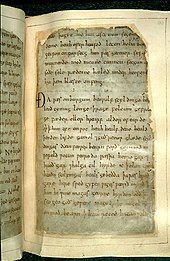
  • v
  • t
  • e

Part of a series on the

History of Afghanistan

Timeline

show

Ancient

show

Medieval

show

Modern

show

Related historical regions

show

Related topics

  • Category
  • flag Afghanistan portal
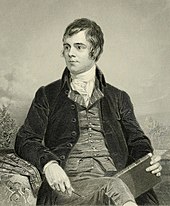
  • v
  • t
  • e

The culture of Afghanistan[1][2] has persisted for over three millennia, tracing record to at least the time of the Achaemenid Empire in 500 BCE,[3] and encompasses the cultural diversity of the nation. Afghanistan's culture is historically strongly connected to nearby Persia, including the same religion, as the people of both countries have lived together for thousands of years. Its location at the crossroads of Central, South and Western Asia historically made it a hub of diversity, dubbed by one historian as the "roundabout of the ancient world".[4]

Afghanistan is a mostly tribal society with different regions of the country having their own subculture. Despite this, nearly all Afghans follow Islamic traditions, celebrate the same holidays, dress the same, consume the same food, listen to the same music and are multi-lingual to a certain extent. Its culture is strongly tied with elements of Turko-Persian and Indo-Persian cultures,[5][6] which can be seen in the likes of language, cuisine or classical music.

Afghan culture is increasingly becoming a dynamic realm of academic study in scholarly terms.[7] In more recent history, Afghan culture has been threatened and fragmented due to the prolonged conflict in the country.[8][9]

History[edit]

See also: History of Afghanistan

[icon]

This section needs expansion. You can help by adding to it. (August 2023)

Music and dance[edit]

Main article: Music of Afghanistan

Afghan musicians in Farah, Afghanistan.

Traditionally, only men have been involved in theater acting. Recently, in theater arts, women have begun to take center stage.[10]

Since the 1980s, the nation has witnessed several wars so music has been suppressed and recording for outsiders minimal. During the 1990s, the Taliban government banned instrumental music and much public music-making. Many musicians and singers continued to play their trade in the cities of other countries. Pakistani cities such as Peshawar, Karachi and Islamabad are important centers for the distribution of Afghan music. Kabul has long been the regional cultural capital, but outsiders have tended to focus on the cities of Herat and Mazar-e-Sharif with its Qataghani style. Lyrics across the country are typically in both Dari-Persian and Pashto, Uzbeki, Hazaragi, Hindi, and western style songs and music are also very popular in Afghanistan.[11]
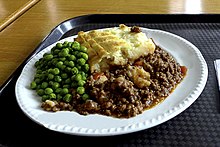
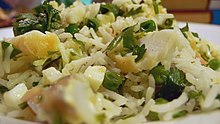
Women dancing in traditional dress in San Francisco

Afghans enjoy music by playing many types of instruments. They also enjoy performing the Attan, which is considered the national dance of Afghanistan. What is typically heard in the country are folk songs or ballads. Many of the songs are known by almost everyone and have been around for many years. The main traditional Afghan music instruments include:

  • Harmonium
  • Santur
  • Chang
  • Rubab
  • Tabla
  • Sitar
  • Zurna
  • Flute
  • Dayereh
  • Tanbur[12]
  • Dambura

Language and literature[edit]

Main article: Afghan literature

Dari and Pashto are both the official languages of Afghanistan,[2] although Dari (Afghan Persian) serves as the lingua franca for the majority. People in the northern and central areas of the country usually speak Persian/Dari, while those living in the south and east speak Pashto. Afghans living in the western regions of Afghanistan speak both Dari and Pashto. Most citizens are fluent in both languages, especially those living in major cities where the population is multi-ethnic. Several other languages are spoken in their own regions, which includes Uzbek, Turkmen and Balochi.[2] English is gradually becoming popular among the young generation. There are smaller number of Afghans who can understand Russian, mainly among the northern Tajik, Uzbek and Turkmen groups.

Poetry[edit]

Main article: Poetry of Afghanistan

Poetry in Afghanistan has long been a cultural tradition and passion. It is mainly in Persian/Dari and Pashto languages, although in modern times it is also becoming more recognized in Afghanistan's other languages. Classic Persian and Pashto poetry plays an important role in the Afghan culture. Poetry has always been one of the major educational pillars in the region, to the level that it has integrated itself into culture. Some notable poets include Khushal Khan Khattak, Rahman Baba, Massoud Nawabi, Nazo Tokhi, Ahmad Shah Durrani, and Ghulam Muhammad Tarzi.[13] Some of the famous Persian-language poets and authors from the 10th to 15th centuries are Rumi, Rabi'a Balkhi, Khwaja Abdullah Ansari, Jami, Alisher Navoi, Sanai, Abu Mansur Daqiqi, Farrukhi Sistani, Unsuri, and Anvari. Contemporary Persian language poets and writers include Khalilullah Khalili[14] and Sufi Ashqari.[15]

Proverbs[edit]

Main article: Afghan proverbs

Afghans prize wit and cleverness in speech. "Zarbul Masalha" (pronounced zar-bull mah-sal-HAA) means "proverbs" in Dari, and these zarbul masalha deeply reflect Afghan culture. U.S. Navy Captain Edward Zellem pioneered the use of Afghan proverbs as a positive relationship-building tool during the war in Afghanistan, and in 2012 he published two bilingual collections of Afghan proverbs in Dari and English.[16][17]

afighinstan  food

Afghan cuisine is influenced to a certain extent by Persian, Central Asian and Indian cuisines due to Afghanistan's close proximity and cultural ties.[1][2] The cuisine is halal and mainly based on mutton, beef, poultry and fish with rice and Afghan bread. Accompanying these are common vegetables and dairy products, such as milk, yogurt, and whey,[3] and fresh and dried fruits such as apples, apricots, grapes, bananas, oranges, plums, pomegranates, sweet melons, and raisins.[4] The diet of most Afghans revolves around rice-based dishes, while various forms of naan are consumed with most meals.[5] Tea is generally consumed daily in large quantities, and is a major part of hospitality.[6] The culinary specialties reflect the nation's ethnic and geographic diversity. The national dish of Afghanistan is Kabuli palaw, a rice dish cooked with raisins, carrots, nuts, and lamb or beef.[7]

Background[edit]

Location of Afghanistan in Asia

The cuisine of Afghanistan is halal and has elements from various places, for example garam masala from India, coriander and mint from Iran, dumplings and noodles from Uzbekistan and Xinjiang, China, and baklava from Turkey.[8][9] The similarities can be seen in the use of spices like cumin and cinnamon (as in Indian cuisine), green cardamom flavors (as in Chinese tea), and kebabs and yoghurts (as in Turkish and Arab cuisines).[10]

Staple foods[edit]

Rice[edit]

Afghan Kabuli palaw

Rice with kofta (meatballs) and corn

Rice is a core staple food in Afghan cuisine and the most important part of any meal.[9] Biryani is one of the less popular rice dishes in Afghanistan. It is consumed mostly in cities closer to neighboring Pakistan, such as Kandahar, Jalalabad and Khost. Challow, or white rice cooked with mild spices,[11] is served mainly with qormas (korma: stews or casseroles). Palaw is cooked similarly to challow, but a combination of meat, stock, qorma, and herbs are also mixed in before baking, resulting in the elaborate colors, flavors, and aromas from which the rice got its name. Sometimes caramelized sugar is used to give the rice a rich brown color. Examples of palaw include:

  • Kabuli palaw (the national dish[7]) – meat and stock are added, plus a topping of fried raisins, slivered carrots, and pistachios
  • Yakhni palaw – meat and stock are added to give the rice a brown color
  • Zamarod palaw – spinach qorma is mixed in before the baking process, hence zamarod, meaning "emerald"
  • Bore palaw – lawand is added giving the rice a yellow color
  • Landi palaw – a traditional meal of rice (with stock made from chicken or mutton that has been salted and dried in the sun)
  • Bonjan-e-roomi palaw – bonjan-e-roomi (tomato qorma) is added during baking giving the rice a red color
  • Serkah palaw – similar to yakhni pulao, but with vinegar and other spices
  • Shibet palaw – fresh dill and raisins are added during baking
  • Narenj palaw – a sweet elaborate rice dish made with saffron, orange peel, pistachios, almonds, and chicken
  • Maash palaw – a strictly vegetarian sweet-and-sour pilaf baked with mung beans, apricots, and bulgur wheat
  • Alou balou palaw – a sweet rice dish with plums and chicken

Afghan bread[edit]

This section is in list format but may read better as prose. You can help by converting this section, if appropriate. Editing help is available. (February 2022)

Naan (bread) from a local baker, the most widely consumed bread in Afghanistan

Afghan bread is flat and cooked in a tanoor or tandoor (a vertical ground clay oven). The bread is slapped onto a stone wall to cook. Tabakhai is a flatbread cooked on a flat upside-down pan.

Major dishes[edit]

Steamed dumplings[edit]

Mantu in a steamer before cooking

Afghan aushak

There is a wide variety of dumplings. Known under the name khameerbob and often eaten as dumplings, these native dishes are popular. Due to the long time required to make the dough for the dumplings, they are rarely served at large gatherings, such as weddings. They are instead served on special occasions at home.[citation needed]

  • Aushak – dumplings filled with a mixture consisting mainly of leeks, topped with either garlic-mint qoroot or a garlic yogurt sauce, sautéed tomatoes, red kidney beans, and a well-seasoned ground-meat mixture (It is a dish associated with Kabul, the capital of Afghanistan.)
  • Mantu – steamed dumplings filled with onion and ground beef or lamb, usually topped with a tomato- and yogurt- or qoroot-based sauce and then garnished with dried mint and coriander (The yogurt-based topping is usually a mixture of yogurt, garlic, and split chickpeas. The qoroot-based sauce is made of goat's cheese and also mixed with garlic; a qoroot and yogurt mixture will sometimes be used.)

Qormah[edit]

This section is in list format but may read better as prose. You can help by converting this section, if appropriate. Editing help is available. (February 2022)

Qormah (also spelled "korma" or "qorma") is an onion- and tomato-based stew or casserole usually served with challow rice.[3] First, onion is caramelized, for a richly colored stew. Then tomato is added, along with a variety of fruits, spices, and vegetables, depending on the recipe. The main ingredient, which can be meat or other vegetables, is added last. There are hundreds of different types of qormahs including:

  • Qormah e gosht (meat qormah) – usually the main qormah served with palaw at gatherings
  • Qormah e alou-bokhara wa dalnakhod – onion-based using veal or chicken, sour plums, lentils, and cardamom
  • Qormah e nadroo – onion-based, using lamb meat or veal, yogurt, lotus roots, cilantro, and coriander
  • Qormah e lawand – onion-based, using chicken, lamb, or beef, plus yogurt, turmeric, and cilantro
  • Qormah e sabzi – lamb, sautéed spinach, and other greens
  • Qormah e shalgham – onion-based using lamb, turnips, and sugar (sweet and sour taste)

Kabob[edit]

Kofta kabob with naan

Afghan kabob is most often found in restaurants and at outdoor street vendor stalls. Most of the time, it contains lamb meat. Kabob is made with naan instead of rice. Customers have the option to sprinkle sumac or ghora (dried ground sour grapes) on their kabob. Pieces of fat from the sheep's tail (jijeq) are usually added to the skewers to add extra flavor.

Chopan kabob being prepared

Other popular kabobs include the lamb chop, ribs, kofta (ground beef), and chicken.

Chapli kebab, a specialty of eastern Afghanistan, is a patty of minced beef. It is a popular barbecue meal in both Pakistan and Afghanistan. It is prepared flat and round and served with naan. The original recipe of chapli kabob dictates a half-meat, half-flour mixture which renders it lighter in taste and less expensive.

armania culture

Armenian literature began in 405 A.D. when Mesrop Mashtots created the Armenian alphabet,[1] according to tradition, probably basing it on the Pahlavi and Greek alphabets.[2] Movses Khorenatsi (Moses of Khorene) was a prominent Armenian writer of the 5th century and the author of the History of the Armenians.

Modern writers include the Russian-Armenian author, poet, and philosopher Mikael Nalbandian, who worked to create a new Armenian literary identity in the 19th century.

Movses Khorenatsi

Mesrop Mashtots (19th century painting)

Dance[edit]

Main article: Armenian dance

Traditional Armenian Dance

Yarkhushta performed by Karin folk dance troupe from Yerevan.

From the fifth to the third millennia B.C., in the higher regions of Armenia there are rock paintings of scenes of country dancing.[3]

The energetic Armenian Yarkhushta is a martial dance mentioned in the medieval works of Movses Khorenatsi, Faustus of Byzantium, and Grigor Magistros.[4] It has traditionally been danced by Armenian soldiers before combat engagements, partly for ritualistic purposes, and partly in order to cast off fear and boost battle spirit.[5]

The dance is performed by men, who face each other in pairs. The key element of the dance is a forward movement when participants rapidly approach one another and vigorously clap onto the palms of hands of dancers in the opposite row.[4]

Architecture[edit]

Main article: Armenian architecture

Two 16th-century khachkars ("cross-stones") from the Julfa cemetery, now at Etchmiadzin

Etchmiadzin Cathedral, regarded as one of the oldest cathedrals in the world (tradionally, between 301 and 303 CE).[6]

The Armenian Tatev Monastery

Classical Armenian architecture is divided into four separate periods. The first Armenian churches were built between the 4th and 7th centuries, beginning when the Armenian monarchy converted to Christianity and ending with the Arab invasion of Armenia.[7] The early churches were mostly simple basilicas, some with side apses. By the 5th century the typical cupola cone in the center had become widely used. By the 7th century, centrally-planned churches were built with a more complicated niched buttress and radiating Hripsime style. By the time of the Arab invasion most of classical Armenian architecture had formed.

Carpets[edit]

Main article: Armenian carpet

Armenian vishapagorg (dragon-carpet) style Artsakh carpet[8] from Shushi, 1813

Armenian rugs at Vernissage market in Yerevan

Various rug fragments have been excavated in Armenia dating back to the 7th century BC or earlier. Complete rugs, or nearly complete rugs of this period have not yet been found. The oldest, single, surviving knotted carpet in existence is the Pazyryk carpet. Although claimed by many cultures, this square tufted carpet, almost perfectly intact, is considered by many experts to be of Caucasian, specifically Armenian, origin. The rug is woven using the Armenian double knot, and the red filaments color was made from Armenian cochineal.[9][10][11][12] Traditionally, since ancient times the carpets were used in Armenia to cover floors, decorate interior walls, sofas, chairs, beds and tables.[13] The Armenian words for carpet are "karpet" (Armenian: կարպետ)[14] or "gorg" (Armenian: գորգ).[15] Though both words in Armenian are synonymous, word "karpet" is mostly used for non-pile rugs and "gorg" is for a pile carpet. Though women historically dominated carpet-weaving in Armenian communities, several prominent carpet-weavers in Karabakh are known to have been men, and in some cases whole families took up the art. The oldest extant Armenian carpet from the region, referred to as Artsakh during the medieval era, is from the village of Banants (near Gandzak) and dates to the early 13th century.[16] The first time that the Armenian word for pile carpets, gorg, was used in historical sources was in a 1242-1243 Armenian inscription on the wall of the Kaptavan Church in Artsakh.[8]

Art historian Hravard Hakobyan notes that "Artsakh carpets occupy a special place in the history of Armenian carpet-making. Common themes and patterns found on Armenian carpets were the depiction of dragons and eagles. They were diverse in style, rich in color and ornamental motifs, and were even separated in categories depending on what sort of animals were depicted on them, such as artsvagorgs (eagle-carpets), vishapagorgs (dragon-carpets) and otsagorgs (serpent-carpets). The rug mentioned in the Kaptavan inscriptions is composed of three arches, "covered with vegatative ornaments", and bears an artistic resemblance to the illuminated manuscripts produced in Artsakh.[8]

The art of carpet weaving was in addition intimately connected to the making of curtains as evidenced in a passage by Kirakos Gandzaketsi, a 13th-century Armenian historian from Artsakh, who praised Arzu-Khatun, the wife of regional prince Vakhtang Khachenatsi, and her daughters for their expertise and skill in weaving.[17]

Armenian carpet was also renowned by foreigners who traveled to Artsakh; the Arab geographer and historian Al-Masudi noted that, among other works of art, he had never seen such carpets elsewhere in his life.[18]

Art[edit]

Main pages: Armenian art, List of museums in Yerevan, and Category:Art museums and galleries in Armenia

The National Art Gallery in Yerevan has more than 16,000 works that date back to the Middle Ages. The National Gallery of Armenia, Modern Art Museum of Yerevan, and the Matenadaran are three examples of museums displaying various forms of visual art.

Armenian Needlelace circa 2004

Lacemaking[edit]

This section does not cite any sources. Please help improve this section by adding citations to reliable sources. Unsourced material may be challenged and removed. (October 2023) (Learn how and when to remove this template message)

Like Lacis, Armenian needlelace seems to be an obvious descendant of netmaking. Where lacis adds decorative stitches to a net ground, Armenian needlelace involves making the net itself decorative. There is some archaeological evidence suggesting the use of lace in prehistoric Armenia and the prevalence of pre-Christian symbology in traditional designs would certainly suggest a pre-Christian root for this art form. In contrast to Europe where lace was the preserve of the nobility, in Armenia it decorated everything from traditional headscarves to lingerie. Thus lacemaking was part of many women's lives.

Theater[edit]

Main article: Theater of Armenia

Born in Cairo, Egypt, Atom Egoyan is now an internationally known filmmaker who is celebrated for his contemporary work, including personal feature films and other related projects. He is the winner of many awards at international film festivals, such as the Grand Prix and international Critics' Awards from the Cannes Film Festival and two Academy Award nominations for "The Sweet Hereafter". Egoyan has also worked in the television and theatre industries, producing Wagner's Die Walkure which was performed by the Canadian Opera Company in April 2004.[19] Egoyan's creation Ararat (2002) is about the 1915 Armenian Genocide perpetrated by Turks in the Turkish Ottoman Empire. It depicts the consequences and suffering of a child survivor Arshile Gorky, and is an incredibly made-movie for both Armenians and non-Armenians.[20]

Music[edit]

Main article: Music of Armenia

Duduk player and a singer

One of the most important parts of Armenian culture is the music, which has brought new forms of music in recent years, while maintaining traditional styles too. This is evidenced by the world-class Armenian Philharmonic Orchestra that performs at the beautifully refurbished Aram Khachaturian Concert Hall in the Yerevan Opera House, where one can also attend a full season of opera. In addition, several chamber ensembles are highly regarded for their musicianship, including the Komitas Quartet, Hover Chamber Choir, National Chamber Orchestra of Armenia and the Serenade Orchestra. Classical music can also be heard at one of several smaller venues, including the Yerevan State Musical Conservatory, the Komitas Chamber Music Hall and the Komitas Museum. Jazz is popular in Armenia, especially in the summer when live performances are a regular occurrence at one of the city's many outdoor cafés and parks. Armenian rock has made its input to the rock culture. The most known Armenian traditional instrument is the Ծիրանափող, meaning apricot flute, also known as duduk (pronounced [duˈduk] or doo-dook).

Modern day Armenian artists have incorporated folk music into more modern jazz and rock genres so that the traditional music still influences their creations, such as Zartong a late 70's Armenian progressive folk band based out of France.[21]

Inga and Anush Arshakyans are an unexpected duo who create ethno, contemporary tracks that are also full of Armenian spirit. After graduating from the Yerevan State Conservatory, the singers started performing together on the professional stage in 2000. Later, in 2009 Inga & Anush represented Armenia in the Eurovision Song Contest in Moscow. They ended up taking the tenth place with 92 points. Their music is a balanced fusion of Armenian folk music, rock, jazz and other contemporary genres.[22]

Another singer from Yerevan, Armenia who is popular among young adults is Armen Gondrachyan, more famously known as 'Armenchik'. The influence of his father, who was also a singer, inspired Armen to start singing at the young age of seven. In 1989, Armen and his family moved to the United States, while in 1995, at the age of fifteen, he found a band and recorded his first album.[citation needed] In 1988, Armen went back to his hometown in Armenia and lived there for a year, and at the same time released the album, "Armen, memories from Armenia." This release initiated his path to star-dom.[23] With his current fame, Armen is still very dedicated to the Armenian community. It was in October 2003 that he had his first concert in Glendale, California. The concert was a sellout, and in that same year, Armen received an award for the best-selling album of the year, "Anunt Inche".[24]

Isabel Bayrakdarian is an opera singer of Armenian descent and is now known and popular both among Armenians and non-Armenians. She graduated from the University of Toronto with a degree in biomedical engineering, but has become very successful in North America as an opera singer and an active concertizer. She is featured on the Grammy-award-winning soundtrack of the film, the Lord of the Rings: The Two Towers. Bayrakdarian is also the winner of four Juno Awards for Best Classical Album (Vocal). Further, she is a featured vocalist of Atom Egoyan's movie, Ararat, in collaboration with the band "Delerium", which brought in another Grammy nomination.[25]

Şahan Arzruni is an internationally renowned concert pianist, born in Istanbul, Turkey. Through his live performances and sound recordings he has disseminated the Armenian piano music throughout the world. He has some two dozen recordings, devoted mostly to the works of Armenian composer. Arzruni is also an author, a lecturer, a producer and impresario. He has been awarded two medals by the Armenian government for furthering Armenian culture. He lives in New York City.[citation needed]

Since 2014, The Naghash Ensemble has been touring in Europe performing new music by American-Armenian composer John Hodian based on sacred Armenian poetry by the medieval painter, poet and priest Mkrtich Naghash. With three female vocalists, duduk, oud, dhol and piano, The Naghash Ensemble combines new classical music and post-minimaslism with Armenian folk and spiritual music.

Cinema[edit]

Main article: Cinema of Armenia

Moscow Cinema in Yerevan

Soviet Armenia (1924) was the first Armenian documentary film. Namus was the first Armenian silent black and white film (1926, Namus at IMDb Edit this at Wikidata), directed by Hamo Beknazarian and based on a play of Alexander Shirvanzade describing the ill fate of two lovers, who were engaged by their families to each other since childhood, but because of violations of namus (a tradition of honor), the girl was married by her father. In 1969, Sergei Parajanov created The Color of Pomegranates.

armania food

Armenian cuisine (Armenian: Հայկական խոհանոց) includes the foods and cooking techniques of the Armenian people and traditional Armenian foods and drinks. The cuisine reflects the history and geography where Armenians have lived and where Armenian empires existed. The cuisine also reflects the traditional crops and animals grown and raised in Armenian-populated or controlled areas.

The preparation of meat, fish, and vegetable dishes in an Armenian kitchen often requires stuffing, frothing, and puréeing.[1] Lamb, eggplant, and bread (lavash) are basic features of Armenian cuisine. Armenians traditionally prefer cracked wheat to maize and rice. The flavor of the food often relies on the quality and freshness of the ingredients rather than on excessive use of spices.

Fresh herbs are used extensively, both in the food and as accompaniments. Dried herbs are used in the winter when fresh herbs are not available. Wheat is the primary grain and is found in a variety of forms, such as whole wheat, shelled wheat, bulgur (parboiled cracked wheat), semolina, farina, and flour. Historically, rice was used mostly in the cities and in certain rice-growing areas (such as Marash and the region around Yerevan). Legumes are used liberally, especially chick peas, lentils, white beans, and kidney beans. Nuts are used both for texture and to add nutrition to Lenten dishes. Of primary usage are not only walnuts, almonds, and pine nuts, but also hazelnuts, pistachios (in Cilicia), and nuts from regional trees.[2]

Fresh and dried fruit are used both as main ingredients and as sour agents. As main ingredients, the following fruits are used: apricots (fresh and dried), quince, melons, and others. As sour agents, the following fruits are used: sumac berries (in dried, powdered form), sour grapes, plums (either sour or dried), pomegranate, apricots, cherries (especially sour cherries), and lemons. In addition to grape leaves, cabbage leaves, chard, beet leaves, radish leaves, strawberry leaves, and others are also stuffed.

Background

A typical meal in an Armenian household might consist of bread, butter, buttermilk, cheese, fresh and pickled vegetables, and radishes. Lunch might include a vegetable or meatball soup with sour milk.[3]

Lamb, yogurt, eggplant and bread are basic features of the Armenian cuisine, but there are some regional differences. In Soviet cookbooks the Armenian cuisine is always stated to be the oldest of Transcaucasia and one of the oldest in all of Asia. Armenian dishes make use of cracked wheat, while Georgian variations use maize. Armenian cuisine also makes use of mixed flours made from wheat, potato and maize, which produces flavors that are difficult to replicate. Armenians tail fat dmak.[4] Archaeologists have found traces of barley, grapes, lentils, peas, plums, sesame, and wheat during excavations of the Erebuni Fortress in Yerevan.[5]

Herbs are used copiously in Armenian cuisine, and Armenian desserts are often flavored with rose water, orange flower water and honey.[4] Salads are a staple of the Armenian diet, along with various yogurt soups and lamb stews, which sometimes include apricots.[3] Pomegranate juice is a popular beverage.[6] Murat Belge has written that both Armenian and Iranian cuisines have meat and fruit dishes, where meat is cooked together with fruits like quince and plums, which are uncommon in Ottoman cuisine.[7]

Mezes made with chickpeas, lentils, beans and eggplants play a role in Armenian cuisine, often served with traditional lavash bread. Lavash may also be used as a wrap for various combinations of fried meat, vegetables, cheese and herbs.[3] Armenian cuisine also features filled pastry pies called boereg, various types of sausages, toasted pumpkin seeds, pistachios, pine nuts, basturma, and dolma.[4]

Cinnamon is a very commonly used spice in Armenian cuisine; it is sprinkled on soups, breads, desserts and sometimes even fish. Salads are served with a lemon-cinnamon dressing alongside as an accompaniment to meat kebabs.[5] In a survey of Armenian-American cuisine, ginger was rated an important spice.[8][3]

Sources

Armenians were affected by the ongoing Ottoman–Persian Wars (one text laments "The whole land is enslaved by the cursed Suleyman") and produced many literary works in the 16th and 17th centuries emphasizing the Christian identity of Armenians in troubled Anatolia. Food became a central theme in this body of Armenian literature. Despite prohibitions in early Armenian law codes against Armenians eating or drinking with Muslims, a "sort of blasphemous" 17th century Armenian drinking song describes a feast in Van attended by Armenian priests, laymen and Turks, with the refrain repeating "Intercede to the great barrel, bountiful is its wine."[9] The poem contains many Armenian terms for common foods. Some of the terms found in Andreas are:

  • Halva
  • Porak
  • Paxlava
  • Herisa
  • Lahana
  • K'ufta
  • Xorovac

Ardashes H. Keoleian authored the Oriental Cookbook (1913) is a collection of recipes from the Middle East "adapted to American tastes and methods of preparation" is a mixed collection of recipes that includes some recipes from the Armenian cuisine.[10]

Armenian-American cookbook author Rose Baboian made her collection of traditional Armenian recipes accessible for young, English-speaking Armenians. Mark Zanger, a Boston-based food reporter, wrote that Baboian's book "stands out as a model of American ethnic food because she recorded so many traditions".[11] She is considered to have anticipated Armenian American fusion cooking with recipes like "chocolate yogurt".[12]

Grains and legumes

Grains used in traditional Armenian cuisine included millet, wheat, barley, rye, peas and maize. Various legumes were also consumed such as lentils, chickpeas, and beans.[13]

Grains are used for a variety of purposes: traditional lavash bread is made from wheat flour and grains are also added to soups to give them a thicker consistency.[3] Lavash is baked in a traditional clay tonir oven. Bread is a very important staple of Armenian cuisine.[5]

Kofta can be made with bulgur, finely chopped vegetables, herbs and often lamb. There are variations intended to be eaten cold or served hot. Sini keufteh is a dish similar to kibbeh, but layered and baked in a baking dish. The two outer layers are made with bulgur, lamb mince, onion and spices. The inner filling includes butter, onion, lamb mince, pine nuts and spices.[14]

Armenian Harissa

Harissa (Armenian հարիսա harisa, also known as ճիտապուր) is a thick porridge made of wheat and meat cooked together for a long time, originally in the tonir but nowadays over a stove. Ardashes Hagop Keoleian called it the "national dish" of Armenians.[15] Traditionally, harissa was prepared on feast days in communal pots. The wheat used in harissa is typically shelled (pelted) wheat, though in Adana, harissa is made with կորկոտ (korkot; ground, par-boiled shelled wheat). Harissa can be made with lamb, beef, or chicken. A small piece of butter is often put at the top of the harissa.[16]

A common dish of Armenian cuisine is pilaf (եղինձ; yeghints). Pilaf is a seasoned rice, bulgur, or shelled wheat dish often served with meats such as lamb or beef. Armenian recipes may combine vermicelli or orzo with rice cooked in stock seasoned with mint, parsley and allspice.[17] One traditional Armenian pilaf is made with the same noodle rice mixture cooked in stock with raisins, almonds and allspice.[18] Armenian rices are discussed by Rose Baboian in her cookbook from 1964 which includes recipes for different pilafs, most rooted in her birthplace of Aintab in Turkey.[19] Baboian recommends that the noodles be stir-fried first in chicken fat before being added to the pilaf. Another Armenian cookbook written by Vağinag Pürad recommends to render poultry fat in the oven with red pepper until the fat mixture turns a red color before using the strained fat to prepare pilaf. Pilaf made with bulgur and liver is a specialty of Zeytun (present day Süleymanlı).[20]

Lapa prepared with poppy seeds.

Lapa is a kind of savory rice porridge or gruel eaten in Armenia, but it also is an Armenian word with several meanings.[21] One of which is "watery boiled rice, thick rice soup, mush" and lepe which refers to various rice dishes differing by region.[22] Antranig Azhderian describes Armenian pilaf as "dish resembling porridge".[23]

In Agn (present-day Kemaliye) a thin flatbread calling loshig was baked and dried. It would be wetted again before being eaten. Badjoug was a pastry of fat and flour stamped with designs and sent as a wedding invitation. Glodj was unleavened bread made for Lent and klrdig was a bread made of semolina.[24]

Herbs, spices and sauces

Armenians make extensive use of various herbs in their dishes. One porridge prepared from cereals and wild herbs is called kerchik. (The same name is used by Yazidis.) Armenians usually eat kerchik with pickled cabbage, whereas Yazidis eat it with knotgrass (Polygonum aviculare).[25] The Eastern Anatolia region, where many Armenians lived prior to the Armenian genocide, has an immensely rich plant biodiversity with over 3,000 vascular plant taxa—of these almost 800 are endemic species. The inhabitants of this region often lived in inaccessible area and were dependent on local cultivated and wild flora. Some of the most important areas of the region, in terms of plant diversity, include Harput, Lake Hazar and Munzur.[26]

In Armenia there are more than 3,600 wild plant species. Those include stinging nettle (mostly used for tea), asparagus and mallow an herb that formed the original basis for marshmallows.[27]

Commonly used spices include black pepper, sumac, cumin, caraway, cardamom, mahleb, clove, anise, curcuma, fennel, fenugreek, blue fenugreek, allspice, ziziphora, saffron, paprika, cayenne, and cinnamon.[28] Some greens were dried and used to season cooking including garlic, spinach, parsley, mint, coriander, dill, summer savory, thyme, tarragon, leek, chive, celery, marjoram, bay leaves, and basil.[29][30] Red pepper pulp was dried in the sun. Sprigs of terebinth were dried and infused in a mixture of water, olive oil and brine, then toasted and ground. The ground terebinth was added as a seasoning for eetch, tabouleh, and baked breads.[31][32]

An Armenian spice mix called cemen (Armenian: չաման), that consists of caraway, paprika, blue fenugreek, fenugreek, black pepper, allspice, cumin, garlic, salt, and cayenne (optional). When used as a marinade, (mostly for basturma) the spice blend is added to tomato paste, parsley, crushed garlic cloves, and either olive oil, or matzoon.[33][34][35] A sweet Armenian “spice mix” called khoritz, which is used to prepare Armenian desserts like Gata or Nazook, is made of sugar, flour, and butter. In some variations walnuts are added.[36][37]

One Armenian sauce that is also the base of some Armenian dishes, is Lecho (Armenian: լեչո). It is made with tomato, peppers/paprika, parsley and salt, and it is usually served hot.[38] Red jajek (Armenian: կարմիր ջաջիկ), also called matsnaprtosh (Armenian: մածնաբրդոշ matsnaprt'oš) in Artsakh, is a yogurt sauce made with matzoon, sour cream, red beet, onion, garlic, cucumber(optional), black pepper, dill, and coriander.[39] Matzoon alone can also be used as a sauce, and when used as one, spices and herbs are often added to it. Other popular sauces in that are used in Armenian cuisine include ajika, and jajek.[40][41]

Dairy and cheese

Armenian lori cheese

Typical dairy items were present in the Armenian cuisine such as matzoon, strained yogurt, butter, cream, and cheese.[31]

pakistan culture

The culture of Pakistan (Urdu: پاکستانی ثقافت Pākistāni S̱aqāfat) is based in the Indo-Persian cultural matrix that constitutes a foundation plank of South Asian Muslim identity.[1] The region has formed a distinct cultural unit within the main cultural complex of South Asia, Middle East and Central Asia.[2][3] There are differences in culture among the different ethnic groups in matters such as dress, food, and religion, especially where pre-Islamic customs differ from Islamic practices.

The existence of Pakistan as an Islamic state since 1956 has led to the large-scale injection of Islam into most aspects of Pakistani culture and everyday life, which has accordingly affected the historical values and traditions of the Muslim-majority population. Marriages and other major events are significantly affected by regional differences in culture, but generally follow Islamic jurisprudence where required. [citation needed]

Civil society in Pakistan is largely hierarchical, emphasising local cultural etiquette and traditional Islamic values that govern personal and political life. The basic family unit is the extended family,[4] although for socio-economic reasons there has been a growing trend towards nuclear families.[5] The traditional dress for both men and women is the shalwar kameez; trousers, jeans, and shirts are also popular among men.[6] In recent decades, the middle class has increased to around 35 million and the upper and upper-middle classes to around 17 million, and power is shifting from rural landowners to the urbanised elites.[7] Pakistani festivals, including Eid-ul-Fitr, Eid-ul-Azha, Ramazan, Christmas, Easter, Holi, and Diwali, are mostly religious in origin.[4] Increasing globalisation has resulted in Pakistan ranking 56th on the A.T. Kearney/FP Globalization Index.[8]

Literature[edit]

Main articles: Pakistani literature, List of Urdu-language poets, and Pakistani poetry

Muhammad Iqbal

Muhammad Iqbal, Pakistan's national poet who conceived the idea of Pakistan

Pakistan has literature in Urdu, Sindhi, Punjabi, Pashto, Balochi, Persian, English, and many other languages.[9] The Pakistan Academy of Letters is a large literary community that promotes literature and poetry in Pakistan and abroad.[10] The National Library publishes and promotes literature in the country. Before the 19th century, Pakistani literature consisted mainly of lyric and religious poetry and mystical and folkloric works. During the colonial period, native literary figures were influenced by western literary realism and took up increasingly varied topics and narrative forms. Prose fiction is now very popular.[11][12]

The national poet of Pakistan, Muhammad Iqbal, wrote poetry in Urdu and Persian. He was a strong proponent of the political and spiritual revival of Islamic civilisation and encouraged Muslims all over the world to bring about a successful revolution(regarding to the freedom from Hindus).[13] Well-known figures in contemporary Pakistani Urdu literature include Josh Malihabadi Faiz Ahmed Faiz and Saadat Hasan Manto. Sadequain and Gulgee are known for their calligraphy and paintings.[12] The Sufi poets Shah Abdul Latif, Bulleh Shah, Mian Muhammad Bakhsh, and Khawaja Farid enjoy considerable popularity in Pakistan.[14] Mirza Kalich Beg has been termed the father of modern Sindhi prose.[15] Historically, philosophical development in the country was dominated by Muhammad Iqbal, Sir Syed Ahmad Khan, Muhammad Asad, Maududi, and Mohammad Ali Johar.[16]

Ideas from British and American philosophy greatly shaped philosophical development in Pakistan. Analysts such as M. M. Sharif and Zafar Hassan established the first major Pakistani philosophical movement in 1947.[clarification needed][17] After the 1971 war, philosophers such as Jalaludin Abdur Rahim, Gianchandani, and Malik Khalid incorporated Marxism into Pakistan's philosophical thinking. Influential work by Manzoor Ahmad, Jaun Elia, Hasan Askari Rizvi, and Abdul Khaliq brought mainstream social, political, and analytical philosophy to the fore in academia.[18] Works by Noam Chomsky have influenced philosophical ideas in various fields of social and political philosophy.[19]

Performing arts[edit]

Music[edit]

Main article: Music of Pakistan

A sitar workshop in Islamabad, Pakistan.

Pakistani music ranges from diverse forms of provincial folk music and traditional styles such as Qawwali and Ghazal Gayaki to modern musical forms that fuse traditional and western music.[20] Pakistan has many famous folk singers. The arrival of Afghan refugees in the western provinces has stimulated interest in Pashto music, although there has been intolerance of it in some places.[21]

Dances[edit]

Pakistan has various regional dances including:

Punjabi[edit]

Main article: Folk dances of Punjab

  • Luddi - Pothohari folk dance, mostly performed on weddings
  • Dahamal – Punjabi folk dance (The dance is rooted in Sufi trance dances on trance drum beats)
  • Bhangra – Punjabi folk dance
  • Jhumar – Saraiki folk dance

Balochi[edit]

  • Chaap – Baloch folk dance performed at weddings

Pashtun[edit]

  • Attan – Folk dance of Pashtuns tribes of Pakistan including the unique styles of Quetta and Waziristan
  • Khattak Dance – Sword dance of Khattak tribe in Khyber Pakhtunkhwa

Sindhi[edit]

Main article: Folk dances of Sindh

Artistic depiction of Sindhi soldiers during medieval times

  • Jamalo – Sindhi dance.
  • Jhumir: wedding dance.
  • Dhamal: performed by Sindhi Sufi devotees on Sufi shrines. The main performance is done by Sufi dervishes who wear long Jamas, special rings, necklaces and Sindhi faqeeri topi or turban.

Drama and theatre[edit]

Main article: Theatre in Pakistan

These are very similar to stage plays in theatres. They are performed by well-known actors and actresses in the Lollywood industry. The dramas and plays often deal with themes from everyday life, often with a humorous touch.

Architecture[edit]

Main article: Pakistani architecture

The Lahore Fort, a landmark built during the Mughal era, is a UNESCO World Heritage Site

The Tomb of Shah Rukn-e-Alam is part of Pakistan's Sufi heritage.[22]

Four periods are recognised in Pakistani architecture: pre-Islamic, Islamic, colonial, and post-colonial. With the beginning of the Indus civilization around the middle of the 3rd millennium BCE,[23] an advanced urban culture developed for the first time in the region, with large buildings, some of which survive to this day.[24] Mohenjo Daro, Harappa, and Kot Diji are among the pre-Islamic settlements that are now tourist attractions.[citation needed] The rise of Buddhism and the influence of Greek civilisation led to the development of a Greco-Buddhist style,[25] starting from the 1st century CE. The high point of this era was the Gandhara style. An example of Buddhist architecture is the ruins of the Buddhist monastery Takht-i-Bahi in Khyber Pakhtunkhwa.[26

pakistan food

Pakistani cuisine (Urdu: پاکستانی پکوان, romanized: pākistānī pakwān) can be characterized as a blend of regional cooking styles and flavours from across South, Central and Western Asia. Pakistani cuisine is influenced by Persian, Indian, and Arab cuisine. The cuisine of Pakistan also maintains certain Mughal influences within its recipes and cooking techniques.[2][3] Pakistan's ethnic and cultural diversity, diverse climates, geographical environments, and availability of different produce lead to diverse regional cuisines.

Pakistani cuisine, as in the food culture of most Muslim nations, is structured around halal principles, which, for example, forbid pork and alcohol consumption in accordance with Sharia, the religious laws of Islam. Many more details of halal regulations apply to meats, which types of animals are acceptable or “clean” for human consumption.

International cuisine and fast food are popular in major cities such as Islamabad[4] and Karachi;[5] blending local and foreign recipes (fusion food), such as Pakistani Chinese cuisine, is also common in large urban centres. As a result of lifestyle changes, health trends, and new dietary research being published, traditional ingredients such as masala (pre-mixed and ready-to-use) and ghee (clarified butter)—with its health benefits and high smoke point—have been increasingly popular.

Historical influences[edit]

Main article: History of Pakistani cuisine

Pakistan's national cuisine directly inherits both Indo-Aryan and Iranic culture coupled with Muslim culinary traditions. Evidence of controlled preparatory cuisine in the region can be traced back to as early as the Bronze Age with the Indus Valley Civilization. Around 3000 BCE, sesame, eggplant, and humped cattle were domesticated in the Indus Valley;[6] spices like turmeric, cardamom, black pepper and mustard were harvested in the region concurrently.[7] For a thousand years, wheat and rice served as basic comestibles in the Indus Valley.[8]

The arrival of Islam in South Asia and intermittent conquests influenced the local cuisine of the region to a great degree. Due to its Muslim-majority population, Pakistan's cuisine sees a strict observance of Islamic dietary laws. Most prominently, forbiddance on the consumption of pork and alcohol by Islamic regulation has shifted the focus of Pakistani cuisine to other types of meat, such as beef, lamb, chicken, and fish, alongside a variety of fruits, vegetables, and dairy.

Elements[edit]

Main articles: Origins of Pakistani foods, List of Pakistani spices, and List of plants used in Pakistani cuisine

Pakistani dishes are known for being aromatic and spicy. Some dishes contain liberal amounts of oil, contributing to a richer, fuller mouthfeel and flavour. Brown cardamom, green cardamom, cinnamon, cloves, nutmeg, mace, star anise and black pepper are the most commonly used spices in the making of a wide variety of dishes throughout Pakistan. Cumin seeds, chili powder, turmeric, and bay leaves are also very popular. In the Punjab province, spice blends are characterized by their use of coriander powder. Garam masala (a mixture of aromatic spices) is a popular blend of spices used in several Pakistani dishes including Bannu Pulao.

Regional cuisines[edit]

Balochistan[edit]

Main article: Balochi cuisine

Balochi cuisine belongs to the Balochistan region of Pakistan. Baloch food has a regional variance in contrast to the many cuisines of Pakistan.[9][10] Among the most popular Balochi dishes are Balochi sajji (skewered lamb or chicken filled with rice), mutton rosh (mutton chops) and dampukht (meat slow-cooked in fats).

Khyber Pakhtunkhwa[edit]

Main article: Pashtun cuisine

Rice dishes and kebabs feature prominently in Pashtun cuisine. Lamb is eaten more often in Pashtun cuisine than any other Pakistani cuisines. Kabuli palaw, Bannu Pulao, Chapli kabab, tika, and mutton karahi are the most famous dishes of the region. Historical variations include Peshawari cuisine. The Pashtun and Balochi cuisines are traditionally non-spicy.

Kalash[edit]

Main article: Kalash cuisine

Kalashi people have a rich food culture that includes various types of breads and cheese. The famous bread is made with flour and different types of nuts. Some breads are bilili (walnut bread), jã'u, (walnut bread), and kurau (flour kindled in crushed grape juice).

Punjab[edit]

Main article: Punjabi cuisine

Since Punjabi identity is considered geographical and cultural, almost all inhabitants of Punjab follow some variations within the cuisine, but on the other hand show many similarities together. This cuisine then falls into the broad category of Punjabi cuisine. Regional cuisine is mutual with some differences in many regions, including the South Punjab regions. Paye/kharoray (made from legs and joints of cow, goat, buffalo or sheep), pulao, saag (mustard leaves), makai roti (maizeflour tortilla) and murgh cholay (chicken and chickpeas slow-cooked) are considered authentic Punjabi specialties in Pakistani cuisines. The most popular Punjabi drink is Lassi.

Sindh[edit]

Main articles: Sindhi cuisine and Cuisine of Karachi

Sindhi cuisine refers to the native cuisine of the Sindhi people from Sindh, Pakistan. Sindhi Cuisine is considered to be very meaty (not many vegetarian dishes) and consists of a variety of chicken dishes. Karhi, daal pakwan, Palo fish and many other. They usually eat less spicy food.

The capital of Sindh Karachi is mixture of all regions. However the same is heavily dominated by the Mughlai, Deccani and other cuisines of Muslims who migrated from present day India post partition of British India in 1947.

Gilgit-Baltistan[edit]

Main articles: Gilgiti cuisine and Balti (food)

Gilgit Baltistan is rich in unique food and dishes, each district of Gilgit Baltistan has their cultural dish that symbolizes the people.

Gilgiti cuisine is the cuisine of Gilgit-Baltistan, Pakistan. Prominent Gilgiti dishes, such as the Chapshoro have gained massive popularity among different parts of Pakistan. Dumplings (Locally called Mumtu) are often served with yogurt and parsley and black pepper, vinegar, chili sauce.

Hunza[edit]

Staple foods like barley, wheat, and millet form the foundation of dishes such as chapshuro and thukpa, hearty soups that provide warmth in the cold climate. Fresh fruits like apricots and cherries are transformed into jams, dried fruits, and juices, while dairy products like yogurt and cheese play a significant role in both savory and sweet offerings. Dishes like buckwheat bread, rosehip oil bread, and almond bread are commonly prepared in Hunza.

Nagar[edit]

Chapshuro is the local alternative of pizza in Nagar. Initially a local product of only Nagar valley, now it is widely prepared in Hunza and other localitises on the Karakoram.

Ghizer[edit]

Ghizer is famous for kelawo (also spelled kilao), walnuts dipped in honey and mulberry juice.

Gilgit[edit]

Dumplings locally called mumtu are well known in Gilgit cuisine. As Gilgit itself is a blend of cultures from neighboring districts like Hunza, Ghizer and Chilas, the cuisines of these regions is also widely found here.

Baltistan[edit]

See also: Hunza diet

Meal structure[edit]

A Sindhi/Punjabi-style woven plate for chapati (flat bread)

Pakistanis generally eat three meals a day, i.e. breakfast, lunch, and dinner. During the evening, many families have tea with snacks. During the Islamic holy month of Ramadan, the eating patterns change to suhur, pronounced “Sehari” in Pakistan, and iftar. It is considered proper to eat only with the right hand, per Islamic tradition (also a tradition in many other Asian cultures). Many Pakistani families, particularly when guests are too many to fit at a table, eat sitting at a cloth known as Dastarkhān, which is spread out on the floor. In Pakistan, many street eateries serve food on a takht, in a style similar to what is seen in Afghanistan. A takht is a raised platform, where people eat their food sitting cross-legged, after taking tith sauce with a piece of baked bread (naan) or rice.

Breakfast[edit]

Having nihari and halwa puri in breakfast is popular among people living in Lahore.

A typical Pakistani breakfast, locally called nāshtā (ناشتہ), consists of eggs (boiled/scrambled/fried/omelette), a slice of loaf bread or roti, parathas, sheermal with tea or lassi, kulcha with chole, qeema (minced meat), fresh seasonal fruits (mangoes, apples, melons, bananas, etc.), milk, honey, butter, jam, shami kebab or nuts. Sometimes breakfast includes baked goods like bakarkhani and rusks. During holidays and weekends, halwa poori and chickpeas are sometimes eaten. In Punjab, sarson ka saag (mustard leaves) and maakai ki roti (cornbread) are local favourites. Punjabi people also enjoy khatchauri, a savory pastry filled with cheese. Pakistan is not unlike many other Asian nations, in the sense that meat dishes are eaten as breakfast, especially on holidays. A traditional Sunday breakfast might be Siri-Payay (the head and feet of lamb or cow) or Nihari (نہاری) (a dish which is cooked overnight to get the meat extremely tender. The name "Nihari" comes from the Arabic word "Nahar", meaning "Day" or "Daybreak".) Many people used to eat "Bong" (Shank curry) in their Sunday brunch.

roman culture

Ancient Roman culture grew through the almost 1200 years of Rome's civilization. The Romans conquered many people and brought back from their wars many things from each land. Their way of life was a mix of many cultures, influences, and religions. Starting in the 2nd century BC, Greek influence became very important. Architecture, painting, sculpture, laws, and literature grew to a high level.[1] Slaves, and Christians were treated differently by different rulers. Rome was a trading nation which kept military control over a wide range of peoples, mostly around the Mediterranean.

Classes[change | change source]

There were four classes of people in Rome: the aristocrats, the equestrians, the common citizens, and the slaves. The aristocrat class had about 300 families, mostly senators. The aristocrat class was very powerful. The equestrians or “equites” were merchants, government builders, and bankers who were usually less rich.[1] The common citizens were farmers, industrial workers, and the city mob. Slaves had to work hard and were usually released when they became old.[1] Some slaves were trained to be gladiators for people to watch. Other slaves worked in rich homes as doorkeepers, litter-bearers, messengers, or servants. Some Greek slaves were teachers who taught their language, or doctors.

Religion[change | change source]

The original Roman religion had many gods, with stories called Roman mythology.

Christianity[change | change source]

At the time of the birth of Jesus, the Roman Empire ruled the entire Mediterranean area.[1] Jesus taught to worship God only. Because Christians worshiped only God and did not join in the festivals to other gods, Romans thought they were unpatriotic.[1] Many Christians were crucified.[1] Romans persecuted them for many years. Sometimes they were killed by animals for a show.

However, Christianity still spread in the Roman Empire. A great change took place when Constantine I became emperor. He moved the capital of the empire to Byzantium, converted to Christianity, and protected Christians from harm. Many Romans continued to worship the old gods.

House[change | change source]

See the main article: Roman house

In the Imperial Age, the poorer Roman houses were built of sun-dried brick. These houses only had one room.[1] In this one room the family slept, ate, and had visitors. Richer people had mansions. Statues and paintings were shown. Small rooms were used as living and dining places. In the center there was a court with a garden. It was decorated with fountains, plants, and flowers.[1] Floors were often made of mosaics, tiles, or marble with lots of different colors.[1] Some walls were painted.[1] Dishes were made of pottery or glass. There was plumbing in some houses and in the public baths, and a sewer system was used.[1] Hot air warmed the house from a heating system. Many rich Romans had two houses, one in the town and one in the country.[1]

Poor people lived in buildings where the top floors were for the poorest. Sometimes they could have as many as 200 steps to reach them.[1] Many fires happened. Buckets of water were used to put out fires, though many times it did not work.[1]

Meals[change | change source]

Poor people ate vegetables, fish, salt, cheese, fruits, nuts, and olive oil. Meat, especially beef, was usually not eaten. Breakfast was usually not eaten and, for lunch, leftovers were used.[1] Rich people ate dinner before four in the afternoon. They usually ate from three to ten hours. Hands were washed between the courses.[1] One emperor served 22 courses at his dinner parties. If visitors were invited to dinner, slaves were sent to bring them on time, because water clocks did not always work the same.[1] People enjoyed eating grapes for dessert. At first, cold clams and oysters were eaten for dessert, but later people ate them at the beginning of a meal instead.

Public baths[change | change source]

The public baths were used not only for bathing. Besides the hot water rooms and cold water rooms, there were gardens, stadiums, art galleries, libraries, and places to eat. There were even underground passageways to get to places more easily. Aqueducts fed water for the baths. They were so well built that some are still used.[1]

The Romans were very proud of their aqueducts. They thought they were better than the "useless" Egyptian pyramids.[1] They also used these for drinking water.

Ships[change | change source]

Big ships called quinqueremes had 300 people to row with oars. They could travel 100 miles (160 km) a day. Trade paths were protected from pirates. Many ships carried food; others carried pearls, pepper, cotton, cinnamon, and silk. A pound of silk, at that time, cost a pound of gold.[1]

Arts[change | change source]

The language of Rome has influenced many cultures. Its influence can be seen in this Latin Bible from 1407.

Language and literature[change | change source]

The native language of the Romans was Latin.[2] Its alphabet was based on the Etruscan alphabet, which was in turn based on the Greek alphabet.[3] The Romans wrote plays. The Romans were usually practical, and kept the Grecian culture alive.[1]

The surviving Latin literature is in Classical Latin from the 1st century BC. The spoken language of the Roman Empire was Vulgar Latin, which differed from Classical Latin in grammar and vocabulary, and eventually in pronunciation.[4] Out of Latin came Portuguese, Spanish, French, and Italian.[1] Latin was used for medicine and science words.

Latin remained the main written language of the Roman Empire. Greek became the language spoken by the well-educated elite, because most of the literature studied by Romans was written in Greek. Roman literature was much influenced by Greek literature. Some of the best known examples are the Aeneid by Virgil, Plutarch's Lives of Famous Men, and Odes by Horace.[1]

In the eastern half of the Roman Empire, which later became the Byzantine Empire, Latin did not replace Greek at all. After the death of Justinian, Greek became the official language of the Byzantine government.[5] The expansion of the Roman Empire spread Latin throughout Europe. Vulgar Latin evolved into dialects in different locations, gradually changing into the distinct Romance languages.

Architecture[change | change source]

The Romans built great roads and bridges. Many of the aqueducts they made are still there and used. They also used domes and arches in many of their biggest buildings. Their buildings were decorated with mosaics on the floors, and mural paintings done directly on the walls.

Rome had the first hospitals in the Western World. They also had the first system of state medicine for poor people.[1]

Music[change | change source]

Woman playing a kithara. A kithara is a greek instrument.

The Romans' music was an important part of their lives. Song (known as carmen) was part of almost every social occasion. Music accompanied spectacles and events in the arena. It was part of the performing arts form called pantomimus, an early form of story ballet that combined expressive dancing, instrumental music and a sung libretto.[6]

They were influenced by Etruscan and Greek music. What the Romans sang simply followed the natural melody of the song..[7]

References[change | change source]

  1. ↑ Jump up to:1.00 1.01 1.02 1.03 1.04 1.05 1.06 1.07 1.08 1.09 1.10 1.11 1.12 1.13 1.14 1.15 1.16 1.17 1.18 1.19 1.20 1.21 1.22 1.23 Hofflund, M.A., Ethel (March 2001). History and Geography 603 The Civilizations of Greee and Rome. Rock Rapids: Alpha Omega Publications, Inc (Lifepac). ISBN 978-0-86717-553-0.
  2. ↑ Latin Online: Series Introduction Archived 2015-04-29 at the Wayback Machine by Winfred P. Lehmann and Jonathan Slocum. Linguistics Research Center. The University of Texas at Austin. Written 15 February 2007. Retrieved 1 April 2007.
  3. ↑ The Latin Alphabet by J. B. Calvert. University of Denver. Written 8 August 1999. Retrieved 1 April 2007.
  4. ↑ Classical Latin Supplement. page 2. Retrieved 2 April 2007.
  5. ↑ Adkins, Lesley & Roy 1998. Handbook to life in ancient Rome. Oxford: Oxford University Press, page 203. ISBN 0-19-512332-8
  6. ↑ Franklin, James L. Jr. 1987. Pantomimists at Pompeii: Actius Anicetus and his troupe. American Journal of Philology 108, (1).
  7. ↑ Grout, Donald J. and Claude V. Palisca 1996. A history of western Music, New York: W.W. Norton.

roman food

Roman cuisine comes from the Italian city of Rome. It features fresh, seasonal and simply-prepared ingredients from the Roman Campagna.[1] These include peas, globe artichokes and fava beans, shellfish, milk-fed lamb and goat, and cheeses such as pecorino romano and ricotta.[2] Olive oil is used mostly to dress raw vegetables, while strutto (pork lard) and fat from prosciutto are preferred for frying.[1] The most popular sweets in Rome are small individual pastries called pasticcini, gelato ("ice cream") and handmade chocolates and candies.[3] Special dishes are often reserved for different days of the week; for example, gnocchi is eaten on Thursdays, baccalà (salted cod) on Fridays, and trippa on Saturdays.

History[edit]

Classic Roman spaghetti alla carbonara

Rome's food has evolved through centuries and periods of social, cultural, and political changes. Rome became a major gastronomical center during the ancient age. Ancient Roman cuisine was mainly based on cereals, cheeses, legumes and fruit.[4] Subsequently, the empire's enormous expansion exposed Romans to many new, provincial culinary habits and cooking techniques. In the beginning, the differences between social classes were not very great, but disparities developed with the empire's growth. Later, during the Italian Renaissance, Rome became well known as a center of high-cuisine, since some of the best chefs of the time worked for the popes. An example of this could be Bartolomeo Scappi, who was a chef working for Pius IV in the Vatican kitchen, reaching fame with his cookbook Opera dell'arte del cucinare, published in 1570. Here he lists approximately 1000 recipes of Renaissance cuisine and describes cooking techniques and tools, giving the first known picture of a fork.[5] Roman and all Italian cuisine were transformationally influenced by the introduction of new world crops by the Spanish, especially the tomato.

Traditional cucina romana[edit]

The Testaccio rione, Rome's trade and slaughterhouse area, is the place where Rome's most original and traditional foods can still be found. The area was often known as the "belly" or "slaughterhouse" of Rome, and was inhabited by butchers, or vaccinari.[6] The most common or ancient Roman cuisine included the "fifth quarter".[6] Popular foods include pig's trotters, brain, and the genitals of other animals,[6] which were often carefully cooked and richly spiced with different savouries, spices and herbs. The old-fashioned coda alla vaccinara (oxtail cooked in the way of butchers)[6] is still one of the city's most popular meals and is part of most of Rome's restaurants' menus. Lamb is also a very popular part of Roman cuisine, and is often roasted with spices and herbs.[6] There is a considerable Jewish influence in Roman cuisine, since many Jews lived in the city, and some of the traditional meals of the ghetto date back over 400 years. Such include the carciofi alla giudia (Jewish-style artichokes), Jewish courgettes and the pizza dolce di Beridde.

Pasta in Rome[edit]

Pasta is one important element of Roman cuisine. Famous Roman pasta dishes include cacio e pepe (cheese and black pepper), gricia (a sauce made with guanciale and hard cheese, typically pecorino romano), carbonara (like gricia but with the addition of egg), and amatriciana (like gricia but with the addition of tomato). Alfredo (invented in Rome by the chef of restaurant Alfredo alla Scrofa) is famous abroad, but not considered traditional and mostly unheard of in Rome.

There used to be a pasta museum in Rome called the Museo Nazionale della Paste Alimentari (the National Museum of Pasta),[6] but now there is a hotel there. Rome's most common pasta shape is spaghetti, but there are many other forms.[6]

Beverages[edit]

The city is known as a center of white wine. Frascati and Castelli Romani have been called the best ones in the city.[7]

Desserts[edit]

There are also many desserts and sweets in Roman cuisine, many of which are made with ricotta cheese. Typical of Rome is the grattachecca, a type of shaved ice.[6]

Dishes[edit]

NameImageDescription

Abbacchio alla romanafloured lamb chops cooked in garlic, olive oil and chopped ham. Cooking is completed with rosemary, vinegar, salt and pepper. It is usually served with roasted potatoes. At the end of cooking the abbacchio in the oven, a sauce based on anchovies and aromatic herbs is added.[8]

Bucatini all'amatricianapasta dish with tomato sauce, guanciale, and grated pecorino romano[9]
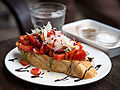
Bruschettaa popular antipasto or appetizer in central Italy. It comes from the Romanesco word 'bread which is lightly burnt' and it's typically rubbed with garlic and topped with olive oil and tomatoes.

Cacio e pepepasta dish with a sauce made with black pepper and grated pecorino romano

Carciofi alla romanawhole artichokes filled with minced garlic and parsley and cooked in olive oil[10]
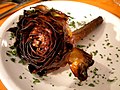
Carciofi alla giudia (Jewish-style artichokes)whole artichokes deep-fried in olive oil[10]
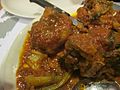
Coda alla vaccinaraoxtail stew, either cooked with tomato sauce, bitter chocolate, celery, clove, white wine, lard and onions, or with tomato sauce, celery, dark cocoa, pine nuts and raisins

Coppiette ("couples")stripes of dried meat (pork or horse), usually spicy

Crostata di ricottatart made with ricotta, sometimes flavored with lemons (or oranges) and Marsala wine[6]

Fiori di zuccazucchini flowers filled with mozzarella and anchovies, battered and deep-fried

Gnocchi alla romanaoven-baked semolina gnocchi

Maritozzia split brioche roll filled with cream

Pasta alla griciapasta dish with a sauce made with guanciale, black pepper and grated pecorino romano

Penne all'arrabbiatapasta dish with a sauce made from garlic, tomatoes and dried red chili peppers, cooked in olive oil

Rigatoni con la pajatapasta dish with a sauce made with ringed intestines of a milk-fed veal and pecorino romano[11]

Saltimbocca alla romanaRoman-style veal with prosciutto crudo, sage, white wine, butter and flour. Saltimbocca is a contraction of "salta in bocca", which literally means 'jump in the mouth'.[12]

Scaloppine alla romanaveal sautéed with fresh baby artichokes

Spaghetti alla carbonarapasta dish with a sauce made with egg yolks, guanciale, black pepper and grated pecorino romano

Supplìfried rice croquettes, either filled with beef ragout and mozzarella, or chicken giblets, mincemeat and provatura

Trippa alla romanatripe cooked with tomato sauce, pennyroyal, chilli pepper, cloves, laurel, celery, carrots and onions and topped with pecorino romano[1