england culture
The culture of the United Kingdom is influenced by its combined nations' history; its historically Christian religious life, its interaction with the cultures of Europe, the individual cultures of England, Wales and Scotland and the impact of the British Empire. The culture of the United Kingdom may also colloquially be referred to as British culture; Northern Ireland, though not geographically part of Great Britain, may still be considered as having a place within British culture. Although British culture is a distinct entity, the individual cultures of England, Scotland, Wales and Northern Ireland are diverse. There have been varying degrees of overlap and distinctiveness between these four cultures.[1]
British literature is particularly esteemed. The modern novel was developed in Britain, and playwrights, poets, and authors are among its most prominent cultural figures.[2] Britain has also made notable contributions to music, cinema, art, architecture and television. The UK is also the home of the Church of England, the state church and mother church of the Anglican Communion, the third-largest Christian denomination. Britain contains some of the world's oldest universities, has made many contributions to philosophy, science, technology and medicine, and is the birthplace of many prominent scientists and inventions. The Industrial Revolution began in the UK and had a profound effect on socio-economic and cultural conditions around the world.
British culture has been influenced by historical and modern migration, the historical invasions of Great Britain, and the British Empire. As a result of the British Empire, significant British influence can be observed in the language, law, culture and institutions of its former colonies, most of which are members of the Commonwealth of Nations. A subset of these states form the Anglosphere, and are among Britain's closest allies.[3][4] British colonies and dominions influenced British culture in turn, particularly British cuisine.[5]
Sport is an important part of British culture, and numerous sports originated in the country including cricket, football, tennis and rugby.[6] The UK has been described as a "cultural superpower",[7][8] and London has been described as a world cultural capital.[9][10] A global opinion poll for the BBC saw the UK ranked the third most positively viewed nation in the world (behind Germany and Canada) in 2013 and 2014.[11][12]
History[edit]
Throughout its history, the culture of Great Britain has primarily consisted of the separate native traditions of England, Scotland and Wales. With regard to cultural influences, prior to the expansion of the British Empire, the island had been most notably influenced by French culture (via the Normans), Scandinavian culture (via the Vikings) and Italian culture (via the Romans).
The arrival of Celtic and Germanic tribes influenced Britain's early development.[13][14] The Celtic peoples introduced unique languages, traditions, and social structures. Subsequently, the migrations of Germanic tribes, such as the Anglo-Saxons, further influenced Britain's cultural landscape. The ancient Roman occupation of Britain, lasting almost 400 years, also impacted the linguistic and cultural identity of Great Britain.[15]
Following the expansion of the British Empire, England, Scotland and Wales absorbed different peoples from around the world, and, post-World War II, Britain developed a more diverse cultural landscape through higher levels of immigration. Today, it has a sizable immigrant population, and encompasses the cultures of British people from various backgrounds, with South Asian, Continental European, African and Caribbean descent being most prevalent.[16]
Language[edit]
Main article: Languages of the United Kingdom
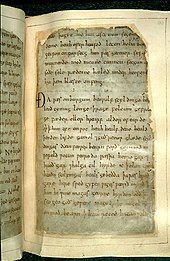
The Old English heroic poem Beowulf is located in the British Library.
First spoken in early medieval England, the English language is the de facto official language of the UK, and is spoken monolingually by an estimated 95% of the British population.[17][a] Seven other languages are recognised by the British Government under the European Charter for Regional or Minority Languages – Welsh, Scottish Gaelic, Scots, Cornish, Irish, Ulster Scots, and British Sign Language.
In Wales, all pupils at state schools must either be taught through the medium of Welsh or study it as an additional language until age 16, and the Welsh Language Act 1993 and the Government of Wales Act 1998 provide that the Welsh and English languages should be treated equally in the public sector, so far as is reasonable and practicable. Irish and Ulster Scots enjoy limited use alongside English in Northern Ireland, mainly in publicly commissioned translations. The Gaelic Language (Scotland) Act, passed by the Scottish Parliament in 2005, recognised Gaelic as an official language of Scotland and required the creation of a national plan for Gaelic to provide strategic direction for the development of the Gaelic language.[b] The Cornish language is a revived language that became extinct as a first language in Cornwall in the late 18th century.
Regional accents[edit]
Main article: Regional accents of English
Dialects and regional accents vary heavily amongst the four countries of the United Kingdom, as well as within the countries themselves. This is partially the result of the long history of immigration to the UK, for example Northern English dialects contain many words with Old Norse roots.[18] Scottish English, Welsh English, and Hiberno-Irish are varieties of English distinct from both English English and the native languages of those countries. Received Pronunciation is the Standard English accent in England and Wales, while in Scotland Scottish Standard English is a distinct dialect. Although these accents have a high social prestige, since the 1960s a greater permissiveness toward regional English varieties has taken hold in education.[19]
The great variety of British accents is often noted, with nearby regions often having highly distinct dialects and accents, for example there are large differences between Scouse and Mancunian despite Liverpool and Manchester being only 35 miles (56 km) apart.[20][21] Dialectal English is often found in literature, for example Emily Brontë's novel Wuthering Heights contains Yorkshire dialect.[22]
Arts[edit]
Literature[edit]
Main article: Literature of the United Kingdom
The United Kingdom inherited the literary traditions of England, Scotland and Wales. These include Arthurian literature and its Welsh origins, Norse-influenced Old English literature, the works of English authors Geoffrey Chaucer and William Shakespeare, and Scots works such as John Barbour's The Brus.
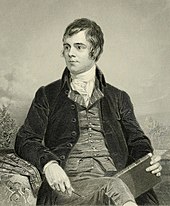
Robert Burns is regarded as the national poet of Scotland.[23]
The early 18th century period of British literature is known as the Augustan Age and included the development of the novel. Daniel Defoe's Robinson Crusoe (1719) and Moll Flanders (1722) are often seen as the first English novels, however the development of the novel took place in a wider literary context that included the rise of prose satires – which reached a high point with Gulliver's Travels – and earlier foreign works like the Spanish Don Quixote.[24] Also linked to the Augustan period is Samuel Johnson's A Dictionary of the English Language. Published in 1755, it was viewed as the pre-eminent British dictionary until the completion of the Oxford English Dictionary 150 years later.[25]
The subsequent Romantic period showed a flowering of poetry comparable with the Renaissance 200 years earlier, and a revival of interest in vernacular literature. In Scotland the poetry of Robert Burns revived interest in Scots literature, and the Weaver Poets of Ulster were influenced by literature from Scotland. In Wales the late 18th century saw the revival of the eisteddfod tradition, inspired by Iolo Morganwg. The period also saw the publication of A Vindication of the Rights of Woman (1792), by Mary Wollstonecraft, is one of the earliest works of feminist philosophy.
The late Georgian and Victorian era saw a renewed focus on the novel. A key theme of these novels was social commentary. Early in the period Jane Austen satirised the lifestyle of the gentry and nobility, while the later novels of Charles Dickens often used humour and keen observations to criticise poverty and social stratification. The three Brontë sisters and George Eliot commented on Northern England and the Midlands respectively, though all four women wrote under male pen names during their lifetimes, partly to deflect anti-feminist criticism. Nevertheless, openly female authors achieved considerable success in the period, such as the predominantly religious poems of Elizabeth Barrett Browning and Christina Rossetti.
Rudyard Kipling exemplifies the British Empire's influence on British literature. His novels The Jungle Book and The Man Who Would Be King are both set in British India, the poem If— evokes the concept of the "stiff upper lip", while The White Man's Burden demonstrates a white supremacist Imperialist outlook.[26]

Welsh native Roald Dahl is frequently ranked the best children's author in British polls.[27]
World War I gave rise to British war poets and writers such as Wilfred Owen, Siegfried Sassoon, and Rupert Brooke, who wrote (often paradoxically) of their expectations of war, and their experiences in the trenches. Initially idealistic and patriotic in tone, as the war progressed the tone of the movement became increasingly sombre and pacifistic.[28] The beginning of the twentieth century also saw the Celtic Revival stimulate a new appreciation of traditional Irish literature, while the Scottish Renaissance brought modernism to Scottish literature as well as an interest in new forms in the literatures of Scottish Gaelic and Scots. The English novel developed in the 20th century into much greater variety and it remains today the dominant English literary form.
The contemporary British literary scene is marked by awards such as the Booker Prize, created in 1969, and festivals including the Welsh Hay Festival, held since 1988. The prominent status of children's literature in the UK was demonstrated in the opening ceremony of the London 2012 Olympic Games, which contained sequence dedicated to prominent children's literary characters.[29] In 2003 the BBC carried out a British survey entitled The Big Read in order to find the "nation's best-loved novel", with works by English novelists J. R. R. Tolkien, Jane Austen, Philip Pullman, Douglas Adams and J. K. Rowling making up the top five on the list.[30] More than 75% of the British public read at least one book annually.[31] The UK is also among the largest publishers of books. As of 2017, six firms in the United Kingdom rank among the world's biggest publishers of books in terms of revenue: Bloomsbury, Cambridge University Press, Informa, Oxford University Press, Pearson, and RELX Group.[32]
Theatre[edit]
Main article: Theatre of the United Kingdom
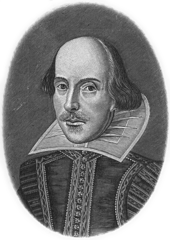
William Shakespeare has had a significant impact on British theatre and drama.
From its formation in 1707 the United Kingdom has had a vibrant tradition of theatre, much of it inherited from England, Scotland and Wales. The Union of the Crowns coincided with the decline of highbrow and provocative Restoration comedy in favour of sentimental comedy, domestic tragedy such as George Lillo's The London Merchant (1731), and by an overwhelming interest in Italian opera. Popular entertainment became more important in this period than ever before, with fair-booth burlesque and mixed forms that are the ancestors of the English music hall. These forms flourished at the expense of other forms of English drama, which went into a long period of decline. In Scotland the opposite occurred, with the emergence of specifically Scottish plays including John Home's Douglas and the works of Walter Scott, which included original plays as well as adaptations of his Waverley novels. The late 19th century saw revival of English theatre with arrival of Irishmen George Bernard Shaw and Oscar Wilde, who influenced domestic English drama and revitalised it. Their contemporaries Gilbert and Sullivan had a similar impact on musical theatre with their comic operas. The Shakespeare Memorial Theatre was opened in Shakespeare's birthplace Stratford upon Avon in 1879 and Herbert Beerbohm Tree founded an Academy of Dramatic Art at Her Majesty's Theatre in 1904.[33]
The early twentieth century was dominated by drawing-room plays produced by the likes of Noël Coward, which were then challenged by the kitchen sink realism and absurdist drama influenced by Irishman Samuel Beckett in the 1950s and 60s. Conversely 1952 saw the first performance of Agatha Christie's The Mousetrap, a drawing-room murder mystery that has seen over 25,000 performances and is the longest-running West End show.[34] At the same time the performing arts theatre Sadler's Wells, under Lilian Baylis, nurtured talent that led to the development of an opera company, which became the English National Opera (ENO); a theatre company, which evolved into the National Theatre; and a ballet company, which eventually became the English Royal Ballet. Elsewhere the Royal Shakespeare Company was founded in 1959 at Stratford-upon-Avon, and continues to mainly stage Shakespeare's plays.
Contemporary British theatre is focused on the West End, London's major theatre district. The Theatre Royal, Drury Lane in the City of Westminster dates back to 1663, making it the oldest London theatre, however the Theatre Royal at the Bristol Old Vic is the oldest continually-operating theatre in the English speaking world, opening in 1768.[35] The musicals of Andrew Lloyd Webber have dominated the West End since the late 20th century, leading him to be dubbed "the most commercially successful composer in history".[36] A National Theatre of Scotland was set up in 2006.
Music[edit]
Main article: Music of the United Kingdom
See also: British pop music, British rock, British blues, New wave of British heavy metal, Britpop, British soul, British Invasion, and Second British Invasion
Classical music[edit]

The Grenadier Guards band playing "The British Grenadiers" at Trooping the Colour. Formed in 1685 the band performs at British ceremonial events.
British Baroque music was heavily influenced by continental fashions. This is exemplified by George Frideric Handel, a German-born naturalised British citizen whose choral music set British taste for the next two centuries. His operas also helped Britain challenge Italy as a centre of operatic production. Classical music attracted much attention from 1784 with the formation of the Birmingham Triennial Music Festival, which was the longest running classical music festival of its kind until the final concerts in 1912. Beyond this, the establishment of the London Philharmonic Society in 1813, Royal Academy of Music in 1822, and Irish Academy of Music in 1848 aided the professionalisation of British classical music and patronage of composers.
The Philharmonic Society was a strong supporter of the German Felix Mendelssohn, an early Romantic composer who also strongly influenced British music. In Ireland, John Field invented the nocturne and may have been an influence on Chopin and Liszt. A notable development of the mid- to late-nineteenth century was the resurgence of English-language opera and the establishment of several prominent orchestras, including the Royal Liverpool Philharmonic in 1840, Manchester-based Hallé in 1858, the Scottish Orchestra in 1891 and the City of Birmingham Symphony Orchestra in 1920. The most notable trend in classical music at the turn of the century was the nationalistic trend that developed. This was initially seen in works like The Masque at Kenilworth, which reconstructed an Elizabethan masque, but later took a pastoral turn under the influence of the British folk revival. Examplars of this period are Ralph Vaughan Williams' English Folk Song Suite, and Sir Alexander Mackenzie's Scottish Rhapsodies.
Modern and contemporary classical music takes a variety of forms. Composers such as Benjamin Britten developed idiosyncratic and avant-garde styles, while the likes of William Walton produced more conventional ceremonial and patriotic music. The UK now has several major orchestras, including the BBC Symphony Orchestra, and the Philharmonia, while the establishment of the Opera North in 1977 sought to redress the balance of operatic institutions away from London. There are several classical festivals, such as Aldeburgh and Glydebourne, while the BBC Proms are an important annual fixture in the classical calendar.