portugal food
The oldest known book on Portuguese cuisine (Portuguese: Cozinha portuguesa), entitled Livro de Cozinha da Infanta D. Maria de Portugal, from the 16th century, describes many popular dishes of meat, fish, poultry and others.[1]
Culinária Portuguesa, by António-Maria De Oliveira Bello, better known as Olleboma, was published in 1936.[2] Despite being relatively restricted to an Atlantic, Celtic sustenance,[3][4] the Portuguese cuisine also has strong French[2] and Mediterranean[5] influences.
The influence of Portugal's spice trade in the East Indies, Africa, and the Americas is also notable, especially in the wide variety of spices used. These spices include piri piri (small, fiery chili peppers), white pepper, black pepper, saffron, paprika, clove, allspice, cumin, cinnamon and nutmeg are used in meat, fish or multiple savoury dishes from Continental Portugal, the Azores and Madeira islands. Cinnamon, vanilla, lemon zest, orange zest, aniseed, clove and allspice are used in many traditional desserts and some savoury dishes.
Garlic and onions are widely used, as are herbs; bay leaf, parsley, oregano, thyme, mint, marjoram, rosemary and coriander being the most prevalent.

Broa was likely introduced by the Suebi as brauþ (bread)
Olive oil is one of the bases of Portuguese cuisine, which is used both for cooking and flavouring meals. This has led to a unique classification of olive oils in Portugal, depending on their acidity: 1.5 degrees is only for cooking with (virgin olive oil), anything lower than 1 degree is good for dousing over fish, potatoes and vegetables (extra virgin). 0.7, 0.5 or even 0.3 degrees are for those who do not enjoy the taste of olive oil at all, or who wish to use it in, say, a mayonnaise or sauce where the taste is meant to be disguised.
Portuguese dishes include meats (pork, beef, poultry mainly also game and others), seafood (fish, crustaceans such as lobster, crab, shrimps, prawns, octopus, and molluscs such as scallops, clams and barnacles), vegetables and legumes and desserts (cakes being the most numerous). Portuguese often consume rice, potatoes, sprouts (known as grelos), and bread with their meals and there are numerous varieties of traditional fresh breads like broa[6][7][8] which may also have regional and national variations within the countries under Lusophone or Galician influence.[2][9] In a wider sense, Portuguese and Galician cuisine share many traditions and features.[10]
Middle Ages[edit]
During the Middle Ages, the Portuguese lived mostly from husbandry. They grew cereals, vegetables, root vegetables, legumes and chestnuts, poultry, cattle, pigs, that they used as sustenance. Fishing and hunting were also common in most regions. During this period, novel methods to conserve fish were introduced, along with plants like vines and olive trees.[11] Bread (rye, wheat, barley, oats) was widely consumed and a staple food for most of the populations.[11] Oranges were introduced in Portugal by Vasco Da Gama in the 15th century. [citation needed] Many of today's foods such as potatoes, tomatoes, chilli, bell peppers, maize, cocoa, vanilla or turkey were unknown in Europe until the post-Columbus arrival in the Americas in 1492.
Meals[edit]
See also: List of Portuguese dishes
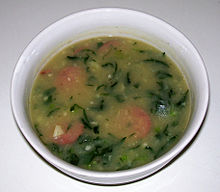
Traditional caldo verde served in a bowl
A Portuguese breakfast often consists of fresh bread, with butter, ham, cheese or jam, accompanied by coffee, milk, tea or hot chocolate. A small espresso coffee (sometimes called a bica after the spout of the coffee machine, or Cimbalino after the Italian coffee machine La Cimbali) is a very popular beverage had during breakfast or after lunch, which is enjoyed at home or at the many cafés in towns and cities throughout Portugal. Sweet pastries are also very popular, as well as breakfast cereal, mixed with milk or yogurt and fruit. Portuguese love a fresh baked "Pastel de Nata" which is one of their unique pastries. They enjoy it together with a shot of espresso, for breakfast or even as an afternoon treat.
Lunch, often lasting over an hour, is served between noon and 2 o'clock, typically around 1 o'clock and dinner is generally served around 8 o'clock. There are three main courses, with lunch and dinner usually including a soup. A common Portuguese soup is caldo verde, which consists of a base of cooked, then pureed, potato, onion and garlic, to which shredded collard greens are then added. Slices of chouriço (a smoked or spicy Portuguese sausage) are often added as well, but may be omitted, thereby making the soup fully vegan.
Among fish recipes, salted cod (bacalhau) dishes are pervasive. The most popular desserts are caramel custard, known as pudim de ovos or flã de caramelo, chocolate mousse known as mousse de chocolate,[12] Crème brûlée known as leite-creme,[13] rice pudding known as arroz doce[14] decorated with cinnamon, and apple tart known as tarte de maçã. Also a wide variety of cheeses made from sheep, goat or cow's milk. These cheeses can also contain a mixture of different kinds of milk. The most famous are queijo da serra from the region of Serra da Estrela, Queijo São Jorge from the island of São Jorge, and Requeijão.[15] A popular pastry is the pastel de nata, a small custard tart often sprinkled with cinnamon.
Fish and seafood[edit]

Pastéis de bacalhau (literally "codfish pastries")

Amêijoas à Bulhão Pato (Bulhão Pato clams)
Portugal is a seafaring nation with a well-developed fishing industry and this is reflected in the amount of fish and seafood eaten. The country has Europe's highest fish consumption per capita, and is among the top four in the world for this indicator.[16][17] Fish is served grilled, boiled (including poached and simmered), fried or deep-fried, stewed known as caldeirada (often in clay pot cooking), roasted, or even steamed.
Foremost amongst these is bacalhau (cod), which is the type of fish most consumed in Portugal. It is said that there are more than 365 ways to cook cod,[18] meaning at least one dish for each day of the year. Cod is almost always used dried and salted, because the Portuguese fishing tradition in the North Atlantic developed before the invention of refrigeration—therefore it needs to be soaked in water or sometimes milk before cooking. The simpler fish dishes are often flavoured with virgin olive oil and white wine vinegar.
Portugal has been fishing and trading cod since the 15th century, and this cod trade accounts for its widespread use in the cuisine. Other popular seafoods includes fresh sardines (especially as sardinhas assadas),[19] sea bass, snapper, swordfish, mackerel, sole, brill, halibut, John Dory, turbot, monkfish, octopus, squid, cuttlefish, crabs, shrimp and prawns, lobster, spiny lobster, and many other crustaceans, such as barnacles, hake, horse mackerel (scad), scabbard (especially in Madeira), and a great variety of other fish and shellfish, as well as molluscs, such as clams, mussels, oysters, scallops and periwinkles.
Caldeirada is a range of different stews consisting of a variety of fish (turbot, monkfish, hake, mussels) and shellfish, resembling the Provençal bouillabaisse, or meats and games, together with multiple vegetable ingredients. These stews traditionally consist of (rapini) grelos,[20] and/or potatoes, tomatoes, peri-peri, bell peppers, parsley, garlic, onions, pennyroyal, and in some regions, coriander.
River lamprey and eels are considered fresh water delicacies. The Coimbra and Aveiro regions of central Portugal, are renowned for eel stews[21] and lamprey seasonal dishes and festivals.[22] Arganil and Penacova have popular dishes such as Arroz de Lampreia or Lampreia à Bordalesa.[23][24]

Grilled sardines in Portugal
Sardines used to be preserved in brine for sale in rural areas. Later, sardine canneries developed all along the Portuguese coast. Ray fish is dried in the sun in Northern Portugal. Canned tuna is widely available in Continental Portugal. Tuna used to be plentiful in the waters of the Algarve. They were trapped in fixed nets when they passed the Portuguese southern coast on their way to spawn in the Mediterranean, and again when they returned to the Atlantic. Portuguese writer Raul Brandão, in his book Os Pescadores, describes how the tuna was hooked from the raised net into the boats, and how the fishermen would amuse themselves riding the larger fish around the net. Fresh tuna, however, is usually eaten in Madeira and the Algarve where tuna steaks are an important item in local cuisine. Canned sardines or tuna, served with boiled potatoes, black-eyed peas, collard greens and hard-boiled eggs, constitute a convenient meal when there is no time to prepare anything more elaborate.
Meat and poultry[edit]

Cozido à portuguesa with its variety of meats
Eating meat and poultry on a daily basis was historically a privilege of the upper classes. Pork and beef are the most common meats in the country. Meat was a staple at the nobleman's table during the Middle Ages. A Portuguese Renaissance chronicler, Garcia de Resende, describes how an entrée at a royal banquet was composed of a whole roasted ox garnished with a circle of chickens. A common Portuguese dish, mainly eaten in winter, is cozido à portuguesa, which somewhat parallels the French pot-au-feu or the New England boiled dinner. Its composition depends on the cook's imagination and budget. An extensive lavish cozido may include beef, pork, salt pork, several types of charcutaria (such as cured chouriço, morcela e chouriço de sangue, linguiça, farinheira, etc.), pig's feet, cured ham, potatoes, carrots, turnips, cabbage and rice. This would originally have been a favourite food of the affluent farmer, which later reached the tables of the urban bourgeoisie and typical restaurants.
Meat[edit]

Bife com ovo a cavalo

Arroz de pato (duck rice) often includes toucinho (bacon) and chouriço as a topping

Cured meats
Tripas à moda do Porto (tripe with white beans) is said to have originated in the 14th century, when the Castilians laid siege to Lisbon and blockaded the Tagus entrance. The Portuguese chronicler Fernão Lopes dramatically recounts how starvation spread all over the city. Food prices rose astronomically, and small boys would go to the former wheat market place in search of a few grains on the ground, which they would eagerly put in their mouths when found. Old and sick people, as well as prostitutes, or in short anybody who would not be able to aid in the city's defence, were sent out to the Castilian camp, only to be returned to Lisbon by the invaders. It was at this point that the citizens of Porto decided to organize a supply fleet that managed to slip through the river blockade. Apparently, since all available meat was sent to the capital for a while, Porto residents were limited to tripe and other organs. Others claim that it was only in 1415 that Porto deprived itself of meat to supply the expedition that conquered the city of Ceuta. Whatever the truth may be, since at least the 17th century, people from Porto have been known as tripeiros or tripe eaters. Another Portuguese dish with tripe is dobrada.
Nowadays, the Porto region is equally known for the toasted sandwich known as a francesinha (meaning "Frenchie").
Many other meat dishes feature in Portuguese cuisine. In the Bairrada area, a famous dish is Leitão à Bairrada [ pt] (roasted suckling pig). Nearby, another dish, chanfana (goat slowly cooked in red wine, paprika and white pepper) is claimed by two towns, Miranda do Corvo ("Capital da Chanfana")[25] and Vila Nova de Poiares ("Capital Universal da Chanfana").[26] Carne de porco à alentejana, fried pork with clams, is a popular dish with some speculation behind its name and its origin as clams would not be as popular in Alentejo, a region with only one sizeable fishing port, Sines, and small fishing villages but would instead have a much popular usage in the Algarve and its seaside towns. One of the theories as to why the plate may belong to the Algarve is that pigs in the region used to be fed with fish derivatives, so clams were added to the fried pork to disguise the fishy taste of the meat.[27] The dish was used in the Middle Ages to test Jewish converts' new Christian faith; consisting of pork and shellfish (two non-kosher items), Cristãos-novos were expected to eat the dish in public in order to prove they had renounced the Jewish faith.[28] In Alto Alentejo (North Alentejo), there is a dish made with lungs, blood and liver, of either pork or lamb. This traditional Easter dish is eaten at other times of year as well. A regional, islander dish, alcatra, beef marinated in red wine, garlic and spices like cloves and whole allspice, then roasted in a clay pot, is a tradition of Terceira Island in the Azores.
The Portuguese steak, bife, is a slice of fried beef or pork marinated in spices and served in a wine-based sauce with fried potatoes, rice, or salad. An egg, sunny-side up, may be placed on top of the meat, in which case the dish acquires a new name, bife com ovo a cavalo (steak with an egg on horseback). This dish is sometimes referred to as bitoque, to demonstrate the idea that the meat only "touches" the grill twice, meaning that it does not grill for too long before being served, resulting in a rare to medium-rare cut of meat. Another variation of bife is bife à casa (house steak), which may resemble the bife a cavalo[29] or may feature garnishing, such as asparagus.[30]
Iscas (fried liver) was a favourite request in old Lisbon taverns. Sometimes, they were called iscas com elas, the elas referring to sautéed potatoes. Small beef or pork steaks in a roll (pregos or bifanas, respectively) are popular snacks, often served at beer halls with a large mug of beer. In modern days, a prego or bifana, eaten at a snack bar counter, may constitute lunch in itself. Espetada (meat on a skewer) is very popular in the island of Madeira.
Charcuterie[edit]

Alheiras basket display, Mirandela
Alheira,[31] a yellowish sausage from Trás-os-Montes, traditionally served with fried potatoes and a fried egg, has an interesting story. In the late 15th century, King Manuel of Portugal ordered all resident Jews to convert to Christianity or leave the country. The King did not really want to expel the Jews, who constituted the economic and professional élite of the kingdom, but was forced to do so by outside pressures. So, when the deadline arrived, he announced that no ships were available for those who refused conversion—the vast majority—and had men, women and children dragged to churches for a forced mass baptism. Others were even baptized near the ships themselves, which gave birth to a concept popular at the time: baptizados em pé, literally meaning: "baptized while standing". It is believed that some of the Jews maintained their religion secretly, but tried to show an image of being good Christians. Since avoiding pork was a tell-tale practice in the eyes of the Portuguese Inquisition, new Christians devised a type of sausage that would give the appearance of being made with pork, but only contained heavily spiced game and chicken. Over time, pork has been added to the alheiras. Alheira-sausage varieties with PGI protection status, include Alheira de Vinhais and Alheira de Barroso-Montalegre.[32][33]
Chouriço or Chouriça (the latter usually denoting a larger or thicker version) is a distinct sausage and not to be confused with chorizo. It is made (at least) with pork, fat, paprika, garlic, and salt (wine and sometimes pepper also being common ingredients in some regions). It is then stuffed into natural casings from pig or lamb and slowly dried over smoke.[34] The many different varieties differ in color, shape, spices and taste. White pepper, piri-piri, cumin and cinnamon are often an addition in Portuguese ex-colonies and islands. Traditional Portuguese cured chouriço varieties are more meaty, often use red wine and not many spices.[35] Many Portuguese dishes use chouriço, including cozido à portuguesa and feijoada.[36]
Farinheira is another Portuguese smoked sausage, which uses wheat flour as base ingredient. This sausage is one of the ingredients of traditional dishes like Cozido à Portuguesa. Borba, Estremoz and Portalegre farinheiras all have a "PGI" in the European Union.[37][38]

Presunto de Chaves, cured prosciutto
Presunto (prosciutto ham) comes in a wide variety in Portugal, the most famous presunto being from the Chaves region. Presunto is usually cut in thin slices or small pieces and consumed as aperitif, tea, or added as ingredient to different dishes.
Several varieties of presunto are protected by European law with protected designations of origin (PDO) or protected geographical indication (PGI), such as Presunto de Barrancos or Presunto Bísaro de Vinhais.[39][40]
Porco bísaro is a prized native pig breed in Portugal with PDO status.[41] Several products derived from this breed, such as «Bucho de Vinhais», «Chouriço de Ossos de Vinhais» and «Chouriça Doce de Vinhais» also have PGI status. According to the General Cattle Census on the Continent of the Kingdom of Portugal (1870), "... bísaro is the name given to the tucked-up pig, more or less leggy, with loose ears to distinguish him from the good plump and pernicious pig of the Alentejo". The name Celtic is proposed and used by Sanson to express the antiquity of the race of this type, which was the only one that existed in the regions inhabited by the Celtic people,[42] such as the north of Portugal and Galicia, the former Gaul and the British islands, before the introduction in these countries, of the Asian and Romanesque races.
In 1878, Macedo Pinto described the bísaro pig as an animal belonging to the Typo Bizaro or Celta, with the morphological characteristics mentioned above, distinguishing two varieties within the breed, according to the corpulence, color and greater or lesser amount of bristles.

Traditional Portuguese enchidos
He considered the existence of pigs from 200 to 250 kg of carcass and others between 120 and 150 kg; as for color, he says they are mostly black, also some spotted and those with white fur were called Galegos, as they come from Galicia. Molarinhos were spotted animals that had few bristles and smooth, smooth skin. The same author also mentions that they are animals of slow and late growth, difficult to fatten (only completing their growth at the age of two), producing more lean meat than fat and accumulating more in the fat than in thick blankets of bacon. In 1946, Cunha Ortigosa classifies the Bísara breed, originally from the Celtic family, as one of the three national breeds. When describing the varieties within the breed, in addition to Galega and Beirôa which encompasses the Molarinho and Cerdões subtypes.[43]
Portuguese cold cuts and sausages (charcutaria and enchidos, respectively) have long and varied traditions in meat preparation, seasoning, preservation and consumption: cured, salted, smoked, cooked, simmered, fermented, fried, wrapped, dried. Regional variations in form and flavour, specialities and names also occur. Further pork (and other meats) charcuterie products include toucinho, paio, morcela, beloura, bucho, butelo, cacholeira, maranho, pernil, salpicão and others.[44][45]